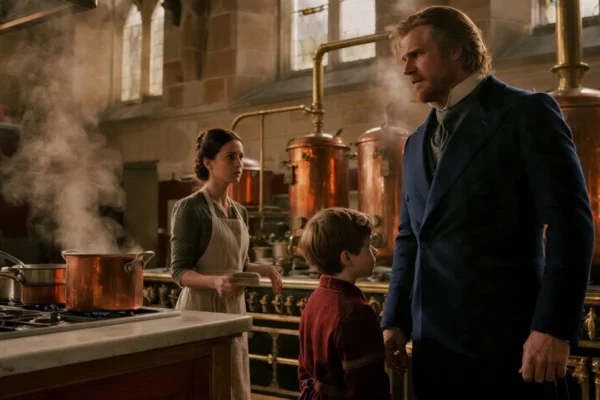
El dragón nunca permitía que nadie se acercara a su ojo herido; ella le lavaba la sangre mientras él temblaba.

Emperor Vantor took a hooked barb to the eye during a skirmish with poachers who had no business inside the royal preserve’s boundaries and even less business carrying weapons designed for exactly the kind of close-range ambush they sprang against him.
The preserve existed as one of the few places in the empire where he flew without the weight of court business pressing against every hour.
a stretch of protected forest his own grandfather had set aside generations before as sanctuary for creatures considerably less dangerous than an emperor in dragon form.
The poachers, three men working a trap line for pelts worth a season’s wages on the black market, had not expected to encounter him at all, and their panic at the sudden appearance of a dragon overhead produced exactly the kind of desperate, poorly aimed violence that a calmer confrontation might never have escalated to.
The hooked barb, loosed from a modified crossbow meant for considerably smaller game, caught him just below the brow ridge and drove deep enough into the eye itself that the damage was immediate and severe.
He drove the poachers off through sheer overwhelming presence rather than any deliberate violence, more concerned with the sudden white-h hot pain blooming through half his vision than with delivering the punishment their trespass technically warranted, and made his way back toward the palace grounds on instinct alone.
one eye rendered useless and the other struggling to compensate for a threat assessment that had in the space of a few violent seconds become considerably more complicated than any ordinary flight home required.
The flight back tested his navigation considerably more than the distance itself should have.
Half his depth perception gone entirely and the remaining eye watering steadily against pain that made even the simplest course corrections a genuine effort of will.
He had flown wounded before in skirmishes and border patrols across a rain that had asked considerable physical cost of him more than once, but always with both eyes intact.
Both halves of his vision cooperating in the ordinary way a creature’s sight was meant to function.
This particular injury introduced a disorientation that went beyond simple pain.
A fundamental wrongness in how the world presented itself that made the familiar flight path back to the palace grounds feel for the first time in years genuinely uncertain.
The palace guards at the outer gate registered the wounds severity the moment he came into proper view.
And the alarm that spread through the grounds in the following minutes carried an urgency that matched the injury’s actual gravity rather than the more measured concern an ordinary battlefield wound might have produced.
Word reached the court steward within minutes, and the summons for the palace’s most senior physicians went out before Vantor had even fully settled into the treatment chamber his own household staff hurried to prepare.
The court’s most senior physicians were summoned within the hour.
Three men of considerable reputation and training, each of them approaching the wounded eye with the careful clinical confidence their decades of practice had earned them.
And each of them driven back in turn by a fear Vantor himself could not fully name, let alone explain to men, trained to treat symptoms rather than the deeper terror beneath them.
The first physician lasted only a few minutes before Vantor’s own instinctive recoil, more powerful than any conscious decision, drove him back across the treatment room with a violence that left the man visibly shaken.
The second, more cautious in his approach, managed slightly longer before the same pattern repeated itself.
The eyes owner, unable to permit the careful proximity treatment actually required.
The third, the most senior of the palace’s medical staff, tried a full three times across two days before conceding, with evident professional frustration that whatever was preventing the treatment lay beyond his own considerable expertise to address.
I do not understand it myself, Majesty, he admitted after the third failed attempt, and I confess that not understanding it troubles me nearly as much as the wound itself.
You have endured considerably worse injuries in your reign without this particular resistance.
Something about this wound specifically seems to have reached past the ordinary pain into something else entirely.
Vantor did not answer the physicians implicit question because he did not yet have language for the fear that kept driving away every trained hand that approached him, and the eye continued its slow worsening through each failed attempt.
The court’s collective concern mounting alongside a growing sense that formal medical training alone was not going to solve whatever this particular crisis actually required.
The council convened an emergency session on the second day, debating options that ranged from summoning specialists from distant provinces to the considerably more drastic possibility of attempting the treatment by force, restraining him through whatever means necessary to permit the physicians the access his own instinctive recoil kept denying them.
Vantor refused the latter option outright the moment it reached his ears.
a flat, immovable refusal that carried enough authority, even through his own weakened state, to end the discussion entirely.
I will not be held down and treated like a beast too dangerous to reason with, he told the assembled council, his voice carrying a rawness that had nothing to do with the physical wound.
Whatever this fear is, however irrational it may appear to men who have not felt it themselves, I will not have it answered with force.
find another way or find a healer whose approach does not require overpowering me to succeed.
The council dispersed with no clear solution in hand.
And it was in the uncertain days that followed, the eyes condition worsening by careful measurable degrees, that the minor cordier’s suggestion of a village healer from a distant province finally reached the exhausted steward’s ears, offered almost as an afterthought against the more prestigious options already exhausted.
The court steward having exhausted the palace’s own considerable medical resources reached beyond them on the advice of a minor cordier whose home province maintained a modest reputation for producing skilled village healers trained outside the formal physicians guild entirely practical hands-on training passed down through apprenticeship rather than institutional credential.
Sabra Ashwald had spent the whole of her working life in exactly that tradition, trained across one memorable season by a traveling oculist, who had passed through her town on his way toward a more prestigious posting, and left behind, in the brief months of his stay, more practical eye treatment knowledge than most village healers ever accumulated in a full career.
She had been 16 when the Oculus arrived, apprenticed to him almost by accident after her own quick hands proved useful, assisting with a difficult cataract removal on a neighbor no one else in town had been willing to help, and had spent every subsequent year, building on that single season’s foundation through sheer practical repetition, treating whatever eye trouble her modest province produced, refining technique through trial and careful observation, rather than any further formal instruction, she treated cataracts and battlefield wounds and everything in between with the same unhurrieded careful hands, entirely unaware when the summons arrived at her own modest practice of exactly what kind of resistance three of the empires most senior physicians had already failed to overcome.
The summons itself arrived without much explanation beyond the bare fact of an injury requiring specialized attention, and Sabra packed her modest kit of instruments and salves, with the same unhurried competence she brought to any house call, assuming reasonably enough that the journey to the capital represented an unusually distinguished patient rather than the particular crisis of trust that actually awaited her.
The journey itself took the better part of 3 days.
Mountain roads giving way gradually to the wider, bettermaintained thoroughares that marked the approach to the capital proper.
And Sabra spent the traveling time doing what she always did before a difficult case.
running through the range of treatments her limited but thorough training had equipped her to attempt mentally cataloging which approaches might suit which possible presentations of injury, preparing herself as best she could for a patient whose actual condition remained until she arrived entirely unknown to her.
She had treated palace sentent patients only twice before in her career.
Minor courters passing through her province with ordinary ailments, and neither prior encounter had prepared her for the particular scale of concern radiating from the capital’s messengers, whose urgency suggested a crisis considerably graver than her own modest experience with palace business had led her to expect.
Sabra arrived at the palace with none of the anxious deference the summons might reasonably have produced in someone less accustomed to treating difficult frightened patients and approached Vantor’s chamber with the same plain unhurried competence she brought to every house call in her own modest practice icians have already tried and failed she said taking in the wounded eyes visible deterioration with the practical assessment of someone who had seen considerably worse damage respond well to proper for treatment.
I do not know what happened in those attempts, Majesty, and I am not particularly interested in guessing at it before I have heard your own account of the trouble.
What is it precisely that made their approach unbearable? Vantor considered the question for a long moment, the same fear that had driven off three trained physicians rising again at her proximity, though something in her plain, unhurrieded patients, kept the worst of the instinctive recoil at bay long enough for him to attempt an answer.
I do not know that I can properly explain it, he admitted finally.
I have lost creatures I loved to wounds that began exactly this way.
Small treatable until the treatment itself went wrong and the wound became the thing that killed them.
I do not think I am afraid of the pain healer.
I think I am afraid of hands.
I do not trust making the wound worse rather than better.
and I have found since the poacher’s barb struck that I do not seem to trust any hands at all, however qualified their training.
That is the most sensible fear I have heard from a patient in a considerable while, Sabra said, without a trace of the dismissive reassurance the physicians had likely offered.
I would not ask you to trust my hands blindly, Majesty.
I would ask instead whether you might tolerate my hands moving slowly enough that you can stop me the moment anything feels wrong.
That is not the same request the physicians made of you.
I think how would you propose to move slowly enough? Vantor asked some of his own considerable skepticism plain in the question when I am given to understand the eye requires reasonably urgent attention before the damage becomes permanent.
I do not doubt your intentions healer.
I doubt whether patience and urgency can both be properly served at once.
They can if the patience is spent correctly, Sabra said.
The physicians, I suspect, spent their limited time attempting the actual treatment itself and lost most of it to your understandable recoil before any real progress could be made.
I intend to spend my time differently.
I will spend the first several sessions doing nothing more than letting you grow accustomed to my hands being near the wound at all without ever attempting treatment during those sessions.
It will feel, I expect, like slower progress than the physicians more direct approach.
I believe it will actually prove faster because it will not keep failing and starting over from the same frightened beginning.
He considered this proposal for a long moment, weighing it against the accumulated frustration of three failed attempts, and an eye that worsened by visible degrees, with everyday treatment continued to elude him.
The practical cost of further delay weighed carefully against the far greater cost of another failed attempt, driving him deeper into a fear no one else had yet managed to properly address.
Very well, he said finally, I will permit the slower approach.
On the condition that you tell me plainly at each stage exactly what you intend before you attempt it, I find I can tolerate a great deal more when I am not also managing the fear of not knowing what is coming next.
That is precisely how I intended to proceed regardless.
Majesty, Sabra said, I do not treat frightened patients any other way.
She moved with a deliberateness that made every stage of her approach visible and predictable, narrating each small step before she took it.
the exact distance she intended to close, the precise moment her hand would first make contact, the specific sensation he should expect to feel, so that nothing about her hands progress toward the wound arrived as the kind of sudden uncontrolled proximity that had driven off every physician before her.
I am going to rest two fingers against the ridge above your brow now, she said, her voice steady and unhurried.
Not near the wound itself, simply near enough that you can feel my hand is there before it moves any closer.
Tell me the moment anything feels wrong, and I will stop exactly where I am.
He held himself rigid through the contact, the old instinctive recoil rising sharp and immediate, and found, to his own considerable surprise, that her hands actual weight against his brow, carried none of the danger his fear had been anticipating.
steady, warm, entirely unhurried, exactly as she had described it would be before she ever made contact at all.
That is tolerable, he managed, his voice rougher than he intended.
Continue, if the continuing is equally slow, the full treatment required considerably more than one session.
Sabra’s approach building trust in careful, deliberate increments across nearly two weeks of daily visits.
each session advancing only as far as his own tolerance genuinely allowed rather than as far as clinical efficiency might have preferred.
The first few sessions accomplished little beyond simple proximity, her hands resting near the wound without attempting actual treatment, building the foundation of trust the eyes healing would eventually require.
By the fourth session, she had progressed to gently cleaning the wounds outer edges, narrating each motion in the same steady, predictable voice that had carried the first contact.
By the seventh, she was addressing the barb’s remaining fragments directly, a delicate extraction that any of the three physicians more clinically efficient approaches would likely have attempted in a single session, accomplished instead across nearly a week of patient incremental progress that never once triggered the recoil his fear had produced for every faster attempt.
You are considerably more patient than the physicians were, Vantor observed.
midway through the seventh session, watching her work with a calm that would have seemed impossible two weeks prior.
I do not know that I have properly thanked you for that patience.
Patience is not generosity, majesty, Sabra said, continuing her careful work without pausing.
It is simply the correct pace for a wound that has already taught its owner not to trust quick hands.
I would be doing you no favors, rushing toward a result your own fear is not yet ready to permit.
The palace staff, watching the sessions unfold over the following days, remarked among themselves at the strangeness of a treatment that seemed, by any ordinary clinical measure, to be accomplishing so little so slowly, and yet visibly succeeding, where three considerably more decorated physicians had failed within minutes of attempting a faster approach.
The court steward, checking in periodically to report the treatment’s progress to an anxious council, found himself struggling to explain to skeptical ministers exactly why an eyes healing seemed to be proceeding through conversation and careful narration nearly as much as through any conventional medical intervention.
She spends half of each session simply telling him what she is about to do, the steward reported after the fifth day’s visit, and the other half actually doing it at a pace that would have taken any of the physicians perhaps a tenth of the time.
And yet, the eye improves session by session in a way it did not improve at all under 3 days of considerably more direct attempts.
I confess I do not fully understand the mechanism, but I have stopped questioning results that speak so plainly for themselves.
By the ninth session, the pattern had become familiar enough to both healer and patient that the narration itself had shortened.
Vantor’s trust, having advanced to the point where fewer words were needed to carry him through each stage of the treatment.
Sabra noted the change without remarking on it directly, simply adjusting her own pace to match the trust that had visibly grown between them, session by patient session, in a way neither of them had explicitly planned for, but both had quietly welcomed as the treatment’s natural progress.
The full truth of his fear emerged gradually across the treatment’s later sessions offered in the particular unguarded honesty that extended proximity and patient trust tend to produce between two people working through a difficult process together.
I lost my first bonded companion to a wound that began exactly this way.
he told her during a session’s quiet middle stretch, the confession arriving without any of the careful court formality he usually reserved for difficult admissions.
A young dragon under my early toutelage, wounded in a training accident that should have been entirely survivable.
The court physician of that era treated the wound with confidence and considerable skill, and the treatment itself introduced an infection that the wound alone would never have produced.
I watched a small treatable injury become the thing that killed someone I loved because the treatment moved faster than the wound could safely tolerate.
I have carried that fear unnamed through every injury since and this one striking the same vulnerable point, finally forced the fear into the open where I could no longer simply outendure it in silence.
Sabra absorbed this without the reflexive sympathy that might have derailed the session’s careful progress.
Instead, folding the new understanding directly into her own approach’s remaining pace.
That explains a great deal, she said.
I am not the physician who failed your companion, Majesty, and I do not intend to repeat his error, but I understand now why slow felt like the only survivable option available to you.
and I will keep the pace exactly as slow as the fear requires for as long as the requiring continues.
What became of the physician? She asked some sessions later once enough trust had accumulated between them that the question felt like a natural continuation of an old wound rather than an intrusion into private grief.
The one whose treatment introduced the infection.
I do not ask to judge him, Majesty.
I ask because I think understanding the whole of what happened might help me treat what remains of the fear more completely.
He left court service within the year, Vantor said, unable to reconcile his own considerable skill with an outcome his skill had directly caused.
I did not blame him for the death itself.
Infections of that kind were not well understood in that era, and his treatment followed every standard his training had equipped him with.
I blamed him for a long time for the confidence with which he had promised me a good outcome before the treatment ever began.
I have come to think across the years since that the promise itself was the real error, not the treatment, the certainty.
I do not make promises of that kind.
Sabra said, I did not promise you a good outcome when I first arrived, Majesty, and I will not promise you one now, this close to the treatment’s end.
I can tell you what I observe and I can tell you what I believe is likely.
I have found over years of treating frightened patients that likely serves them considerably better than certain, however much certain might feel more comforting in the moment.
I have come to agree with you entirely.
Vantor said, I think I trusted your hands in the end precisely because you never once promised me the fear was unfounded.
You simply moved slowly enough that the fear had no opportunity to prove itself right.
The wound’s actual healing, once the barbs fragments were fully removed and the surrounding tissue properly cleaned, progressed with a speed that surprised even Sabra’s own considerable experience.
The body’s natural recovery finally permitted to do its work once the treatment itself had stopped triggering the deeper fear that had been compounding the physical injury with something closer to genuine trauma.
The vision will return, I believe, though perhaps not fully to what it was before, she told him, examining the healing tissue at what both of them understood without needing to say so directly was very likely their final necessary session.
The barb did real damage, majesty, and I do not want to promise you a result I cannot fully guarantee.
But the infection risk that took your companion is not present here.
And a wound that heals clean, even imperfectly, is considerably better than the alternative your fear was quite reasonably guarding against.
Imperfect and alive is a trade I will take without hesitation, Vantor said.
Against the alternative I have been dreading since the poacher’s barb first struck.
You have given me something I did not fully realize I needed, healer, beyond the treatment itself.
I do not know that I have trusted anyone’s hands in any capacity since the training accident that took my companion.
I find I trust yours completely, and I find the finding surprises me considerably less than it perhaps should.
She returned once more, some weeks later, for a final assessment of the healing’s full progress, and found him waiting for her arrival with none of the guarded tension that had marked every one of their earlier sessions.
a plain steady welcome that spoke to exactly how far the trust between them had traveled since the first careful narrated touch.
I have been considering, he said once her examination confirmed the healing had settled as well as either of them could reasonably have hoped.
What it actually means that my hands stopped trembling in fear of yours somewhere across these past weeks and started instead simply wanting them near for reasons that have very little to do with the eyes treatment anymore.
I noticed the difference myself, Majesty, Sabra said, with the same plain honesty that had carried her through every session.
I do not treat every patients fear quite so thoroughly as I treated yours.
And I do not think the thoroughess alone explains why I found myself looking forward to sessions that should, by any reasonable measure, have simply been difficult, careful work.
She had, in plain truth, extended her stay at the palace beyond what the treatment itself strictly required.
finding small professional justifications for additional visits that both of them understood without either quite saying so directly had less to do with the eyes remaining healing and more to do with a reluctance neither one was yet prepared to name plainly.
The court had begun to notice the pattern as well.
The stewards periodic reports to the council shifting in their final weeks from clinical updates on the treatment’s progress to a more careful diplomatic silence on a subject that had clearly moved past medical business into territory the whole palace could see developing before either of its two principles had fully acknowledged it themselves.
She had treated a great many frightened patients in her years under her own master’s training.
village folk who flinched from a healer’s hands for reasons far less dramatic than a dead companion and a decade of court physicians confirming session after session that quick hands could not be trusted with a wound this personal.
None of those patients she found herself admitting privately during the long ride back to the outpost after each visit had ever occupied her thoughts for the whole of the intervening days the way this particular patient now did.
She told herself at first that the preoccupation was simply professional thorowness, a healer’s natural attention to a difficult and still incomplete case.
By the session’s final weeks, she no longer bothered pretending the explanation held.
I find I am not eager for the final session to arrive, Vantor admitted, watching her pack away her instruments with the same careful competence she had brought to the whole treatment.
which strikes me as a strange thing to admit about the conclusion of a treatment I have been anxiously awaiting the end of for weeks.
I am not eager for it either.
Majesty, Sabra said.
Though I suspect for both our sakes, the eyes healing does not care much for either of our reluctance to see the sessions concluded properly.
Healing rarely waits for two stubborn people to admit what they would rather say plainly.
Instead, he asked her to remain at the palace in a more permanent capacity once the treatment had fully and properly concluded, not merely as a physician on formal retainer, but as someone whose steady presence he had come across the long weeks of patient healing, to want considerably more than any clinical arrangement alone could ever have required of her.
Victor Hugo wrote, He told her in the quiet garden where he had finally worked up the nerve to say plainly what the treatment’s slow trust had been building toward all along, that to love another person is to see the face of God.
I confess I did not understand the sentiment properly until I watched you approach a wound three trained physicians had failed to treat.
Not with greater skill alone, though your skill was considerable, but with a patience that saw past the wound itself to the fear underneath it, and treated both with the same careful, unhurried respect.
I have spent a great deal of my reign looking outward healer toward borders and treaties, and the ordinary business of holding an empire together.
I did not expect to find in the treatment of an injured eye someone whose patient attention taught me something considerably larger about what it means to actually see another person clearly.
She stayed in the end, not merely as the court’s newly appointed head physician for matters no formal training alone could properly address, but as the woman he married the following year, in a ceremony held in the same quiet garden, where the true nature of her patients had first fully revealed itself to him, attended by a small gathering that included, at Vantor’s own particular insistence, the third physician who had first admitted his own failure to understand what the wound actually required.
You were the only one of the three honest enough to say plainly that you did not understand the trouble, Vantor told him at the wedding itself, raising a glass in the old physicians direction before the gathered guests.
I have come to think that honesty mattered considerably more than any of you realized at the time.
It was the door Sabra’s approach eventually walked through, and I do not know that she would have found it half so easily without your own honest admission clearing the way first.
The palace’s medical staff, initially skeptical of a village trained healer’s methods, came in time to adopt her patient, narrated approach as standard practice for any patient whose fear complicated an otherwise straightforward treatment.
And the story of the eye that three physicians could not touch, healed instead by a healer who understood that trembling hands needed patience more than skill, became the training example every new physician at the palace was taught before ever attempting a difficult case of their own.
Sabra herself continued treating patients well into her later years, villageorn and palaceapp appointed alike, and never once abandoned the unhurried narrated method that had first won an emperor’s trembling trust.
Proof enough.
She liked to say to every new apprentice she trained that the slowest road to healing was very often in the end the only road that actually arrived anywhere worth reaching.
Derechos de autor: DRAGON THRONE ROMANCE