I Want to Feel You Close Whispered the Virgin to the Widowed Apache —and a Forbidden Passion Stirr
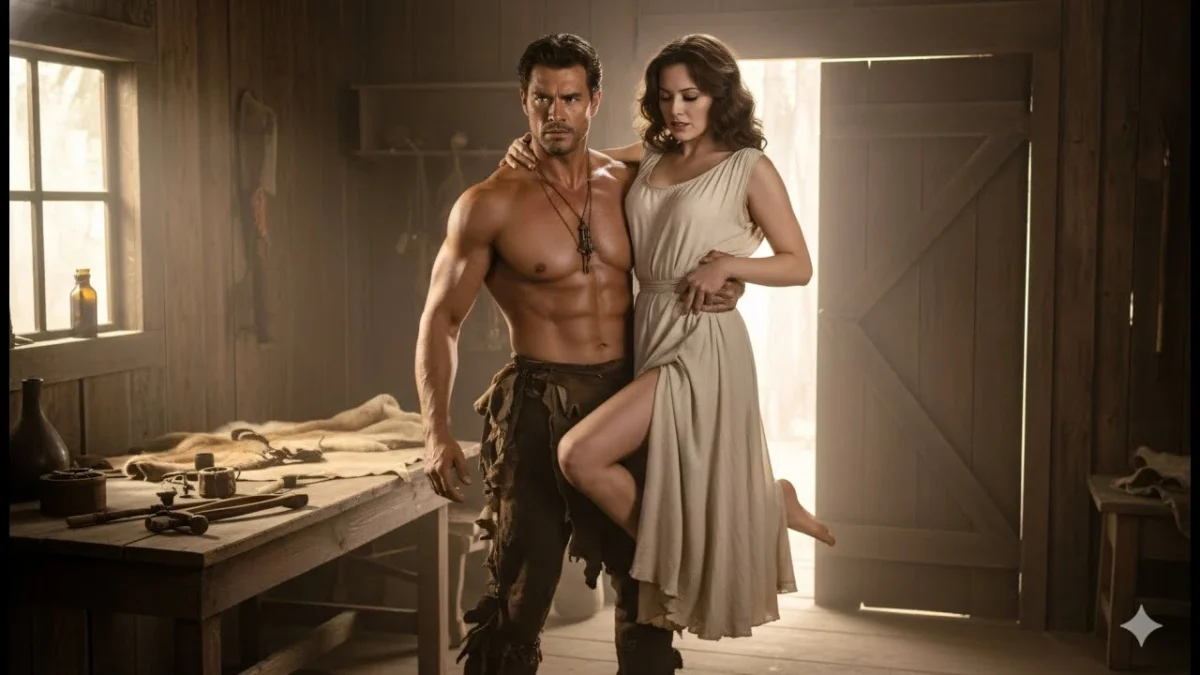
The year was 1883, and the Arizona territory did not welcome strangers.
It tolerated them at best, with the indifference of a land that had seen bones bleach white under the sun for a thousand years, a dry wind, sharp with a scent of sage and heated stone, cut across the open scrubland.
It was a landscape of extremes where the distant mountains were the color of bruised plums against a sky so pale it looked drained of blood.
Heat shimmerred off the hardpacked earth distorting the horizon until the msquite bushes looked like they were dancing in a fever.
Everything alive looked thirsty.
The lizards panting on the rocks, the hawks circling in the updrafts, and the woman riding alone toward the jagged silhouette of Red Mesa.
Evelyn Hart was 22 years old, but in the saddle with her spine stiffened against exhaustion.
She felt ancient.
She rode a mare that had seen better years, a chestnut with a swayback and a stubborn gate.
Evelyn’s hands were a ruin.
The leather rains had rubbed blisters into her palms, and the dust of three days hard riding had settled into the fine lines of her face, turning her skin the color of parchment.
Her dress, once a respectable calico meant for parlor sitting in church Sundays, was stained with sweat and dirt at the hem.
She looked like a woman who had been running for a long time, though the truth was she had only been running since Tuesday.
She had fled a house that smelled of beeswax and expensive cigars, leaving behind a life that was supposed to be her salvation.
Her guardian, a man named Arthur Vance, had made a promise.
It was a marriage promise, a transaction to settle a debt that had nothing to do with love and everything to do with mining shares and cattle futures.
Evelyn was the currency.
As the town of Red Mesa rose out of the dust, Evelyn felt a knot of cold dread tighten in her stomach.
Red Mesa was a cluster of timber and adobe clinging to the edge of civilization like a barnacle on a ship’s hull.
It was a place where miners came to spend their silver and cattlemen came to wash the trail dust from their throats.
It was not a place for a woman alone.
She guided the mayor down the main thoroughfare.
Men stopped their conversations to watch her pass.
Their eyes were heavy, assessing, stripping away the exhausted dignity she tried to wrap around herself.
She kept her chin high, staring straight ahead at the white cross at top the church at the end of the street.
She needed a room.
She needed water.
She needed to disappear.
The boarding house was run by the church, a whitewashed building with geranium struggling to survive in pots by the door.
It was supposed to be a sanctuary.
Evelyn tied her horse to the rail, her legs trembling as her boots touched the ground.
She smoothed her skirt, a feudal gesture against the grime, and walked inside.
The interior was cool and smelled of lie soap and boiled cabbage.
Mrs.
Gable, the widow who ran the establishment, stood behind a high counter.
She was a woman built of angles and judgment, her hair pulled back so tightly it pulled the corners of her eyes upward.
I would like a room for the night, Evelyn said, her voice raspy from the dry air.
Miss.
Gable looked at her.
She looked at the ringless left hand resting on the counter.
She looked at the dust in Evelyn’s hair and the fear that Evelyn could not quite keep from widening her eyes.
A room, Mrs.
Gable repeated.
She did not open the ledger.
Where is your husband? I have no husband, Evelyn said.
I am traveling to stay with family in Santa Fe.
Family in Santa Fe, Mrs.
Gable echoed.
And your wagon? Your escort? I was separated from my group.
Evelyn lied.
The lie tasted like copper in her mouth.
Please, I can pay.
She placed a silver dollar on the counter.
It was one of only five she possessed.
Mrs.
Gable looked at the coin, then back at Evelyn.
The silence stretched, filled with the buzzing of a fly against the window pane.
We are a respectable house, Mrs.
Gable said finally, snatching the coin.
No visitors in the room.
[clears throat] Breakfast is at 6:00.
If you cause trouble, the sheriff will hear of it.
Evelyn took the key, her hands shaking as she walked up the narrow stairs.
She could feel Mrs.
Gable’s eyes boring into her back.
She could hear the whisper of fabric as two other women in the parlor leaned together.
She knew what they were saying.
They noticed the lack of a ring.
They noticed the terror.
In their world, a woman alone was either a tragedy or a sin.
and they had not yet decided which one she was.
By evening, the town of Red Mesa had settled into a rhythm of piano music and shouting from the saloons.
Evelyn stayed in her room.
Sitting on the edge of the narrow bed, she had washed her face and hands, but the water in the picture was lukewarm and smelled of iron.
She felt exposed.
The walls were thin.
She could hear a man coughing in the next room, could hear the clatter of a wagon passing on the street below.
She was just unlacing her boots when she heard the voice.
It drifted up through the floorboards from the parlor below.
It was a voice she knew better than her own prayers.
It was smooth, rich like molasses, and utterly devoid of mercy.
Silas Crow.
Evelyn froze, her heart hammered against her ribs like a trapped bird.
Silas was her guardians man.
He was an enforcer, a problem solver, a man who wore expensive suits and carried a pistol he knew how to use.
He had been the one to lock her in her room when she had first refused the marriage.
He had been the one who told her with a smile.
That women were like colts.
They just needed breaking.
I am looking for a girl, Silas was saying.
His voice was polite, conversational about this high brown hair riding a chestnut mare that looks ready for the glue factory.
She is confused, you understand? Hysterical.
She ran off from her family and her uncle is beside himself with worry.
We just want to bring her home.
Evelyn crept to the door and pressed her ear against the wood.
She heard Mrs.
Gable’s sharp tone soften.
There was a girl who came in this afternoon.
Mrs.
Gable said ragged looking thing said she was going to Santa Fe.
That is her.
Silus said poor thing.
Her mind is not right.
She is prone to wild stories.
Evelyn realized with a sickening clarity that the town’s respectability was a trap.
If she went to the sheriff, Silas would call her hysterical.
If she screamed, they would say she was mad.
If she submitted, she would be handed back like a parcel of dry goods.
She heard the heavy tread of boots.
Silas was not coming upstairs yet.
He was moving toward the door, likely to speak with the sheriff to ensure the law was on his side.
Evelyn went to the window.
It looked out over the alley behind the boarding house.
Below, she could see the back of the livery stable.
Men were gathered there, smoking in the twilight.
The air carried their voices up to her.
She heard Silas’s voice again, closer now.
He must have stepped out onto the porch.
He was speaking to another man, the voice rougher, sounding like the sheriff.
She is just a girl, Silas said.
But the boss wants her back intact.
The wedding is set for next month.
And what about the herd? The sheriff asked.
Moving them tomorrow, Silas replied.
We are pushing them through the valley near the reservation boundary.
If a few Apaches get in the way, well, maybe it is time we taught them a lesson.
Drive them off.
They have been stealing stock.
Or so we will say.
Evelyn gripped the window sill.
They were planning violence as casually as they planned breakfast.
She knew she could not stay in the room.
Silas would come for her soon.
He would have the key.
He would have the law.
She grabbed her small bundle, a change of stockings, a comb, a piece of dried beef, and the sharp kitchen knife she had stolen from her guardian’s house.
She climbed out the window, her boots finding purchase on the rough trellis that clung to the side of the building.
The wood groaned under her weight, but she did not stop.
She dropped the last few feet, landing in the dust of the alley.
She needed her horse.
She moved through the shadows toward the stable.
The smell of manure and hay was thick.
The stable was dark, save for a single lantern hanging near the entrance.
She found the mare in a stall near the back.
The horse knickered softly, and Evelyn pressed her hand over the animals velvety nose.
Quiet, she whispered.
Please be quiet.
She did not have time to saddle the mayor.
She would have to ride bear back or lead her out.
She reached for the halter.
Going somewhere, Miss Hart.
The voice came from the shadows behind her.
Evelyn spun around, the knife appearing in her hand by instinct.
Silus Crow stepped into the pool of lantern light.
He looked immaculate, not a speck of dust on his dark coat.
He held his hat in his hands, turning the brim slowly.
He smiled.
And it was the smile a wolf gives a lamb before the snap.
I knew you would come for the horse.
Silas said, You always were predictable.
Put the knife down, Evelyn.
You will only hurt yourself.
No, Evelyn said.
Her voice shook, but she did not lower the blade.
Silas took a step forward.
His patience was a terrifying thing.
It was the patience of a man who held all the cards.
Your uncle is very disappointed, Silas said.
And the man you are promised to, he is not happy either, but they are willing to forgive this little tantrum.
Come with me.
We will go back to the hotel, have a nice dinner, and in the morning we go home.
I am not going back, Evelyn said.
I am not property.
Silas sighed.
He placed his hat on a bail of hay.
His face hardened.
You are exactly what we say you are, he said softly.
And right now you are a runaway with no money, no friends, and no future.
No one in this town will help you.
I have already told the sheriff you are sick in the head.
Scream if you want.
They will just help me tie you up.
He lunged.
It was faster than Evelyn expected.
His hand closed around her wrist, crushing the delicate bones.
She gasped, the pain blinding, but she did not drop the knife.
Instead of pulling away, she threw her weight toward him, bringing her knee up.
Silas grunted, his grip loosening just for a fraction of a second.
Evelyn bit his hand hard.
She tasted the salt of his skin and the metallic tang of blood.
Silas roared and yanked his hand back.
You little witch, he snarled.
Evelyn turned and ran.
She did not go for the horse.
There was no time.
She ran out the back door of the stable into the deepening night.
She ran past the last few shacks of Red Mesa, past the trash piles and the sleeping dogs.
She ran until her lungs burned and the lights of the town were just pin pricks behind her.
She was in the open country now.
The darkness was absolute.
The moon was hidden behind a bank of thick, bruising clouds that had rolled in from the north.
The heat of the day was vanishing, replaced by a sudden biting [clears throat] chill.
The landscape became a weapon.
Thorny msquet branches whipped at her face and tore at her skirt.
Loose stones rolled beneath her boots, twisting her ankles.
She fell, scraping her palms raw on the gravel, but she scrambled up and kept moving.
She could not hear footsteps behind her, but she could feel Silus’s presence like a weight on the back of her neck.
Then the rain began.
It did not start as a drizzle.
It began as a deluge, a sudden violent release from the heavens.
The temperature plummeted.
The dry earth baked hard as iron could not drink the water fast enough.
Gullies that had been dry for months instantly turned into slick muddy traps.
Evelyn stumbled blindly.
She was soaked to the bone, her dress heavy and clinging to her legs.
She was shivering uncontrollably.
She needed shelter.
She needed to stop, but fear drove her forward.
She scrambled down a slope, thinking to find cover under an overhang.
The ground gave way beneath her.
She slid, clawing at the mud, sliding down into the darkness of a wash.
She hit the bottom, and the roar filled her ears.
It was the sound of a freight train, deep and rumbling.
Flash flood.
The water hit her before she could stand.
It was a wall of brown sludge, churning with branches and rocks.
It knocked the breath from her lungs and swept her off her feet.
Evelyn screamed, but the water filled her mouth with grit.
She was tumbled over and over, striking her hip against a boulder.
The current was impossibly strong, a living thing that wanted to consume her.
She flailed, her hand catching on a submerged root.
She held on, her head barely above the churning surface.
The cold was paralyzing.
She was going to die here.
She was going to die in the dark, alone.
and Silas would never even find her body.
Help! she choked out, a useless plea to the storm.
Then a hand clamped around her forearm.
It was not the tentative grasp of a rescuer testing the weight.
It was a clamp of iron.
[clears throat] A force hauled her upward.
Evelyn kicked, finding purchase on a submerged rock, and the hand pulled.
She was dragged up the muddy bank, gasping and coughing, until she was deposited on solid ground.
She collapsed, wretching up muddy water.
The rain beat down on her back.
She looked up, wiping her eyes.
A figure stood over her.
A man.
Lightning flashed, illuminating him for a split second.
He was tall, lean, and dressed in buckskins that were dark with rain.
His hair was long and black, plastered to his skull.
He held a rifle in one hand, the barrel pointed safely at the ground.
Evelyn scrambled backward, her heels digging into the mud.
No, she cried out, her voice shrill with hysteria.
Don’t touch me.
The man did not move.
He did not shout.
He simply watched her.
The lightning flashed again.
Evelyn saw his face.
It was a face carved from the same stone as the mountains, angular, hard, and weathered.
He was Apache terror pure and white hot flooded Evelyn’s veins.
She had been raised on stories of the Apache.
They were the monsters in the dark, the savages who stole children and burned ranches.
Silas had been a threat, but this was the nightmare she had been taught to fear since she was a girl.
She fumbled for her knife, but it was gone, lost in the flood.
Please, she whispered, her defiance crumbling into sobbing.
Please just kill me quickly.
The man crouched down.
He moved with a fluidity that was unnerving.
He did not look like a monster.
He looked tired.
There were lines of exhaustion etched around his eyes, and his posture was wary, like a wolf that knows it is being tracked.
He looked at her wrist, where the bruises from Silas’s grip were already darkening.
He looked at her heaving chest, at the terror in her eyes.
He did not speak.
He reached to his belt and unhooked the canteen.
He unscrewed the cap and held it out to her.
Evelyn stared at the canteen.
She stared at him.
He nudged it closer, his expression unreadable.
Evelyn took it with trembling hands.
She drank, the water cool and clean, washing the mud from her throat.
She lowered the canteen and looked at him.
Thank you, she whispered, the shame of her earlier screaming rising in her throat.
The man took the canteen back.
He capped it and stood up.
He pointed toward a ridge of rocks to the east, away from the wash.
High ground, he said.
His voice was low, accented but clear.
The water rises.
He was Taza.
He was 30 years old, and he had been traveling alone for weeks, carrying a grief that felt heavier than the rifle in his hand.
He was a scout, a hunter, a man who walked between worlds and belonged to neither.
He had pulled this white woman from the water, not because he wanted company, but because he could not watch a living thing drown.
Come, Taza said.
Evelyn struggled to her feet.
Her dress was ruined, heavy with mud.
She shivered violently.
She looked at the man’s back as he began to walk.
She had a choice.
Stay here and wait for Silas or follow the Apache into the dark.
She followed him.
They walked for an hour, the rain slowly tapering off into a cold drizzle.
Taza did not speak.
He moved silently, his moccasins making no sound on the wet stone.
Evelyn stumbled behind him, her boots slipping, her breath coming in ragged gasps.
Suddenly, Taza stopped.
He raised a hand, palm flat.
Evelyn froze.
Taza tilted his head, listening.
Then he crouched low and motioned for Evelyn to do the same.
On the ridge above them, [clears throat] silhouetted against the breaking clouds, were three riders.
Evelyn pressed her hand over her mouth.
She recognized the shape of the lead rider’s hat.
Sil, and with him were two other men, their slickers gleaming wetly in the moonlight.
They are tracking, Taza murmured.
It was not a question.
They are hunting me, Evelyn whispered.
Taza looked at the riders, then at Evelyn.
He saw the way she shrank into the rock.
He saw the way the men on the ridge rode, weapons drawn, head scanning the brush.
This was not a family dispute.
This was a hunt.
And if they found him here with a white woman, they would not ask questions before they started shooting.
We move, Taza said.
Quiet.
He led her into a labyrinth of broken rock and msquite.
Here the shadows were deep.
He moved with the land, blending into the stone.
He taught her without words.
He would reach back and touch her shoulder to stop her.
He would point to where she should place her foot so she would not dislodge a stone.
At one point, they had to squeeze through a narrow fissure in the rock.
Taza went first, then reached back to help her.
Evelyn had to press her body against his to get through.
She felt the terrifying closeness of him.
[clears throat] His shoulder brushed hers.
She could smell wet buckskin, wood smoke, and the scent of a man who lived under the sky.
He was solid, warm.
His breath was steady, while hers rattled in her chest.
For a moment, pinned between the cold stone and the warm, dangerous man.
Evelyn felt a spark of something that confused her.
It was not fear.
It was safety.
He was the only thing standing between her and the men who wanted to own her.
They cleared the fissure.
Taza pulled her through, but as he did, he hissed in pain.
He pulled his arm back.
A jagged piece of rock or perhaps a long msquet thorn had slashed his forearm.
Blood welled up dark and quick.
You are hurt, Evelyn said.
It is nothing, Taza [snorts] said.
He kept moving, but the blood dripped onto the stones.
They reached a small shallow cave, little more than an indentation in the cliff face, hidden by a screen of palo verde trees.
Taza sat down heavily.
He began to bind his arm with a strip of cloth from his pouch.
He did it awkwardly, using his teeth to tighten the knot.
Let me, Evelyn said.
She surprised herself.
Her hands were still trembling, but she knelt beside him.
Taza looked at her, his eyes guarded.
He hesitated, then extended his arm.
Evelyn undid his clumsy knot.
She used the hem of her pett coat, tearing a strip of dry cotton from the layers that had been protected from the rain.
She wrapped the wound efficiently.
Her fingers brushed his skin.
It was rough, scarred, and hot.
Thank you, Taza said when she finished.
The coyotes began to call in the distance.
A lonely yipping chorus.
The rain had stopped, leaving the air cold and crisp.
Evelyn sat back against the rock wall.
The adrenaline was fading, leaving her hollow and aching.
I have nowhere to go, she confessed into the darkness.
I cannot go back to Red Mesa.
I am not taking you to Red Mesa, Taza said.
His voice was flat.
If I take you there, they will say I stole you.
They will hang me.
And they will make you a story.
A story? The woman who was taken, Taza, said, The town will pity you and then they will shame you.
They will not make you safe.
Evelyn wrapped her arms around herself.
She thought of Mrs.
Gable’s eyes.
She thought of the men laughing by the stable.
I am still good, she whispered.
It was a plea.
Half to herself, half to him.
I am still untouched.
As if that matters.
As if that should earn me mercy.
Taza looked at her.
The moonlight caught the sharp angle of his jaw.
It tightened.
He looked angry.
Not at her, but at something invisible.
He was angry at a world that taught a woman her worth was tied to her purity.
He was angry that she felt she had to plead her innocence to an Apache stranger in a cave to ensure she wouldn’t be discarded.
You are alive, Taza said.
He spoke the words with a weight that made them feel like a commandment.
That is what matters tonight.
You breathe.
You bleed.
You are alive.
Evelyn stared at him.
No one had ever told her that her life was enough.
She lay down on the hard ground, curling into a ball to preserve heat.
She shivered, her teeth chattering.
Taza watched her for a moment.
Then he unrolled his wool blanket.
He did not cover her with it.
He did not lie next to her.
He placed it on the ground between them, close enough that she could feel the heat radiating from his body, but far enough away that she was not trapped.
Sleep, he said.
I will watch.
Evelyn closed her eyes.
She listened to the steady rhythm of his breathing.
Outside, the desert was vast and cruel and full of men who wanted to hurt her.
But here, in the small space between the rock and the Apache, she finally slept.
The morning did not break gently.
It shattered the darkness with a hard, uncompromising light that revealed exactly how small they were.
Evelyn opened her eyes to a world that seemed to have expanded overnight.
The shallow cave where they had sheltered was merely a dark thumbrint on a landscape so vast it stole the breath from her lungs.
Before her, the Arizona territory unrolled in a series of ridges that jagged upward like the broken teeth of an old skull, jagged and yellow gray against the horizon.
Beyond them lay open flats that stretched for miles, a sea of sage brush and heat shimmer where a person could walk for days and never find a shadow.
Above it all was the sky, an expanse of blinding pale blue that felt heavy, pressing down on the earth with the weight of eternity.
She sat up, her body aching in places she did not know she possessed.
The mud from the flood had dried into a stiff, cracking crust on her dress.
She felt gritty, thirsty, and profoundly exposed.
Taza was already awake.
He stood near the mouth of the cave, his back to her, staring out at the scrub land.
He stood with a stillness that Evelyn had never seen in the men of the town.
The men she knew, Silas, her guardian, the miners, were always in motion, always loud, always imposing their will upon the space around them.
Taza seemed to simply exist within the space, as much a part of the morning as the messet in the stone.
He turned when she shifted, his eyes dark and unreadable.
We move while the air is cool, he said.
He did not ask how she slept.
He did not ask if she was afraid.
He simply picked up his rifle and the small canvas pack he carried, assuming she would follow.
And because the alternative was the vast, empty, terrifying silence of the desert, she did.
They walked for an hour before he led her into a narrow clft between two boulders.
Hidden there, fed by a seep in the rock, was a small pool of water.
It was no bigger than a wash basin, shaded by a twisted scrub oak.
Drink, Taza said.
Evelyn fell to her knees.
She cuped her hands and drank greedily.
The water was cold and tasted of minerals and earth.
It was the best thing she had ever tasted.
She splashed it on her face, scrubbing away the dried mud, gasping as the coolness hit her sunburned skin.
When she looked up, water dripping from her chin.
She found Taza watching her.
He was not looking at her with the hungry, predatory gaze she had learned to expect from men in saloons or from Silas.
He was watching her the way a man watches a small fire in a high wind, guarding a fragile thing from the world, not from himself.
He scanned the ridge behind her, then the horizon.
His attention split between her safety and the threat of discovery.
Evelyn wiped her mouth with the back of her hand.
She felt a sudden sharp pang of indebtedness.
He had saved her life.
He was guiding her.
She fumbled at the waist of her dress, finding the small concealed pocket where she kept her coin purse.
It contained four silver dollars and a handful of smaller coins.
Her entire life savings stolen from the household accounts before she fled.
She pulled the purse out, the coins clinking softly.
I I want to pay you, she said, her voice sounding thin in the open air.
For the help, for the water.
She held the purse out.
Taza looked at the small velvet bag.
He looked at her hand, blistered and shaking.
A strange expression crossed his face.
Not anger, but a weary sort of resignation.
He shook his head slowly.
Keep your metal, he said.
It buys nothing here.
Evelyn lowered her hand, heat rising in her cheeks.
She realized instantly how insulting the gesture was.
She was trying to turn this into a transaction, something she could understand, something that put them on familiar footing.
But there was no transaction here.
Money meant civilization, and civilization was the thing hunting them.
I am sorry, she stammered.
I just I don’t know what else to do.
Taza turned back to the horizon.
Put it away.
You will need it if you live long enough to find a town that will take you.
The words hung in the air.
if you live long enough.
He gestured for her to stand as they began to walk again, the sun climbing higher and turning the air into a furnace.
Evelyn gathered the courage to ask the question that had been gnawing at her since the night before.
Where are we going? she asked.
To your people, to the reservation.
Taza did not break his stride.
No.
Why not? Evelyn asked.
Surely, surely you have family.
People who would help.
Taza stopped so abruptly that Evelyn nearly walked into his back.
He turned to face her.
The sun cast deep shadows beneath his cheekbones, making his face look like a carving of wood and sorrow.
If I bring a white woman to my people, he said, speaking slowly and clearly as if explaining a simple truth to a child.
The soldiers will come.
The Indian agent will come.
They will say we stole you.
They will say we hurt you.
They will use it as a reason to cut the rations or to arrest the young men or to move us to worse land.
He looked at her with a piercing intensity.
I will not bring that storm down on them.
You are a danger to anyone who stands next to you.
Evelyn felt the blood drain from her face.
She had thought of herself as a victim, a poor girl running from a bad marriage.
She had not realized that to him and to his world.
She was a weapon.
Her mere presence was a threat.
I did not choose this, Evelyn whispered.
Taza watched her.
Why did you run? Was it only the marriage? It was not a marriage, Evelyn said, the bitterness rising in her throat like bile.
It was a sale.
My guardian, Mr.
Vance.
He has debts, heavy debts.
The man he promised me to is old, cruel, and rich.
When I refused, they locked me in my room.
Silus.
He told me that a woman’s consent is like the rain.
Nice if it happens, but the plowing gets done either way.
She wrapped her arms around herself, staring at the dust on her boots.
If I go back, I have no voice.
She said, No court will listen to a woman with no husband to speak for her.
They will say I am hysterical.
They will say I belong to Mr.
Vance until I belong to my husband.
I am nothing to them but a signature on a deed.
Taza listened in silence.
He did not offer empty comfort.
He did not tell her it would be all right.
He simply nodded.
A single sharp dip of his chin.
He understood what it meant to be viewed as property rather than a person.
They walked on.
The heat grew oppressive.
The landscape began to change, shifting from open scrub to rolling hills dotted with pon and juniper.
Evelyn began to notice the small ways Taza carried his grief.
He never spoke of his past, never mentioned a home or a name other than his own.
But when the wind picked up, sighing through the needles of the pinon trees with a sound like a distant woman singing.
Taza would flinch.
It was a microscopic movement, a tightening of the muscles around his eyes.
But Evelyn saw it.
She saw too.
How his hand would sometimes drift to his throat.
There, resting against the dark skin of his neck, was a small leather cord strung with a single blue glass bead and a piece of polished shell.
He would touch it when he thought she was not looking, his thumb rubbing the bead with a repetitive, soothing motion.
[clears throat] It was a gesture of such private sorrow that Evelyn felt she was intruding just by witnessing it.
By mid-afternoon, they reached the edge of a valley.
Taza signaled for a halt.
He crouched low behind a cluster of boulders.
pulling Evelyn down beside him.
Look, he said, pointing.
Below them lay a vast stretch of grazing land.
In the distance, Evelyn could see cattle, hundreds of them, moving like slow red ants across the grass.
But it was not the cattle that Taza wanted her to see.
It was the land itself.
Great patches of the valley were black and scarred, burned.
The char was old, but the earth had not recovered.
They burned the brush to clear it for the grass, Taza said, his voice devoid of emotion, but heavy with meaning.
But they also burned the thickets where the deer hide.
They burned the groves where we gathered pinon nuts.
They fenced the water.
Evelyn looked at the green ribbon of a creek winding through the valley.
Barbed wire gleaming new and vicious in the sun ran along both banks.
Stolen water.
Taza murmured.
Evelyn looked at the burned earth.
She had always been told that ranching was progress.
It was civilizing the wild.
But looking at the scars on the valley floor, she saw something else.
She saw a hatred so deep it was willing to wound the land itself just to deny it to someone else.
Prejudice wasn’t just words or laws.
It was a physical thing that ate the world.
Riders.
Taza hissed.
Evelyn snapped her head up.
Far below, moving along the fence line, was a group of four men on horseback.
They were too far to identify faces, but the sunlight glinted off rifle barrels.
They were moving slowly, stopping to check the ground, tracking.
They have found our sign, Taza said.
He did not sound panicked.
He sounded like a man calculating the odds.
He turned to Evelyn.
His eyes were hard.
Hide, he commanded, pointing to a deep depression beneath a thicket of oak brush.
Crawl in.
Do not move.
Do not breathe loud.
Do not come out until I say my name.
What are you going to do? Evelyn asked, fear spiking in her chest.
I will make a trail that leads away, Taza said.
He did not wait for her to argue.
He grabbed a handful of sage brush and swept the ground where they had been standing, erasing their prince.
Then he moved away from her, stepping intentionally into a patch of soft sand, leaving a clear, heavy bootprint.
He was making himself a target.
Taza, Evelyn whispered, but he was already gone, slipping over the ridge line, moving fast and low.
Evelyn crawled into the brush.
The branches scratched her face, and the smell of dry leaves and dust filled her nose.
She pressed herself into the dirt, her heart hammering against her ribs like a trapped bird.
Time stretched.
Seconds felt like hours.
She heard the distant sound of hooves.
The murmur of men’s voices carried on the wind, indistinguishable but terrifying.
If they caught him, he was dead.
They would not arrest an Apache found near cattle.
They would shoot him and leave him for the buzzards.
And then they would find her.
The helplessness washed over her.
She was lying in the dirt, hiding like a rabbit, waiting for a man she barely knew to die for her.
She thought of Silas.
She thought of Mister Vance.
She thought of the way they looked at her as something to be owned.
A cold, hard knot formed in Evelyn’s stomach.
It was heavier than fear.
It was resolve.
I will not be returned, she thought.
I will die in this dirt before I let them put their hands on me again.
A gunshot cracked through the air.
Evelyn flinched, biting her knuckle to stifle a scream.
Then another shot.
Then the sound of galloping horses fading into the distance.
Silence returned to the valley.
She waited.
The sun began to dip toward the western mountains, turning the sky a bruised purple.
The shadows lengthened.
Had they killed him? Was she alone now? Truly alone? A twig snapped.
Evelyn froze.
She gripped a jagged rock she had found in the dirt.
Evelyn.
The voice was a whisper, but it was him.
She scrambled out of the brush.
Taza was crouching near the boulders.
He was breathing hard, sweat streaking the dust on his face, but he was whole.
They followed the trail I made, he said.
They are riding south toward the box canyon.
We have time.
[clears throat] Evelyn looked at him.
The relief that flooded through her was so intense it made her knees weak.
She wanted to weep.
She wanted to laugh, but mostly.
She just wanted to look at him.
You came back, she said softly.
Taza looked at her confused by the statement.
I said I would.
It was such a simple thing for him.
A promise made was a promise kept in her world.
Promises were things to be negotiated or broken when convenient.
Thank you, Evelyn said.
She looked at his face, the high cheekbones, the sweat dampened hair, the dark eyes that saw everything and asked for nothing.
The gratitude she felt shifted, deepening into something warmer, something sharper.
It felt dangerously like longing.
Let us go, Taza said, turning away from her gaze.
The cold comes with the dark.
They walked until the light failed completely.
A cold front was rolling in off the mountains.
Bringing with it a biting wind that cut through Evelyn’s torn dress, they found shelter beneath a rock overhang that curved like a breaking wave, protecting them from the wind.
Evelyn’s hands were shaking so badly from the cold that she could not strike the Lucifer match to light the small pile of dry twigs she had gathered.
She struck it once, twice, the head crumbling uselessly.
Here, Taza said.
He knelt beside her.
He did not take the match from her.
Instead, he reached out and cuped his hands around hers, steadying her fingers.
His hands were rough, calloused from years of riding and fighting.
But his touch was incredibly gentle.
He did not squeeze.
He did not claim.
He simply offered his strength to steady her weakness.
Strike now, he whispered.
Evelyn struck the match.
It flared to life, a small yellow flower of heat.
She lowered it to the tinder and the fire caught.
Taza pulled his hands away immediately.
Evelyn sat back, pulling her knees to her chest, watching him in the growing fire light.
The flames cast dancing shadows across his face, softening the harsh lines of his jaw.
She watched the stillness in his movements as he fed the fire.
She watched the way sorrow seemed practiced in him, a familiar coat he wore without complaint.
She felt a pull she did not want to name.
It was not just that he was handsome.
It was that he was real.
You have a wife? Evelyn asked.
The question slipped out before she could stop it.
Taza froze.
His hand hovered over the fire.
For a long moment, the only sound was the crackle of burning wood and the wind moaning outside the overhang.
I had a wife, he said finally.
What happened to her? Evelyn asked, her voice barely audible.
Taza stared into the flames.
His eyes, usually so guarded, looked suddenly like open wounds.
She died because she was Apache, he said.
His voice was calm, which made the words worse.
Men came.
They wanted the land where our winter camp was.
They had papers from the government.
They said we had to move.
When we did not move fast enough, they started shooting.
He picked up a stick and snapped it in two with a sharp crack.
They could not imagine her as human.
He said to them, She was just part of the landscape, something to be cleared away like a msquite bush.
He looked up at Evelyn, then his eyes had hardened like stone, shielding the pain.
Evelyn felt tears prick her eyes.
Not for herself, but for the enormity of the cruelty he described.
I was taught to hate you, she confessed.
The words tumbled out, burning her throat with shame.
Before I ever saw you in school, in church, they told us you were savages.
They told us you had no souls.
She looked at him, pleading for him to understand the depth of her regret.
I am so sorry, she whispered.
Taza looked at her.
He did not look surprised.
I know, he said quietly.
And I was taught that everyone from towns like Red Mesa is a liar.
I was taught that a white hand is always open to take, never to give, he leaned back against the rock wall, watching her across the fire.
Trusting you, he said.
Feels like touching a hot coal.
I know it will burn, but I do it anyway.
Why? Evelyn asked.
Because you are not the man who killed her, Taza said.
And I am not the monster in your story books.
The fire burned down to embers.
Evelyn laid her head on her bundle, but sleep was thin and ragged.
Sometime in the deepest part of the night, a nightmare seized her.
She was back in the wash, the water filling her mouth, but the hands pulling her down belonged to Silus.
She couldn’t breathe.
She gasped awake, her body jerking upright.
Without thinking, she reached out into the dark, her hand found Taza’s arm.
She gripped his sleeve, her fingers digging into the buck skin.
Taza was awake instantly.
He did not pull away.
He did not startle.
He simply froze.
His muscles tense beneath her hand.
Evelyn’s breath came in ragged sobs.
She realized what she was doing, clinging to him in the dark.
She loosened her grip, pulling her hand back, flushed with embarrassment.
I am sorry, she whispered.
The dream.
She looked at the dark shape of him.
The wind was howling outside, a lonely, desolate sound.
She felt the crushing weight of the empty miles around them, the men hunting them, the hopelessness of it all.
I just, Evelyn’s voice broke.
I want to feel you close, she said it into the silence.
Just close, she added quickly, desperate for him not to misunderstand, because the dark is full of men who would take me, and you are the only one who hasn’t.
Taza hesitated.
The silence stretched heavy and charged.
Then slowly he moved.
He shifted from where he had been sitting opposite her.
He moved around the small fire pit and sat down beside her.
His back against the rock wall.
He did not put his arm around her.
He did not touch her.
He simply sat close enough that their arms were touching.
Lean, he said softly.
Evelyn hesitated for a heartbeat.
then leaned her head against his shoulder.
His body was warm and solid.
It was like leaning against a sunwarmed cliff face.
She could feel the steady, stubborn rhythm of his heart beating beneath the buck skin.
Taza sat rigid for a moment, then slowly relaxed.
He allowed her weight.
He allowed the contact.
The intimacy of it was staggering.
It was not a claiming.
It was a permission.
In a world where men took what they wanted, Taza was giving her the choice to be close.
Evelyn closed her eyes.
The smell of him, smoke and sage and rain, filled her senses.
She felt a warmth spread through her chest that had nothing to do with the fire.
It was desire, yes, but it was a desire stripped of fear.
It comforted her and it terrified her.
She wanted to stay here in this small pocket of safety forever.
She slept without dreams, anchored by the beat of his heart.
When dawn came, the sky was a bruised gray, threatening snow.
The wind had teeth.
They sat up, the space between them suddenly feeling charged with the memory of the night.
Taza stood quickly, moving to check the weather, putting distance between them as if the closeness of the night was a danger in the daylight.
We cannot stay here, he said.
The cold will kill us if the men do not.
Where can we go? Evelyn asked, standing and brushing the dust from her skirt.
There is a trading post, Taza said.
Two days north.
It is run by a man named Ramirez.
He has a puma wife.
It is a mixed place.
Will they help us? Ramirez is fair-minded.
Taza said he might hide you and he might not shoot me on sight.
It was a risk.
A terrible risk.
But staying meant freezing or being captured.
We go, Evelyn said.
Taza looked at her.
He nodded.
We go.
They stepped out from the overhang into the biting wind, leaving the ashes of their fire behind, walking toward a hope that was as thin as the morning air.
The land did not welcome them.
It tolerated their passage with the stony indifference of a world that had seen soft things die for a thousand years.
The journey north toward the trading post turned brutal as the terrain rose into rough broken hills where the wind stripped the moisture from their lips until they cracked and bled.
The ground was a misery of loose shale and prickly pear.
The kind of country where a horse could break a leg in a heartbeat and a human on foot felt every stone through the soles of their boots.
Evelyn walked with her head down, watching her feet.
Her boots, once fine leather meant for town boardwalks, were beginning to fail.
The stitching at the toe of the left boot had given way, and she could feel the grit working its way inside, grinding against skin that was already raw.
She did not complain.
[clears throat] She had learned in the last 48 hours that complaint was a waste of breath, and breath was precious in this high, thin air.
Taza walked ahead, his pace relentless, but slower than before.
Evelyn noticed the way he favored his right side, the way his breath caught sometimes when the trail climbed steeply.
It was the old injury, or perhaps just the crushing weight of the grief he carried, a weariness that seemed to settle in his bones like lead.
He stopped often, ostensibly, to check the horizon for pursuit.
But Evelyn saw how he leaned against the rock, his face gray beneath the dark skin, [clears throat] gathering strength.
They had been walking for 3 days since the cave.
On the afternoon of the third day, the wind shifted, carrying the scent of crushed sage and something else, wood smoke.
Taza stopped instantly.
He raised a hand, signaling Evelyn to freeze.
She stood perfectly still, her heart beginning its familiar, panicked rhythm.
A figure emerged from a fold in the earth, as if the land itself had birthed a woman.
[clears throat] She was short, stout, and moved with a terrifying silence.
She wore a skirt of buckskin and a calico shirt that had seen many washings.
Her hair was stre with gray, pulled back severely.
In her hands, she held a basket of herbs and a digging stick.
She looked at Taza and her expression did not soften.
[clears throat] She looked at Evelyn and her eyes narrowed into slits of obsidian.
Mara, Taza said, his voice low.
The woman Mara did not smile.
She was kin to Taza, a cousin or perhaps a sister-in-law, bound by blood and history.
She stepped closer, ignoring Evelyn entirely to speak to him in their own tongue.
The words were sharp, clipped, sounding like stones striking together.
Taza answered her, his tone respectful but firm.
He gestured to Evelyn.
Mara turned her gaze on Evelyn.
It was a look of profound unmasked assessment.
She looked at the torn dress, the ruined boots, the sunburned nose.
She looked at the fear that Evelyn could not hide.
You bring a storm, Taza, Mara said in English, her accent thick and heavy.
She smells of town soap and fear.
Why do you bring this trouble to us? She needs water, Taza said.
And rest just for the night, Mara scoffed, a harsh sound in her throat.
She needs a grave if she stays out here.
And we will need many if the soldiers follow her.
Evelyn stepped forward, her hands trembling at her sides.
Please, she said, I mean no harm, Mara laughed, a dry, humorless bark.
Innocence is the most dangerous thing in the territory, girl.
It causes more death than rifles, despite her words.
Mara jerked her chin toward the ridge behind her.
Come, but you stay at the edge.
You do not speak unless spoken to.
You are a spark, and the grass is dry.
They followed Mara to a camp hidden in a depression of the hills, sheltered by a stand of twisted juniper.
It was not the romantic image of the noble savage Evelyn had read about in penny dreadfuls, nor was it the chaotic den of thieves the town gossips described.
It was a place of hard, grinding survival.
There were perhaps 20 people.
Women sat in the shade, mending clothes that were already more patched than fabric.
Children played a quiet game with stones, their voices hushed, their eyes darting to the horizon with the instinct of prey.
Elders sat by the small smokeless fires.
Their faces maps of deep lines and sun damage.
There was no excess here.
Every movement had a purpose.
Every object was used until it fell apart.
When Evelyn walked into the periphery of the camp, the silence that fell was heavy enough to crush her.
Heads turned, eyes watched.
There was no welcome.
There [clears throat] was only a wall of suspicion.
Evelyn felt the heat of their stairs like a physical blow.
To them, she was not a woman in distress.
She was the enemy.
She was the town that denied them food.
She was the law that broke their treaties.
She was the reason they were hiding in these rocks.
Mara pointed to a spot near a dead log at the very edge of the clearing.
Sit, she commanded.
Do not wander.
Evelyn sat.
She tucked her legs beneath her tattered skirt.
Trying to make herself small, Taza moved toward the center of the camp.
A man sat there, older than the rest, his hair white as snow, wrapped in a blanket despite the heat.
He was a respected elder, a voice of authority in a fractured world.
Evelyn watched them speak.
She could not hear the words, but she saw the body language.
The elder spoke with slow, heavy gestures.
He pointed to Taza, then to the empty space beside him, then to Evelyn.
Taza stood with his head bowed, listening.
His jaw was tight, a muscle jumping in his cheek.
She saw the elder shake his head, a gesture of profound disappointment.
He seemed to be saying that Taza, of all people, should know better than to invite new sorrow.
Taza took the lecture like a man accepting a sentence he knew he deserved.
He looked lonely, surrounded by his people.
He looked more alone than he had in the cave.
As the sun began to dip, casting long, bruised shadows across the camp.
Evelyn felt the urge to do something, anything, to prove she was not useless.
She saw a woman struggling to stitch a heavy wool blanket.
Her hands gnarled with arthritis.
Evelyn stood up slowly and approached.
May I? she asked softly, pantoiming the stitching motion.
The woman looked at her with cold eyes.
She spat on the ground near Evelyn’s boot.
Evelyn flinched but did not retreat.
She reached into her pocket and pulled out the small sewing kit she had carried in her bundle, a needle and a spool of strong thread.
She held it out.
I can help, Evelyn whispered.
Please.
The woman looked at the needle.
It was a good needle, steel and sharp.
She hesitated, then shoved the blanket at Evelyn.
Evelyn sat in the dust.
She began to stitch, her fingers working with the muscle memory of a thousand parlor afternoons.
But here, there was no tea, no gossip.
There was only the desperate need to mend what was broken.
She worked for an hour.
She fetched water from the skin bag when she saw a child coughing.
She offered the cup to the boy, who looked at her with wide, terrified eyes before snatching it and running away.
Some watched her with open contempt, muttering words that sounded like curses.
Others, like Mara, watched with a grudging, cynical curiosity.
Evelyn realized with a stinging clarity that she had benefited from lies her whole life.
The comfort of her bed, the safety of her town, the food on her table.
It had all been built on the exclusion and suffering of these people.
and now she was asking them for charity.
Night fell and the camp settled into an uneasy quiet.
Taza returned to her side.
He brought a piece of dried meat and a small cake of cornbread.
Eat, he said.
He sat beside her, but not close.
He stared into the darkness beyond the firelight.
They do not want me here, Evelyn said quietly.
No, Taza answered.
They do not.
They think you are bait or a thief.
And you? Evelyn asked, What do you think? Taza looked at her.
He looked at her hands stained with dust resting on the mended blanket.
I think you are trouble, Evelyn Hart.
But I do not think you are a thief.
It was the most he had given her, a small, hard nugget of validation.
The peace did not last the night.
The next day, the sun had barely climbed past the zenith when the lookout on the ridge whistled.
A sharp, piercing sound like a hawk’s cry.
Instantly, the camp dissolved into motion.
Mothers grabbed children.
Elders kicked dirt over fires.
It was a practiced panic, smooth and terrifying.
Taza was at Evelyn’s side in a heartbeat.
Up, he hissed.
Move.
What is it? Evelyn asked, scrambling to her feet.
Riders, Taza said.
Many.
They moved toward the higher rocks, but they were too slow.
The riders were not approaching with caution.
They were riding hard, crashing through the brush with the arrogance of men who held the law in their holsters.
Below, near the river crossing that boarded the camp, the posi burst into view.
It was Silas, and he had brought an army.
There were 12 men, maybe 15 deputies, ranch hands, and men from town who had likely joined for the promise of whiskey and violence.
They spread out, rifles raised.
There she is! a voice shouted.
Evelyn froze.
Silas sat at top his black horse, pointing a gloved finger directly at her.
The Apache kidnapped her.
Silas roared, his voice carrying over the wind.
Cut them down.
Save the girl.
It was a lie so bold, so calculated that it took Evelyn’s breath away.
He was turning a hunt for a runaway bride into a righteous crusade.
He was giving them permission to kill.
Shots cracked through the open air.
[snorts] The sound was deafening.
Dust jumped like living things where the bullet struck the ground.
Run! Taza shouted, shoving Evelyn toward the rocks.
But the camp was in chaos.
A young man, barely 20, ran to gather the horses.
A shot rang out and he crumpled, spinning in the dirt, clutching his leg.
A scream tore from a woman’s throat.
His mother, they had shot an innocent.
They had drawn blood.
The tragedy deepened instantly.
The stakes hardening from a chase into a war.
Evelyn scrambled up the shale, her feet slipping.
She heard the heavy thought of hooves behind her.
She turned.
Silas was there.
He had ridden his horse up the slope, cutting off her path.
He leaned down, his face twisted in a mask of triumph and rage.
I told you.
He hissed.
He grabbed her arm.
His grip was like a steel trap.
He yanked her, lifting her half off the ground.
You will learn obedience.
Evelyn, he snarled.
If I have to break every bone in your body, Evelyn screamed, striking at him.
But she was nothing against his strength.
He began to drag her toward his saddle.
Then a blur of motion hit Silas.
It was Taza.
He had launched himself from a rock ledge, tackling Silas out of the saddle.
The two men hit the ground with a bonejarring thud.
Taza was a whirlwind of controlled fury.
He struck Silas once, twice, hard blows that snapped the head back.
Silas fumbled for his pistol, but Taza kicked it away.
Taza had his knife out.
He pressed the blade against Silus’s throat.
Evelyn watched, her chest heaving.
Do it! A dark part of her mind whispered.
Kill him! Silas froze, his eyes bulging as he felt the cold steel.
Taza’s hand trembled, the rage in him was a tangible heat.
He wanted to kill this man.
He wanted to carve the arrogance out of him.
But Taza looked up.
He saw the posi regrouping below.
He saw the Indian agent watching.
He saw the wounded boy bleeding in the dirt.
If he killed a white man, even a man like Silas, the army would come.
They would burn the camp.
They would hunt every person here until none were left.
Taza made a sound of disgust and pulled the knife back.
He grabbed Silas by the collar and threw him backward down the slope.
Get up! Taza shouted at Evelyn.
He grabbed her hand and pulled her.
They ran.
They ran through the confusion, through the dust, weaving between the boulders where the horses could not follow.
Below them, the shooting stopped.
The posi was pulling back.
They had the camp pinned, but they were not charging into the rocks.
We regroup.
Silus’s voice drifted up, ragged and furious.
Get the sheriff.
Get the agent.
We have witnesses.
The Apache attacked us.
We want the girl returned and the man in irons.
They had what they wanted.
They had a narrative.
Return the girl.
Arrest the Apache.
Evelyn realized with a sickening lurch of her stomach.
How the law worked.
It was a rope.
It was not used to pull people to safety.
It was used to drag them into place.
Her innocence would not save her.
It was the very thing they were using to justify the slaughter.
Taza led her high into the cliffs to a small hollow hidden from below.
Mara was there along with the wounded boy and his mother.
The mood in the hollow was poisonous.
Give her to them, [clears throat] Mara said.
She was tending to the boy’s leg, her hands bloody.
She looked at Taza with eyes that were hard as flint.
Look at this, Taza.
Mara hissed, gesturing to the blood.
They will come back with more men.
They will bring a cannon if they have to.
Give them the white girl.
It is what they want.
She is not property to be traded, Taza said, his voice tight.
She is a curse.
The boy’s mother wept.
She brings death.
Evelyn stood against the rock wall.
She wanted to speak, but her throat was closed with guilt.
They were right.
She was the cause of this.
We keep moving, Taza said.
We go north.
If I give her back, she dies a slow death.
I will not do it.
You choose a stranger over your own blood.
Mara challenged.
I choose not to be what they say we are.
Taza said, he turned to Evelyn.
Come.
He led her away from the group further up the ridge to a small overhang where they could watch the valley without being seen.
Taza sat down heavily.
He winced, his hand going to his ribs.
You are hurt, Evelyn said.
It was the fall.
Taza grunted.
Let me see.
He tried to waver away, but she was insistent.
She knelt beside him.
She pushed aside his torn buckskin shirt.
His side was a mass of dark purple bruising, ugly and angry against his skin.
Evelyn’s hands hovered, then touched him.
Her fingers were steady now.
The fear of the attack had burned away, leaving only a sharp crystalline focus.
She felt the heat of his skin.
She felt the tension in the muscles beneath her fingertips as he held his breath against the pain.
She took a handful of snow from a crevice in the rock.
Winter was close here in the high country and wrapped it in a scrap of cloth.
She pressed it to his ribs.
Taza let out a long ragged breath.
Why did you not let them take me? Evelyn asked softly.
It would have stopped the fighting.
Taza looked at her.
His face was inches from hers.
Because you are not a horse to be returned to a corral.
Evelyn looked down at her hands on his chest.
I want, she started, then stopped.
She took a breath.
I want to choose.
Choose what? Taza asked.
My life, Evelyn said.
I want a life where I choose who I am close to.
I want a future that is mine.
She looked up at him, her eyes searching his.
I want you, she whispered.
The words hung in the cold air.
Not not like a child wants a protector, Evelyn said, her voice trembling but clear.
And not like a drowning woman wants a raft.
I just want you, Taza closed his eyes.
He looked pained.
Evelyn, he said, his voice rough since my wife died.
Desire has felt like betrayal.
I told myself my heart was in the ground with her.
He opened his eyes.
They were dark, bottomless, and filled with a terrified honesty.
But when you are near, the grief loosens the knot in my chest.
It opens, and that scares me more than the rifles.
He reached up, his hand large and scarred, cuped her face.
His thumb brushed her cheekbone, tracing the line of it with a reverence that made Evelyn shiver.
You are not safe with me, Taza said.
I am not safe anywhere, Evelyn replied.
But with you, I am myself.
She leaned into his hand.
Taza hesitated for one second more.
A final war between his past and his present.
Then he leaned forward.
He kissed her.
It was not the hungry, devouring kiss of the romances.
It was careful.
It was reverent.
It was full of restraint, as if he was terrified he might break her, or perhaps break himself.
His lips were warm and dry.
Evelyn’s hands came up to grip his shoulders.
She trembled, a violent shudder running through her body.
She was stunned by it, by the overwhelming sensation of being wanted, not owned, not taken.
Wanted for a moment.
The cold wind, the posi, the bleeding boy, it all vanished.
There was only the heat of his skin and the pressure of his mouth.
Then the world broke back in.
A shout echoed from the valley floor.
The sound of barking dogs, deep baying hounds drifted up on the wind.
Taza pulled back.
His eyes were wide, the pupils blown.
He looked at her and for a split second she saw the raw, unguarded man beneath the warrior.
Then the mask slammed back down.
Dogs? he said.
They have brought dogs.
He stood, pulling her up with him.
He looked at the sky.
Heavy slate gray clouds were rolling over the peaks, swallowing the light.
A storm was coming.
A blizzard.
We have to move, Taza said.
The snow will hide our tracks or it will bury us.
Evelyn looked at the valley one last time where the torches of the posi were beginning to flicker in the twilight.
She looked at Taza.
She took his hand.
We go, she said.
They turned and climbed into the teeth of the storm.
The land swallowing them whole.
Winter did not arrive in the high country.
It invaded.
It came down from the peaks of the Mongolian rim like a conquering army clad in iron grey armor and wielding a wind that stripped the moisture from a person’s lips until they cracked and bled.
The sky which had been a vast and indifferent blue lowered itself until it felt like a ceiling of slate pressing the breath out of the world.
The sun became a pale distant coin that offered light but no heat.
They had been moving for a week since the confrontation at the camp, pushing north through a landscape that grew more hostile with every mile.
The water in their cantens froze thin at night, and they had to break the ice with a knife handle before they could drink the slush inside.
Evelyn walked with her head down, chin tucked into the collar of the rough woolen coat Taza had traded for back at the camp.
It was too big for her, the sleeves swallowing her hands, but she was grateful for it.
Her feet were numb blocks of wood inside her ruined boots.
Every step was a negotiation with gravity and exhaustion.
She crested a ridge, the wind hitting her full in the face, stinging her eyes to tears.
Her foot caught on a hidden root, and she went down hard.
She hit the frozen earth with a grunt, the impact jarring her teeth.
For a moment, she just lay there.
The cold seeped instantly through her clothes.
She felt a sudden overwhelming surge of hatred.
She hated the wind.
She hated the rocks.
She hated the silence of the man walking ahead of her.
But mostly she hated herself.
She hated her weakness, her stumbling, the fact that she was a burden that slowed them down.
She struck the ground with her fist, a useless, muffled thump.
I cannot do this.
She hissed into the dirt.
Taza stopped.
He did not turn immediately.
He stood silhouetted against the gray sky, looking like a part of the mountain that had pulled itself free.
Then he turned and walked back to her.
He did not offer empty pity.
He did not tell her she was strong.
He crouched beside her and unbuckled the canvas pack from her shoulders.
He swung it over his own, adding her weight to his without a grimace.
Up, he said.
Evelyn looked at him, [clears throat] her eyes burning.
I can carry it.
Taza reached out and took her hand.
His glove was rough, but his grip was steady.
The ground is hard, he said.
The pack throws your balance.
I will take it.
He pulled her to her feet.
He brushed the dirt from her sleeve with a quick practical motion.
It was not a caress, yet the care in it landed on Evelyn like a miracle.
He was conserving her.
He was treating her not as a nuisance, but as a vital resource that must be maintained.
Walk behind me, Taza said.
I will break the wind.
He turned and continued the climb.
Evelyn watched his back the way he leaned into the gale, taking the brunt of the cold so she would not have to.
She swallowed the lump in her throat and forced her legs to move.
Two days later, they reached the trading post.
It sat in a valley where the wind died down to a whisper.
A low collection of log buildings huddled near a frozen creek.
Taza stopped on the ridge overlooking the post, lying flat on his stomach to survey the area.
Evelyn lay beside him, the [clears throat] cold from the ground seeping into her hips.
Something is wrong, Taza murmured.
Evelyn squinted.
The post looked quiet.
Too quiet.
There was no smoke rising from the chimney.
The corral was empty.
They moved down the slope with agonizing slowness, slipping from tree to rock, waiting for a shout or a gunshot.
When they reached the main building, the silence was absolute.
The door was barred from the outside.
A piece of paper was nailed to the wood, fluttering in the breeze.
Evelyn stepped forward to read it.
The ink had run slightly in the damp, but the message was clear.
It was a sheriff’s notice.
Closed by order of the county sheriff.
Harboring fugitives and hostiles is a crime against the territory.
Any persons found on these premises will be subject to arrest.
They found us, Evelyn whispered.
Even here, they did not find us, Taza said, scanning the treeine.
They guessed where we would go.
They squeezed the throat of the man who might help.
He touched the wood of the door, his face grim.
Ramirez was a good man.
Now he is gone.
A sound came from the shadows of a freight shed 50 yard away.
A low rhythmic scraping.
Taza spun, his rifle leveling instantly.
Evelyn backed against the wall, her hand going to the knife Taza had given her days ago.
A voice floated out from the shed.
It was deep, grally, and calm.
If you are going to shoot, make it a clean shot.
I am too old to die slow.
A man stepped into the light.
He was a giant, standing over 6 ft tall with skin the color of polished obsidian and a beard that was more salt than pepper.
He wore a heavy buffalo coat and leaned on a shovel.
Elijah Boon, Taza said, lowering the rifle slightly.
The man grinned, though the expression did not reach his eyes.
They were tired eyes, old eyes that had seen too much history repeat itself.
Taza, Elijah said.
I figured you might show up, though I hoped you had the sense to go south.
He looked at Evelyn.
He took off his hat, revealing a head of close-cropped gray hair.
Ma’am, he said with a nod.
You look like you have walked through hell barefoot.
Nar enough, Evelyn said, her voice raspy.
Get in the shed, Elijah said, jerking his thumb behind him.
I have a fire in the stove and coffee that is thick enough to chew, but you cannot stay.
The sheriff left deputies watching the road.
They patrol every 4 hours.
They hurried into the shed.
It smelled of sawdust, mules, and old leather.
In the corner, a pot-bellied stove glowed with a dull red heat.
Elijah poured two tin cups of coffee and handed them over.
Evelyn wrapped her hands around the metal, the heat stinging her frozen fingers.
Where is Ramirez? Taza asked.
Run off, Elijah said.
sitting on a crate.
They threatened to burn him out.
Said he was supplying renegades.
Elijah looked at Evelyn.
They say you were kidnapped.
Miss Hart, they say Taza here dragged you screaming from your bed.
They are liars.
Evelyn said, the anger flaring hot and sudden in her chest.
I went with him.
I ran.
Elijah nodded slowly.
I figured a kidnapped woman does not follow a man like a shadow.
He took a sip of his coffee.
You are in a bad spot.
The law is not looking for truth.
It is looking for a reason.
A reason for what? Evelyn asked.
Elijah leaned forward, his face illuminated by the glow of the stove.
Silus Crow works for the Barquet outfit.
The man who owns it, a fellow named Harrington, has been trying to get water rights to the valley for 5 years.
The reservation boundary sits right on the main creek.
As long as the Apache are there, Harrington cannot dam the water for his herds.
Evelyn felt a chill that had nothing to do with the winter air.
It was all a game.
Her freedom, Taza’s life, the attack on the camp.
It was all just pieces on a board for a man who wanted more water for his cows.
They want a war.
Elijah said if they can prove the Apache are hostile, say by kidnapping a white woman, then the army comes in.
The army pushes the tribe back or locks them up in the fort.
And Harrington gets his water.
Evelyn set her cup down.
Her hand was shaking.
Not from cold, but from rage.
They are using me, she said.
Like a tool.
Elijah agreed.
And right now, you are the most dangerous tool in the territory.
If you speak, their story falls apart.
If you die or if you disappear, their story stands.
Then I will speak, Evelyn said.
The words hung in the dusty air of the shed.
I will tell them, she said, her voice rising.
I will stand in front of a judge and tell them that Silus Crow is a liar.
I will tell them I ran to save my own life.
Taza looked at her.
To do that, we need a court, a real court.
Not the sheriff in Red Mesa who takes Harrington’s money.
Where? Evelyn asked.
Prescott, Elijah said.
The territorial capital.
There are federal judges there, men who might not be in a cattleman’s pocket, but that is two weeks ride.
Three in this weather and you have no horses.
We will walk, Taza said.
Elijah looked at Taza’s side where he was favoring his ribs.
You will die before you get halfway.
Then we die, Taza said simply.
But we do not run in circles anymore.
Elijah sighed.
He stood up and went to a pile of canvas tarps in the corner.
He pulled out a heavy wool blanket and a sack of cornmeal.
I cannot go with you, he said.
I am too old for running and my mules need me.
But you can rest here until moonrise.
Then you have to go.
If they find you here, they will hang us all.
They rested for 6 hours.
It was a fitful, anxious rest.
Listening to the wind rattle the shed door.
At moonrise, Elijah opened the back door.
Keep to the timber, he warned.
The wolves are hungry this year, and watch the ridges.
Harington has hired trackers.
Thank you, Elijah.
Taza said, gripping the older man’s hand.
Elijah looked at Evelyn.
You have got grit, girl.
Do not let them grind it out of you.
They slipped into the night, the darkness swallowing them instantly.
The journey to Prescott became a test of endurance that blurred the lines between living and merely surviving.
The land fought them.
They had to cross creeks where the water was black and fast, the stones slick with ice.
They waited through freezing currents that numbed their legs to the bone, emerging on the other side, shivering so violently they could barely speak.
Wolves tracked them for two days.
Gray shadows drifting through the trees, waiting for a stumble.
Taza kept fires burning high at night, using precious energy to gather wood, his eyes constantly scanning the perimeter.
Evelyn learned to sleep with one hand on her knife, listening to the crunch of snow that might be a paw or a boot.
The constant dread of being seen was a weight heavier than their packs.
Every distant snap of a branch, every shift in the wind sent a jolt of adrenaline through them.
They were hunted things.
On the fourth night, out from the trading post, the temperature plummeted.
The air was so cold it felt solid.
They made camp in a dense thicket of spruce.
the low branches creating a small sheltered pocket.
They could not risk a large fire, only a small smokeless flame that offered meager heat.
Evelyn sat huddled in her coat and blanket, but the cold was inside her.
It was a deep gnawing chill that started in her marrow.
She began to shake.
It started as a tremble in her hands and spread until her teeth chattered uncontrollably and her breath came in short.
panicked gasps.
It was not just the cold.
It was the vastness of the dark, the hopelessness of the miles ahead, the memory of Silus’s hands.
Taza, she whispered.
He was there instantly.
He knelt beside her, checking her face in the dim light.
You are too cold.
He said, I cannot stop.
Evelyn stammered.
She looked at him.
He was shivering too, though he hid it better.
I want to feel you close, she whispered.
She said it again.
the same words from the cave, but the meaning had changed.
It was not a tease.
It was not a strategy for survival.
It was a desperate human need to be anchored to the earth by another living soul.
Please, she said.
Taza hesitated.
He looked at her with a conflict that ravaged his face.
He was a man who had sworn to protect her.
And in his code, protecting her meant keeping his distance, keeping her pure for the world she would return to.
But looking at her shaking form, [clears throat] the code crumbled.
He moved his blanket.
He sat beside her and pulled her into his arms.
It was careful.
It was agonizingly gentle.
He wrapped his arms around her, pulling her back against his chest, folding the blankets around them both until they were a single cocoon of warmth.
Evelyn let out a long, shuddering breath.
She felt the heat of his body seep into hers.
She felt the hardness of his chest, the strength of the arms holding her.
[clears throat] Taza rested his chin on the top of her head.
His breath was warm against her hair.
Is this better? he asked, his voice rough.
Yes, Evelyn breathed.
She relaxed against him.
The shaking began to subside, replaced by a slow, heavy thrming in her blood.
She felt his heart beating against her back.
It was fast, faster than it should be for a man at rest.
She realized then that the tension in his arms was not just from the cold.
It was desire.
It was a storm meeting a storm.
Evelyn turned in his arms, shifting so she could look at him.
Their faces were inches apart in the dark.
You are shaking too, she whispered.
Taza closed his eyes.
I am terrified.
Evelyn, of what? of the soldiers, of myself, he said.
Of becoming the monster they say I am.
He [clears throat] opened his eyes.
They were black and full of pain.
They say an Apache takes what he wants.
They say we are animals.
If I touch you, if I take what I want, do I not prove them right? Evelyn reached up.
Her fingers cold and rough traced the scar that ran down his cheek.
She traced the line of his jaw.
You are not a monster, she said firmly.
You are the man who saved me.
You are the man who carried my pack.
You are the man who is keeping me alive.
She moved her hand to his chest over his heart.
My world calls this sinful, she whispered.
A woman unmarried.
A man like you.
They would say I am ruined.
She looked into his eyes, searching for the truth.
But this does not feel like ruin.
Taza, it feels like safety.
It feels holy.
Taza let out a sound that was half grown, half sigh.
He leaned his forehead against hers.
I want you, he admitted, the words torn from him.
I [clears throat] have wanted you since the river, but I will not claim you.
I will not own you.
Then do not own me, Evelyn whispered.
Just hold me, she tilted her head.
Her thumb brushed his cheekbone.
Taza’s hand came up.
He touched her face as if she were made of glass.
His fingers explored the line of her throat, the curve of her ear.
It was an exploration of boundaries, a learning of what it meant to be close without force.
He kissed her, then it was deeper than the first time, fueled by the cold and the dark and the desperate need to feel alive.
It was a kiss that tasted of wood smoke and sorrow.
Evelyn clung to him, her fingers tangling in his long hair.
For a long time, there was nothing but the two of them in the snow.
Holding back the night with the heat of their bodies, they did not go further.
The line was drawn at comfort.
At the edge of passion, respecting the fragility of their situation, they slept wrapped in each other’s arms, a tangle of limbs and blankets, safe for a few hours.
Morning brought a gray flat light and a bitter realization.
They were packing their camp, the intimacy of the night hanging between them like a fragile thread when the sound of a gunshot echoed from the direction of the trading post.
It was miles away, carried on the wind, but it was unmistakable.
Then another and another.
Taza went still.
He climbed a tall pine tree, moving with the agility of a squirrel.
He looked back toward the valley they had left.
When he came down, his face was a mask of stone.
What is it? Evelyn asked.
Smoke.
Taza said.
Black smoke.
The shed.
Elijah.
Evelyn gasped.
Taza grabbed his pack.
We have to go now.
They moved fast, abandoning caution for speed.
But as they crested the final ridge that looked back toward the valley, they saw it through Taza’s field glass, which he handed to Evelyn.
She saw the trading post.
The shed was a burning p.
A group of men stood around it.
In [clears throat] the center of the group, a man was tied to a wagon wheel.
He was stripped to the waist.
Even from this distance, Evelyn could see the dark stains on his back.
They were whipping him.
Evelyn lowered the glass, her hands shaking so violently she nearly dropped it.
It is Elijah, she choked out.
Because of us.
Because he helped us.
She sank to her knees in the snow.
It is my fault, she sobbed.
Everyone who touches me gets hurt.
The boy at the camp.
Now Elijah, I am a curse.
Just like Mara said, she buried her face in her hands.
I should go back.
I should surrender.
It is the only way to stop it.
Taza knelt before her.
He grabbed her wrists and pulled her hands away from her face.
His grip was hard, bruising.
Look at me, he commanded.
Evelyn looked at him through her tears.
This is not your fault, Taza said fiercely.
Do you hear me? This guilt, it is a trick.
It is a weight they want you to carry, so you will bow your head.
He gestured back toward the burning shed.
The men who are swinging the whip, The guilt belongs to them.
The man who ordered it.
The guilt belongs to him.
Do not take their sin and call it yours.
He pulled her closer.
If you surrender now, Elijah’s pain means nothing.
If you go back, they win.
They hurt him to break us.
Will you let them break us? Evelyn stared at him.
The tears froze on her cheeks.
She thought of Elijah offering them coffee.
She thought of his kindness, and she thought of Silas laughing as the whip fell.
A cold, hard rage replaced the sorrow in her chest.
No, she said.
I will not let them break us.
She stood up.
She wiped her face with her sleeve.
We cannot go to Prescott, she said.
It is too far.
By the time we get there, they will have hurt more people.
And without proof, the judge might not believe us anyway.
What are you saying? Taza asked.
We need proof.
Evelyn said, Real proof.
Elijah said Silas works for the Barquet.
He said Harrington wants the water.
There must be papers, deeds, letters.
Men like Harrington write everything down.
Taza said slowly.
They trust paper more than people.
Where’s the Barquet? Evelyn asked.
It is a day’s ride east, Taza said.
A ranch outpost.
We go there.
Evelyn said it is a fortress.
Taza warned.
Then we go in quietly.
Evelyn said we steal the proof.
We bring the ledger to the judge.
We stop running.
Taza, we fight.
Taza looked at her.
He saw the change in her.
The girl who had run from Red Mesa was gone.
In her place was a woman forged by the winter and the cruelty of men.
He nodded.
We fight, he agreed.
They turned east, away from the safety of the mountains, moving toward the ranch.
They moved like shadows across the snow, risking everything not for revenge, but for the chance to hold a piece of justice in their hands.
The Barquet Ranch sat in the hollow of the valley like a wound in the earth, bleeding light into the surrounding darkness.
It was a sprawling fortress of huneed timber and stone, surrounded by corrals that smelled of manure and money.
Even from the ridge, half a mile out, the tension rising from the place was palpable.
Dogs barked in jagged, rhythmic bursts.
Lanterns bobbed between the bunk house and the main lodge, carried by men whose laughter drifted up on the wind.
a harsh, jagged sound that spoke of whiskey and boredom.
To Evelyn, the ranch felt like a mouthful of teeth, waiting to snap shut.
She pulled the collar of the coat Taza had stolen for her tighter around her throat.
It was a man’s coat, heavy wool that smelled of grease and tobacco, and she wore a battered slouch hat pulled low over her eyes.
She had tucked her hair up inside it.
In the darkness, she was no longer Evelyn Hart, the runaway bride.
She was a shadow.
She was a ghost.
Are you ready? Taza whispered.
He was crouched beside her, melting into the brush.
He had painted his face with mud and ash to dull the shine of his skin.
I am ready, Evelyn said.
Her voice did not shake.
She waited for the fear to paralyze her, as it had in the wash, as it had in the boarding house.
But the fear was different now.
It was cold and hard like a knife blade held in the hand.
She was terrified.
Yes, but she was steady.
She was no longer the girl who only ran.
She was the woman who had walked through a blizzard to get here.
We go to the main house, Taza said.
The office is in the back.
Stay behind me.
If the dogs come, you run for the fence.
Do not wait for me.
They moved down the slope, slipping through the sage brush with a silence that Evelyn had learned from him over the last weeks.
They skirted the edge of the corral where the cattle shifted and blew steam into the freezing air.
A dog barked nearby.
A sharp questioning sound, but the wind carried their scent away, and the animal settled.
They reached the main house.
It was dark, save for a single lamp burning in a corner window.
Taza tested the back door.
Locked.
He slid a thin blade between the frame and the latch, working it with patient precision until the mechanism clicked.
They slipped inside.
The heat of the house hit them instantly, smelling of pine logs and stale cigar smoke.
They moved down a hallway, their boots silent on the rugs.
Taza pushed open the door to the office.
It was a cluttered room dominated by a massive oak desk.
Maps were pinned to the walls.
Maps of the valley with red lines drawn aggressively across the reservation lands.
Look for the ledger, Taza whispered.
Or letters.
Anything with a signature.
Evelyn went to the desk.
She opened the drawers, her fingers rifling through papers, cattle auctions, feed bills, nothing criminal.
She turned to a small safe in the corner.
It was locked.
Heavy iron.
Taza.
She hissed.
He shook his head.
I cannot open that.
Not without noise.
Evelyn looked around frantically.
Her eyes landed on a loose floorboard beneath a heavy bookshelf.
It was a trick she knew from her own guardians house.
Men like Harrington, who owned the bar, often hid their true sins in places they could reach without a key.
She knelt and pried at the board with her knife.
It came up with a groan of protesting wood.
Beneath it lay a thick leatherbound book.
Evelyn pulled it out and opened it to the recent pages.
She slanted the page toward the moonlight filtering through the window.
Here, she whispered.
Her finger traced the entries.
October 10th.
Sheriff Miller.
Payment for looking the other way.
$50.
November 1st.
Indian agent Graves.
Incentive to relocate troublemakers.
$100.
November 12th.
Silus Crow.
Expenses for retrieval of asset.
Asset.
That was her.
It is all here, Evelyn said, her voice trembling with a mix of triumph and nausea.
The bribes, the water claims.
They forged the survey maps.
Take it, Taza said.
We go.
Evelyn tucked the ledger inside her coat, pressing it against her ribs like a second heart.
They turned to the door, and there he was.
Silus Crow stood in the doorway.
He was not holding a lantern.
He was holding a cult revolver, the barrel gleaming dull blue in the shadows.
He wore a heavy duster and his face was a mask of amused cruelty.
I knew you would come back to the honeypot, Silas said softly.
Evelyn froze.
Taza stepped in front of her, his hand going to the knife at his belt.
Easy, Apache, Silas drawled.
I will put a hole in you before you clear leather.
and then I will put a hole in the girl.
He stepped into the room, kicking the door shut behind him with his heel.
He looked at Evelyn, his eyes traveling over her disguise, the oversized coat, the men’s trousers, the dirt on her face.
Look at you.
Silus sneered.
Dressed up like a stable boy playing outlaw.
He laughed a low ugly sound.
You think this changes anything? You think because you rolled in the dirt with a savage? You are not mine.
I am not yours.
Evelyn said, her voice was clear.
It cut through the room like a bell.
Silas’s smile faltered.
You are damaged goods now.
Evelyn, he said, his voice dropping to a hiss.
You think anyone in town will want you after where you have been? You think you can walk back into polite society? I am doing you a favor taking you back.
I am the only one who will have you.
Evelyn stepped out from behind Taza.
She looked Silas in the eye.
My worth is not something you hold in your hands.
Silas, she said, And I would rather be damaged and free than whole and owned by a dog like you.
Silus’s face twisted.
The mask of amusement vanished, replaced by a raw, violent anger.
You little whore! he snarled.
He raised the gun.
Now! Taza shouted.
Taza kicked the heavy oak desk.
It slammed into Silus’s knees.
The gun went off.
Boom! The shot going wide and shattering the window.
The sound was thunderous.
Outside, the ranch erupted.
Dogs went wild.
Men shouted.
Silas stumbled back, firing again blindly.
Taza lunged through the smoke.
He hit Silas low, driving him into the wall.
The gun clattered to the floor.
They grappled.
Silas was bigger, heavier, fueled by rage.
He drove a knee into Taza’s injured ribs.
Taza grunted, the breath leaving him, but he did not let go.
He twisted, using Silus’s own momentum to throw him toward the open door.
Run, Evelyn! Taza roared.
Evelyn grabbed a heavy brass lamp from the table and smashed it over Silas’s head as he tried to rise.
He went down to one knee, blood streaming into his eyes.
Taza was on him instantly.
He kicked Silas flat onto his back.
Taza’s knife was out.
He dropped his knee onto Silas’s chest.
The blade pressed against the man’s throat.
Silas froze, staring up into the eyes of the man he had hunted for weeks.
Taza’s hand shook.
The grief flared in him like a firestorm.
This was the man who had hunted them like animals.
This was the man who had whipped Elijah.
This was the man who represented everything that had taken his wife.
One slice.
That was all it would take.
Justice, revenge.
Silus grinned through his bloody teeth.
Do it.
He choked out.
Make me a martyr.
The army will wipe your people off the map.
Taza looked at Evelyn.
She stood by the broken window.
The ledger clutched to her chest.
She was watching him, not with fear, but with a silent plea.
The future.
Her eyes said, Choose the future.
Taza snarled.
He slammed the pommel of the knife into Silas’s temple.
Silas’s eyes rolled back and he went limp.
Taza stood up, breathing hard.
We go, he said.
They ran out the back door into the chaos of the yard.
Men were running from the bunk house, lanterns swinging.
Over there, someone shouted, by the barn! Taza grabbed a pitchfork leaning against the barn wall and jammed it through the latch of the corral gate.
He threw the gate open and slapped the rump of the nearest horse.
Hea! he shouted.
The horses, already spooked by the gunfire, stampeded.
A dozen terrified animals poured into the yard.
A thundering wave of muscle and hooves.
They crashed into the running men, scattering the ranch hands, knocking over lanterns.
In the confusion, Taza and Evelyn sprinted for the treeine.
They were halfway up the ridge when the shots started coming from behind them, focused.
Deliberate fire.
Someone was tracking them.
Not the confused ranch hands.
A professional.
Go! Taza shouted, pushing Evelyn up a steep bank of shale.
A bullet struck the rock inches from Evelyn’s hand, sending stone fragments into her cheek.
Then from the darkness to their left, a rifle cracked.
A muzzle flash bloomed from a cluster of boulders.
The shooter behind them cried out and stopped firing.
Taza froze.
Mara, he whispered.
It was her.
She must have followed them from the mountains, unwilling to let her kinsmen die alone, even if she disapproved of his choice.
She had been the rear guard they did not know they had.
A second group of riders burst from the treeine below, cutting off the boulders where the shot had come from.
Mara, Taza screamed.
He started to turn back, sliding down the shale.
No.
Evelyn grabbed his arm, digging her heels in.
Taza, look below.
Six men had surrounded the boulders.
They had Mara pinned.
If Taza went back down, he would be cut to pieces in the open ground, and the ledger, the only thing that could stop this war, would be lost.
They have her.
Evelyn sobbed, watching as the men dragged the stout woman from the rocks.
They have her.
Taza watched.
He saw them Taimara’s hands.
He saw a man strike her with a rifle bud.
His face broke.
The agony of it was a physical thing, twisting his features.
He had traded one guilt for another.
We cannot save her tonight, Evelyn said, pulling on his arm with all her strength.
If we die, she dies.
The ledger.
Taza, the ledger is her life.
Taza stared down for one second longer, etching the scene into his memory.
Then he turned.
He ran.
He ran with a cold mechanical fury, leading Evelyn away from the ranch toward the road that led to the capital.
The news traveled faster than they did.
By the time they reached the outskirts of Prescott 3 days later, the story had already been written.
The sheriff of Red Mesa had sent a telegraph.
Apache raid on Barquet Ranch.
Hostiles attacked Main House.
Foreman injured, horses stolen, girls still missing.
The prejudice of the territory was a weapon, honed and ready.
Prescott was nothing like the wild.
It was a sprawling soar of civilization, loud and dirty.
The streets were churned mud, lined with saloons, mercantile stores, and government buildings that tried to look majestic, but only looked out of place.
Smoke hung low over the rooftops.
Signs advertised land claims, mining equipment, and whiskey.
Eyes were everywhere.
Evelyn and Taza entered the town at dawn, slipping in with a wagon train of firewood sellers.
Evelyn had discarded the hat, letting her hair fall loose, but she kept the coat.
She looked like a mad woman, dirty and ragged.
Taza walked with his head down.
A blanket wrapped around his shoulders to hide his rifle, but his presence drew stairs like a magnet.
An Apache in town was either a scout or a prisoner.
There was no in between.
They went straight to the territorial courthouse.
The clerk’s office was a room filled with dust moes and board men and sleeve guarders.
When Evelyn walked in, the conversation died.
I want to file a complaint, Evelyn said.
Her voice was rasping, her throat raw from the cold.
The clerk, a young man with inkstained fingers, looked over the counter.
He wrinkled his nose.
The vagrant office is down the street, ma’am, he said dismissively.
I am not a vagrant.
Evelyn said, I am Evelyn Hart.
The name dropped into the room like a stone into a pond.
The clerk’s eyes went wide.
The kidnapped girl, he stammered.
I was not kidnapped, Evelyn said loudly.
I am here to file charges against Silus Crow and the Barquet Ranch for assault, false imprisonment, and conspiracy to incite a war.
The clerk laughed nervously.
Ma’am, you are confused.
We have the reports.
The Apache took you.
I am standing right here, Evelyn shouted.
She slammed her hand on the counter.
The sound made the clerk jump.
I am not confused.
I am tired.
I am cold.
And I am holding evidence of federal crimes.
Now get me a lawyer who is not bought by cattle money or I will scream this story to every newspaper man in this territory.
She refused to leave.
She stood there swaying with exhaustion, her eyes burning with a manic light.
Her courage was messy.
It was shaking.
It was real.
A door opened in the back.
A man stepped out.
He was older, wearing a suit that had seen better days, with a beard that was more yellow than gray.
He looked like a man who drank too much but read even more.
I am Matthew Sterling, the man said.
I am an attorney, and I’m curious to see this evidence.
Sterling took them into his office.
He listened.
He was cynical at first, but when Evelyn produced the ledger, his demeanor changed.
He read the entries.
He looked at Taza, who stood by the window, watching the street.
He looked at Evelyn’s bruises.
This is a hornet’s nest, Sterling said, closing the book.
Harrington owns half the judges in this territory, but not the federal magistrate.
Evelyn said, Elijah Boone told us the federal judge is new.
He is from the east.
Judge Blackwood.
Sterling nodded.
He is a hard man, but he hates corruption more than he hates Indians, which is rare enough.
He looked at them.
If we do this, they will tear you apart in that courtroom.
They will say you are insane.
They will say you are a [ __ ] And him? Sterling pointed to Taza.
They will try to hang him before the trial is over.
We are already condemned, Taza said, speaking for the first time.
We just want the truth written down before we die.
The hearing was set for 2 days later.
It was not a criminal trial that would take months, but an emergency injunction regarding the validity of the Barquet Water claims and a hearing on the status of Evelyn Hart.
The courtroom was packed.
It smelled of unwashed bodies, tobacco, and damp wool.
The heat was stifling.
When Evelyn walked in, the room erupted in whispers.
Women behind fans murmured that she looked feral, that she must be immoral to have survived so long with a savage.
Men stared at her with a mixture of lust and contempt, as if her fear was entertainment.
Harrington, the owner of the bar, K, sat at the front table.
He was a corpulent man with eyes like flint.
Silas was not there.
He had vanished, likely fleeing the warrant Sterling had managed to secure based on the ledger.
Evelyn took the stand.
She sat in the wooden chair, feeling small.
The bar k lawyer was a shark.
He asked her about her mental state.
He asked if Taza had drugged her.
He asked with a sneer if she had shared a blanket with the Apache.
I did, Evelyn said, the courtroom gasped.
He shared his blanket to keep me from freezing.
Evelyn said, her voice rising.
He gave me his food when I was hungry.
He carried my pack when I could not walk.
You ask if he acted like a man, I tell you, he is the only man I have met in this territory who acted like a Christian.
She looked at Harrington.
And that man there, he paid to have me hunted.
He paid to have a man whipped.
He paid to have a war started just so his cows could drink water that belongs to someone else.
Then Taza took the stand.
The baiff tried to make him swear on a Bible.
Taza refused.
I will speak the truth, Taza said, not for your book.
For the dead.
He was quiet.
He was controlled.
He refused to beg for their understanding.
He named the date his wife was killed.
He named the men who did it.
He named the things that were stolen, not just land, but dignity.
I did not take this woman.
Taza told the silent room.
She chose to run.
I only chose not to leave her to the wolves.
If that is a crime in your law, then your law is broken.
His grief was not loud.
It was a quiet, steady stream that eroded the stone of their prejudice.
For a moment, the room saw him not as an Apache, but as a widowerower.
The outcome was not a victory, but it was not a defeat.
Judge Blackwood pounded his gavl.
He declared the Barquet Water claim suspended pending a federal investigation.
He issued a warrant for the arrest of Silus Crowe and the sheriff of Red Mesa for corruption and assault.
But he did not free Taza.
He ordered him remanded to custody pending an inquiry into the skirmish at the ranch where men had been injured.
Prejudice still held the pen.
That night, Evelyn sat in a room at the boarding house.
Sterling had arranged it, paying for a guard at the bottom of the stairs, but threats had come.
A note slipped under her door read, Indian lover.
She heard a creek in the hallway.
Footsteps, slow, heavy steps that stopped outside her door.
The handle turned.
Evelyn did not scream.
She picked up the knife from the bedside table.
She stood facing the door, her heart hammering.
The door opened.
It was not an assassin.
It was Taza.
He was bruised, exhausted, but free.
Sterling got me out on bail.
Taza said quietly.
He told the judge that if I stayed in the jail tonight, I would not be alive in the morning.
He stood in the doorway, unsure if he should enter.
Evelyn dropped the knife.
Come in, she whispered.
Taza stepped inside and closed the door.
He locked it.
He looked at her.
The room was small, lit by a single candle.
The air between them was charged, heavy with the adrenaline of the trial and the terror of the night.
They tried to come in, Evelyn said, gesturing to the door.
Earlier, you are safe now, Taza said.
I will sit by the door.
No, Evelyn said.
She crossed the room.
She stood before him, looking up into his face.
Not by the door, not across the hall.
She reached out and took his hand.
It was warm, rough, real.
I want you close, Taza.
Close enough that I know you are real.
Close enough that I cannot forget you when the morning comes.
Taza looked down at her.
The restraint that had held him for so long finally snapped.
He pulled her to him.
It was a collision.
Desire pressed up against fear and tenderness.
Finally breaking through.
He kissed her and this time he did not hold back.
He kissed her with the desperation of a man who had walked through fire to get to this moment.
Evelyn wrapped her arms around his neck, pulling him down, melting into him.
They did not speak of the future.
They did not speak of the trial.
They spoke with their hands, with their breath, with the way they clung to each other as the only solid things in a spinning world.
They chose each other, despite the law, despite the town, despite the history that said they were enemies.
In the morning, the world returned.
Sterling arrived with news.
The investigation into the bar had spooked the cattle bosses.
Harrington was looking to cut a deal to save his own skin.
He had offered a trade.
He would drop the charges against Taza.
He would withdraw his claim on the water.
And Mara, Taza asked immediately.
Sterling nodded.
They have her at the ranch.
She is battered but alive.
Harrington agrees to release her to the reservation agent if you leave the territory.
It was an imperfect justice.
Silas was gone, [clears throat] fled to Mexico.
Harington would keep his ranch, though his power was broken.
[clears throat] Taza would have to leave the land of his ancestors, but Mara would live, and Evelyn was free.
We take the deal, Taza said.
They rode out of Prescott 2 days later.
They retrieved Mara from the agent at the edge of town.
She was limping, her face swollen, her spirit scarred, but unbroken.
She looked at Evelyn and for the first time there was no hatred in her eyes, only a weary shared understanding of what it cost to survive.
They rode south, not toward the past, but toward the borderlands.
The story refused an easy victory.
There was no parade.
There was no wedding in a church.
There was only the road, the wind, and the knowledge that they had faced the teeth of the world and had not been swallowed.
The trial in Prescott had been a victory of paper, but the world was not made of paper.
It was made of stone and memory, and neither of those things forgave easily.
In the weeks following the verdict, the retaliation began.
It did not come with gunshots or fires, at least not at first.
It came with silence.
When Evelyn walked down the boardwalk to the merkantile, conversations died.
Men who had tipped their hats to her when she was merely a curiosity now turned their backs.
Women pulled their skirts aside as she passed as if her choices were a contagion that could be caught by the hem of a dress.
She lost the small room she had rented at the boarding house.
The land lady, a woman who had once pressed a handkerchief into Evelyn’s hand, now stood in the doorway with arms crossed.
The room is spoken for, the woman said, her eyes hard.
We have respectable travelers coming.
We cannot have the likes of you bringing trouble to the doorstep.
Evelyn did not argue.
She packed her single bag.
She felt the weight of the town pressing against her, a physical force trying to crush the space she had carved out for herself.
Taza fared no better.
He walked the streets of the territory capital like a ghost.
He was free by the judge’s order, but he was a prisoner of the public gaze.
Soldiers watched him with hands resting on their revolver butts.
The local Apache scouts, men who worked for the army, looked at him with a mixture of pity and disdain to the whites.
He was a savage who had stolen a white woman to some of his own people.
He was a fool who had tied himself to the storm.
They met by the livery stable, the only place where the shadows were deep enough to offer privacy.
We cannot stay here, Taza said.
I know, Evelyn replied.
She wrapped her shawl tighter against the morning chill.
They are starving us out.
We go south, Taza said, to the borderlands near the river.
It is hard country.
The cattlemen do not want it, and the army does not patrol it often.
It is a place for things that do not fit anywhere else.
Evelyn looked at him.
She saw the fatigue in his face, the way his shoulders carried the tension of constant vigilance.
Is it safe? she asked.
No, Taza said.
But it is ours.
They left Prescott before the sun was high enough to cast a shadow.
They rode two horses, one Tazas, one bought with the last of Evelyn’s money, and let a pack mule loaded with flour, beans, and ammunition.
They did not look back.
The journey south took them out of the high pines and down into the scrub oak and mess of the border country.
The land here was fierce.
It was a tangle of canyons and dry washes, broken only by the ribbon of green that marked the river.
The cottonwood stood like sentinels along the banks, their leaves turning gold in the late autumn light.
They found a small abandoned cabin near a bend in the water.
It was little more than a pile of stones and rotting timber.
The roof half collapsed.
It will serve, Taza said, dismounting.
They worked.
The romance of the West that Evelyn had once read about in novels was a lie.
The reality was blistered hands and aching backs.
They mixed mud to [ __ ] the gaps in the stone walls.
They cut willow branches to thatch the roof.
They hauled water until their arms felt like they were being pulled from the sockets.
But in the labor there was a peace.
There were no whispers here.
There were only the wind, the river, and the call of the morning doves.
Evelyn decided she would not just survive.
She would build.
She walked three miles every morning to a small settlement of Mexican families and Puma farmers who lived on the margins of the territory.
They were people who had been pushed aside by the cattle barons, people who knew what it was to be invisible.
She offered to teach.
At first, they were wary.
Why would a white woman want to teach their children to read and write English? But Evelyn was persistent.
She sat in the dirt with the children, drawing letters with a stick.
She helped a mother bind a broken arm.
She wrote a letter for a farmer to the land office, using the legal language she had learned from Matthew Sterling to protect his claim.
Slowly, the weariness turned to acceptance.
They paid her in eggs, in goat milk, in quiet nods of respect.
She was not the scandal of Prescott here.
She was simply the woman who helped.
Taza too began to heal.
The borderlands were close to the places his people had once wintered.
He would disappear for hours walking the ridges.
One evening he returned with a quiet softness in his eyes.
I went to the old camp, he told Evelyn as they sat by the fire.
She looked up from the beans she was stirring.
Is that where she is? Taza nodded.
He reached for the charm at his neck.
The blue bead he always touched.
Her name was Nalin.
He said it was the first time he had spoken it.
The sound hung in the air, fragile and heavy.
Nalin, Evelyn repeated softly.
It is a beautiful name.
She was peace, Taza said.
And she was the sun on my face.
He looked at Evelyn.
His expression was open, vulnerable in a way she had rarely seen.
I loved her, Taza said.
And for a long time, I thought that loving her meant I had to be empty for everyone else.
I thought grief was the only way to honor her.
And now, Evelyn asked, Now I know that the heart is not a cup that can be filled only once.
Taza said, It is a river.
It flows.
Loving you does not erase her.
It just means I am still alive.
Evelyn reached out and took his hand.
His skin was rough, scarred from the work of the last weeks, but his grip was warm.
I am glad you are alive, Taza, she whispered.
Prejudice, however, was not a storm that blew over.
It was a climate.
It remained a constant weather in their lives.
When they rode into the nearest outpost for supplies, heads turned.
Some towns folks spat in the dust when they passed.
Soldiers on patrol watched them too long, their eyes lingering on Evelyn with a mixture of confusion and hostility.
Rumors followed them that Taza was a witch, that Evelyn was mad, that they were plotting a raid, but they endured.
Endurance, Evelyn realized, was not about waiting for the world to change.
It was about forcing the world to make space for you inch by inch.
Then the past came looking for them.
It was early winter.
The cottonwoods were bare skeletons against the gray sky.
Evelyn was returning from the settlement, riding alone when she saw the sign.
A rock placed in the fork of a tree marked with a slash of charcoal.
It was a warning from one of the puma farmers.
Stranger, armed, Evelyn spurred her horse, her heart hammering.
She did not ride to the cabin.
She rode to the ridge that overlooked it.
She lay on her stomach, watching.
A man was waiting by the cabin door.
He was thin, gaunt, his clothes hanging off him like rags.
But the way he stood, the way his hand hovered near his hip was unmistakable.
Silas.
He had not gone to Mexico, or if he had, he had found no peace there.
He had returned, driven by a need for revenge that had hollowed him out.
He wanted the ledger.
He wanted to destroy the witnesses who had ruined him.
Evelyn backed down the ridge.
She did not freeze.
She did not panic.
She rode hard for the settlement.
2 hours later, she returned.
She was not alone.
She [clears throat] rode openly toward the cabin.
She saw Silas straighten as she approached.
He stepped out from the shadow of the wall, his pistol drawn.
I knew you would come home.
He called out.
His voice was cracked.
Dry as the dust.
Silas.
Evelyn said, pulling her horse to a halt 10 yard away.
You look tired.
I am done running.
Evelyn, Silas said, give me the book, the ledger.
I know you kept it.
I needed to buy my way back in or I need to burn it and you with it.
He raised the gun.
You took everything from me, Silus snarled.
My name, my job, my place in the world.
You took those things from yourself, Evelyn said calmly.
Don’t lecture me, Silus shouted.
Get down from the horse.
Evelyn did not move.
She looked past him.
You are not the only one who is done running.
Silas from the drywash behind the cabin.
Taza stood up.
He held a rifle from the trees to the left.
Elijah Boon stepped out.
He had come south after his release, working with the freigherss, and he held a double-barreled shotgun from the ridge.
Three of the Puma men Evelyn had helped stood with old carbines.
Silas spun around, his eyes wide.
He was surrounded.
You brought an army, Silas whispered.
I brought my neighbors.
Evelyn said, Drop the gun, Silas.
Taza said.
His voice was flat, devoid of the rage that had nearly consumed him at the ranch.
It is over.
Silas looked at them.
He looked at the guns leveled at him from every side.
He looked at Evelyn, sitting tall in the saddle.
no longer the terrified girl he had hunted.
He laughed, a bitter, broken sound.
Then his shoulders slumped.
He let the pistol fall from his fingers into the dust.
They did not kill him.
Killing him would have been easy, satisfying in a dark, bloody way.
But they were building something that had to last.
And you cannot build a life on a foundation of murder.
They bound his hands.
They put him on a horse.
Taza and Elijah rode him north.
delivering him to the federal marshalss at the district line.
The news came back weeks later.
Silus Crowe was sentenced to 20 years in the territorial prison at Yuma.
It was a hellhole of heat and stone.
It was not a hanging, but it was justice.
It was a legal defeat that stripped him of his power and his freedom.
It was real.
The final confrontation settled something in the air.
The threat that had hung over them like a hawk was gone.
That night, the wind howled outside the cabin, rattling the new door Taza had built.
Inside, the fire cracked, casting a warm golden light on the stone walls.
Evelyn sat on the rug, mending a shirt.
Taza sat in the wooden chair, cleaning his rifle.
Why did you not let them kill him? Taza asked when he raised the gun.
The men would have shot him if you gave the word.
Evelyn threaded her needle.
Because if we killed him, he stays with us forever.
He becomes a ghost that haunts this cabin.
By sending him to Yuma, he is just a man in a cage.
We can forget him.
[clears throat] Taza watched her.
He set the rifle down.
You have become hard.
Evelyn Hart.
Evelyn looked up.
Not hard.
Taza strong.
There is a difference.
She put the sewing aside.
Do you think we can do this? She asked.
Truly live here in the middle of nowhere with the world hating us.
Taza leaned forward, resting his elbows on his knees.
What is the choice? He asked.
To live apart, to go back to being half a person? He looked at the fire.
Love in this world is not a fairy tale.
Evelyn, it is not what the poets write about.
It is a daily decision.
It is waking up every morning and choosing kindness when the world chooses cruelty.
It is choosing honesty when lies are easier.
It is choosing each other even when it costs us peace.
He looked at her.
I choose you, Evelyn, every day.
Evelyn stood up.
She crossed the small space between them.
She stood before him, the fire light catching the loose strands of her hair.
She thought about the girl she had been in Red Mesa, the girl who thought closeness was something to be bartered, a transaction of safety for obedience.
She thought of the fear she had felt in the cave.
I used to think closeness was something taken, she whispered.
Something I had to lose to survive.
She reached out and touched Taza’s face.
She traced the line of his jaw, the heavy brow, the lips that had learned to smile again.
Now I understand, she said.
It is something given.
She [clears throat] stepped closer until her skirts brushed his knees.
I want to feel you close, Taza.
She said the words they had carried between them for months.
But this time, there was no fear in her voice.
There was no desperation.
[clears throat] There was only a deep abiding desire and a trust that had been forged in fire.
Taza stood up.
He towered over her, blocking the light of the fire.
He did not grab her.
He reached out and took her face in his hands.
His palms were warm, rough with calluses.
The hands of a man who worked the earth.
He lowered his forehead until it rested against hers.
He breathed in the scent of her soap and sage and smoke.
He grounded her.
He was the earth beneath her feet.
He kissed her slowly.
It was a kiss of unhurried claiming, a silent promise that he saw her, all of her.
and wanted what he saw.
Evelyn wrapped her arms around his waist, pulling him against her.
She felt his heart beating, steady and strong.
She felt the tension leave his body, replaced by a surrender that matched her own.
They stood there in the center of their small, hard one home, holding each other against the dark.
There was no need for words.
The emotion filled the room.
safety, longing, and a profound sense of belonging that no law could touch.
They built a future that was believable for the time.
They did not change the world, but they changed their corner of it.
They moved carefully between the communities.
Taza worked as a guide for the honest travelers, earning a reputation for a grim, silent reliability.
Evelyn became the bridge, the woman who spoke for the voiceless, who translated the laws and the letters for the families who had no one else.
They protected the vulnerable when they could.
They sheltered runaways.
They fed the hungry who came to their door regardless of the color of their skin.
They created a home where no one was owned, where the door was barred against hate but open to need.
The years passed, the wind etched lines into their faces.
The sun darkened their skin, but they stood.
The story ended where it began with the land.
It was sunrise.
The light crested the distant mountains, spilling gold across the hard, broken country of the borderlands.
It softened the sharp edges of the meases and turned the river into a ribbon of silver.
Two figures stood on the ridge overlooking the valley.
They stood close, their shoulders touching.
The wind whipped at the woman’s skirt and the man’s long graying hair.
They were scarred.
They carried the marks of the whip, the cold, and the judgment of a hundred eyes, they were still watched by a world that did not understand them.
They were still surviving in a land that tried to kill them.
But as the sun climbed higher, banishing the shadows of the night, they stood together against the wind and the open sky.
They were no longer alone.
Thank you for listening to this story.
Writing the journey of Evelyn and Taza has been a ride through the dust and the snow.
And I hope you could feel the grit and the heart of the American West in every line.
I would love to know where you are listening from.
Please leave a comment below and tell me which part of the world you call home.
If you enjoyed this story and want to hear more tales of survival, love, and the untamed frontier, please subscribe to From Wild West.
Share your thoughts in English in the comments.
I read every one of them and appreciate you taking the time to walk this trail with me.
Copyright: Frontier Taless