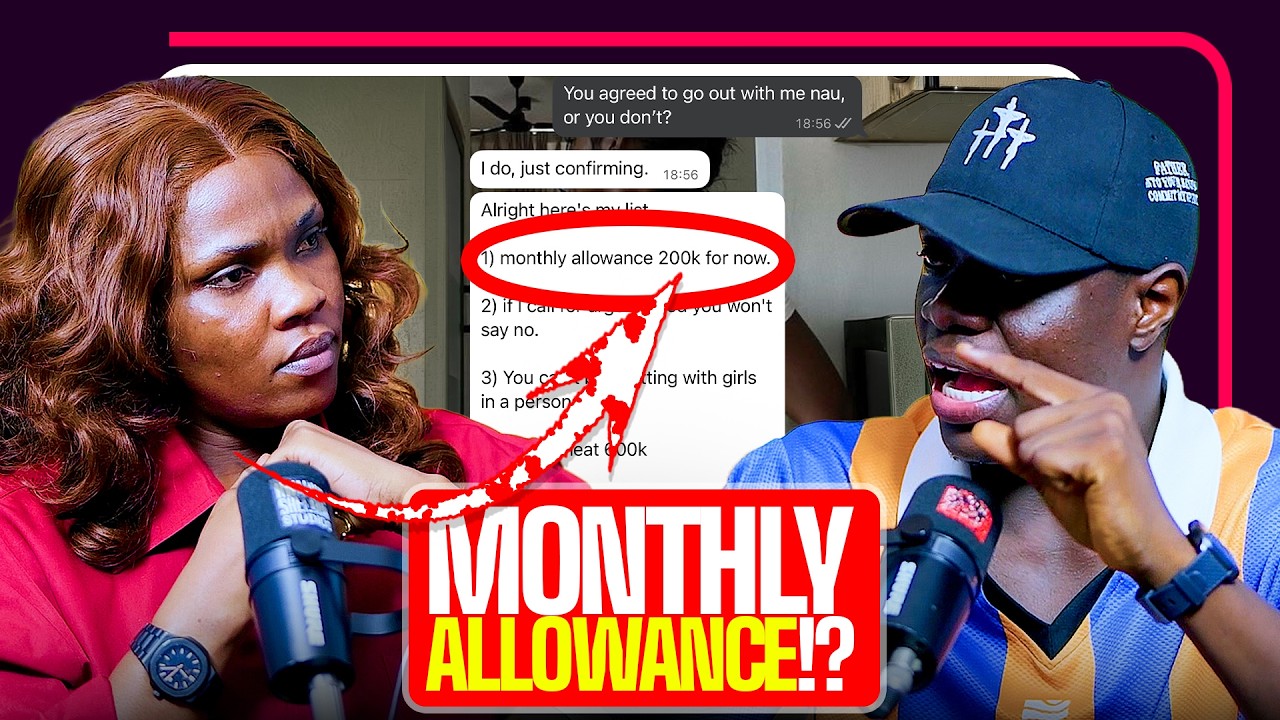
“Before I go out with you, these are my requirements “😭😭😭😭😭😭
Love for Sale: When Dating Becomes a Transaction and Relationships Turn Into Financial Contracts
In contemporary society, the intersection of romance and economics has become increasingly complex and morally ambiguous. What was once considered the sacred domain of love and emotional connection has, in many cases, transformed into a marketplace where affection is negotiated, emotions are commodified, and relationships are structured around explicit financial agreements. A recent episode of the popular YouTube program “Yawa of the Day” from Kwadwo Sheldon Studios brought these uncomfortable realities into sharp focus through the examination of a nineteen-year-old woman named Blessing’s dating requirements and sparked an intense debate about the nature of modern relationships, compensation, and the troubling normalization of transactional love.
The episode began by dissecting Blessing’s list of six specific requirements for any man who wished to date her. These requirements, which would have seemed shocking or even absurd in previous generations, are increasingly becoming normalized in contemporary dating culture. However, what emerged from the hosts’ analysis was not a simple condemnation of Blessing’s demands, but rather a complex examination of the contradictions embedded within her expectations and what these contradictions reveal about modern relationship dynamics. The most glaring inconsistency in Blessing’s requirements centered on the relationship between financial provision and physical intimacy, creating a troubling dynamic that the hosts identified as fundamentally problematic and self-defeating.
Blessing demanded that any potential boyfriend provide her with 200,000 Naira during the first week of dating, ostensibly to cover expenses related to personal grooming, beauty maintenance, and self-care. This financial requirement was framed as a necessary investment in her appearance and well-being. However, simultaneously, she imposed a strict prohibition on sexual relations for the first three weeks of the relationship, claiming this waiting period was necessary to test the man’s sincerity and commitment. The hosts immediately recognized the logical contradiction embedded within these two requirements. On one hand, Blessing was demanding immediate financial investment from a man she had just met. On the other hand, she was withholding physical intimacy as a way to verify his genuine intentions.

The hosts pointed out that this arrangement created a perverse incentive structure that actually undermined the stated purpose of the three-week waiting period. If a man’s primary motivation were deceptive—if he were simply trying to manipulate or exploit Blessing—he would have no difficulty exercising patience for three weeks. A dishonest man would be willing to wait far longer than three weeks if it meant securing access to a woman he was attempting to deceive. The three-week waiting period, rather than serving as a test of sincerity, would actually be an insignificant obstacle for someone with genuinely manipulative intentions. Conversely, the immediate financial demand would serve as a perfect screening mechanism for identifying men with resources, regardless of their actual intentions or capacity for genuine affection.
The hosts characterized Blessing’s approach not as a reasonable set of dating standards, but rather as a set of demands that revealed she was fundamentally unprepared for a healthy, serious romantic relationship. They suggested that Blessing was essentially seeking a “money machine”—someone onto whom she could offload all of life’s pressures and financial burdens. The hosts argued that regardless of how wealthy a man might be, a relationship structured around these kinds of demands would inevitably collapse quickly. The problem was not the specific amounts of money demanded, but rather the underlying dynamic: a relationship based on financial extraction rather than mutual affection, respect, and genuine connection.
The discussion then shifted to an even more controversial territory: the normalization of what might be called “infidelity penalties” or “cheating compensation” in modern relationships. One of the female guests on the program voiced support for Blessing’s requirement that if a boyfriend were caught being unfaithful, he would be required to pay 600,000 Naira—approximately 5,000 Cedis—as compensation for the emotional damage caused by his betrayal. The guest’s reasoning was that while money cannot heal the psychological wound of infidelity, it does provide a concrete financial resource that a woman could use to engage in therapeutic activities: shopping, travel, or beauty treatments that might help her process the pain and move through the healing process.

This perspective, while presented with the intention of protecting women’s interests, actually reveals a troubling normalization of transactional relationships. The argument essentially accepts the premise that emotional harm can and should be compensated through financial payment, transforming betrayal into a quantifiable economic loss rather than a violation of trust and commitment. This framing reduces the complexity of human emotion and the profound damage caused by infidelity to a simple financial calculation.
However, what emerged from the hosts’ investigation was even more disturbing than the theoretical discussion of such arrangements: these “cheating compensation” agreements are not merely hypothetical constructs discussed in abstract terms. Scanti revealed that on social media platform X, numerous couples have publicly acknowledged that they operate according to these exact rules. Some wealthy men have even admitted to proactively transferring one million Naira to their girlfriends each time they engage in infidelity, essentially purchasing forgiveness and continued relationship status through direct financial compensation. This revelation transformed the discussion from an examination of one woman’s unreasonable demands into an acknowledgment of a widespread cultural phenomenon: the normalization of relationships as financial transactions where betrayal is simply another expense to be managed through payment.
The discussion reached its most heated and revealing moment when the guests began discussing an even more extreme manifestation of this transactional approach to relationships: the practice of wealthy men purchasing real estate for their wives after each childbirth. The hosts referenced a story that had circulated on social media three years prior, in which a wealthy husband reportedly purchased a new house for his wife following each time she gave birth to his child. What might initially seem like an extraordinarily generous gesture actually raises profound questions about the nature of reproduction, motherhood, and the commodification of women’s bodies and reproductive labor.

The male rapper and MC present at the taping expressed strong opposition to this practice, articulating a perspective that challenged the transactional framing of reproduction and motherhood. He argued that a child born to a couple is the shared responsibility and joy of both parents. A woman’s experience of pregnancy, labor, and childbirth, while undoubtedly physically demanding and dangerous, represents the fulfillment of a fundamental human function and the creation of a shared family unit, not a service rendered in exchange for material compensation. He rejected the notion that motherhood should be treated as a form of labor for hire, where women exchange their bodies and health for real estate and material goods. He expressed pride in his own approach to relationships, stating that he focused on building a solid financial portfolio and stable foundation for himself rather than viewing marriage as a system of material exchange.
The female guest responded with considerable passion and intensity, challenging the male guest’s perspective by asking him to speak with his own mother about the physical dangers, pain, and risks associated with pregnancy and childbirth. She detailed the various complications and dangers that women face: surgical interventions, the risk of miscarriage, the nine months and ten days of physical burden associated with carrying a pregnancy. She argued that if a man possessed sufficient economic resources, providing his wife with a house or vehicle after she had given birth was not merely a gift but rather a deserved form of compensation for the extraordinary risk she had undertaken. She framed childbirth not as a natural function but as an act of profound sacrifice in which a woman literally wagered her own life to enable a man to become a father.
This exchange revealed a fundamental disagreement about the nature of reproduction and the appropriate relationship between economic provision and biological function. On one side was the argument that reproduction is a shared human experience and that treating it as a transaction undermines the dignity of motherhood and the sanctity of family creation. On the other side was the argument that women’s reproductive labor is so physically dangerous and demanding that it deserves concrete economic recognition and compensation, particularly when the man possesses the financial means to provide it.

What both perspectives failed to adequately address, however, is the deeper problem with framing any aspect of intimate relationships in purely transactional terms. When relationships become systems of financial exchange—whether for sexual access, fidelity, or reproductive labor—they cease to be relationships in any meaningful sense and instead become commercial transactions. The presence of love, trust, and genuine commitment becomes secondary to the negotiation of financial terms and the enforcement of payment schedules.
The normalization of these transactional approaches to relationships reflects a broader crisis in contemporary society regarding the meaning and purpose of intimate partnerships. Relationships have increasingly become viewed as vehicles for economic advancement and material security rather than as spaces for genuine human connection, mutual support, and shared growth. This transformation is not accidental; it reflects real economic pressures, growing inequality, and the increasing difficulty many people face in achieving financial stability without relying on a partner’s economic resources.
However, the solution to these economic pressures is not to further commodify intimate relationships but rather to address the underlying economic conditions that make people feel compelled to treat relationships as financial transactions. When people cannot afford basic necessities without relying on a partner’s income, when healthcare and education are prohibitively expensive, when the future feels economically precarious, it is understandable that people would attempt to secure their financial position through relationship agreements. Yet this approach ultimately undermines the possibility of genuine connection and mutual support that healthy relationships require.

The episode concluded with an important announcement from Kwadwo Sheldon Studios about a new initiative to bring the program’s discussions from the studio into real-world communities. Rather than limiting themselves to analyzing social media posts and abstract scenarios, the production team announced plans to investigate actual problems and issues affecting communities, to document them, and to work toward finding solutions through engagement with local authorities and community leaders. This shift from purely theoretical discussion to practical engagement with real-world problems represents an important evolution in the program’s mission.
The episode as a whole serves as a stark reminder of how far contemporary relationship dynamics have strayed from ideals of genuine connection and mutual care. The normalization of financial compensation for infidelity, the treatment of childbirth as a transaction deserving material payment, and the establishment of explicit financial requirements for dating all represent symptoms of a deeper problem: the transformation of intimate relationships into economic arrangements. While the economic pressures that drive these arrangements are real and deserve serious attention, the solution cannot be to further entrench transactional approaches to love and commitment. Instead, society must grapple with the underlying economic inequalities and insecurities that make people feel compelled to treat relationships as financial contracts. Only by addressing these root causes can we hope to restore relationships to their proper domain: spaces of genuine human connection, mutual support, and authentic commitment that transcend economic calculation.