Eiii..Their Marriage Almost Collapsed Because Of “Makeup Kit”
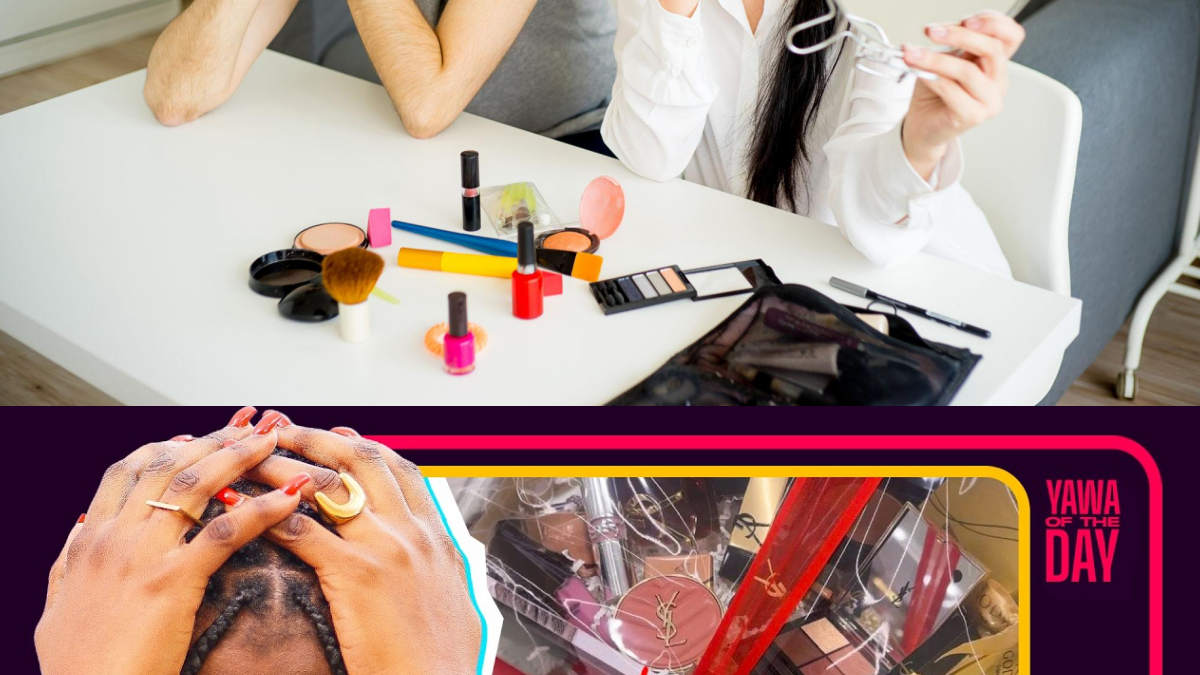
When a Makeup Kit Nearly Destroyed a Marriage: The Story That Divided the Internet and Sparked a Heated Debate About Love, Respect, and Office Politics

In the age of social media, stories that touch on the delicate balance of marriage, workplace dynamics, and personal respect can spread like wildfire, capturing millions of hearts and igniting passionate debates across platforms. One such story recently became the centerpiece of a viral discussion on Twitter (X) and found its way into the spotlight through the popular YouTube program “Yawa of the Day” by Kwadwo Sheldon Studios. What started as a seemingly innocent corporate gift exchange evolved into a profound examination of marital values, emotional intelligence, and the often-overlooked pain of feeling underappreciated by the person you love most.
The narrative begins innocuously enough. A husband attended a corporate lunch event exclusively for company employees, where he participated in a raffle draw. His luck struck gold when he won an exceptionally luxurious and expensive makeup and skincare set—the kind of premium product that most people would consider a significant prize. However, what happened next would set off a chain of events that nearly fractured his marriage and sparked conversations about respect, consideration, and the small gestures that matter most in relationships.
Rather than bringing the coveted gift home to his wife, the husband made an immediate decision that would later haunt him. He handed the makeup kit directly to a female colleague standing nearby. When he returned home that evening, he recounted this act of generosity with apparent pride, seemingly unaware of the emotional minefield he had just created. He spoke of his magnanimity, his willingness to share, and his thoughtfulness toward a colleague. What he failed to recognize was that his actions carried a message far deeper than simple kindness.

The situation escalated when the company’s official social media page posted a photograph capturing the moment of the gift exchange. The image showed the husband and his female colleague smiling brightly, holding the makeup kit between them, with the company’s caption praising his “gallantry” and “generosity.” For many, this would have been a forgotten moment, a minor incident in the daily grind of corporate life. But for the wife, scrolling through social media while exhausted from managing household responsibilities, childcare, and preparing dinner, the photograph felt like a public declaration of her irrelevance.
The emotional weight of this moment cannot be understated. Here was a woman, working tirelessly behind the scenes to maintain the family home and care for their children, watching her husband publicly celebrated for giving a luxury gift to another woman. The makeup kit itself became secondary to what it represented: a symbol of her husband’s failure to prioritize her, to consider her feelings, or to recognize her sacrifices. When she expressed her hurt and disappointment, his response only deepened the wound. He dismissed her concerns, labeling her as paranoid, exaggerating, and irrationally jealous. He defended himself by appealing to his ego, arguing that it would have looked strange for a man to accept a makeup kit at a public event, so he had no choice but to give it away immediately.
This story became the subject of intense discussion on the YouTube program “Yawa of the Day,” where hosts Scanti and Highest Erie found themselves on opposite sides of a passionate debate that reflected broader societal divisions about marriage, gender roles, and emotional intelligence. Their disagreement was not merely academic; it represented two fundamentally different worldviews about what constitutes respect and consideration in a marriage.

Erie took the position that the wife was overreacting, amplifying a minor issue into something unnecessarily dramatic. From her perspective, the wife’s mention of her household duties—cleaning, cooking, childcare—was a petty attempt to score points in an argument rather than a genuine reflection of her emotional state. Erie suggested that the wife likely already possessed numerous makeup products at home, making the gift redundant anyway. She further proposed that the husband’s action could be interpreted as a form of workplace diplomacy, a thoughtful gesture to help a colleague improve her appearance and presentation. In this framing, the husband was not being disrespectful to his wife; he was simply being a decent colleague and a practical thinker who recognized that accepting a makeup kit would have been socially awkward.
Scanti, however, vehemently disagreed with this interpretation. He argued that the husband was fundamentally wrong on every level. The responsibility to make a female colleague look better, Scanti contended, is not the obligation of a married man. If the wife already owned similar products, that only strengthened the case for giving the gift to her, as it would have been a gesture of love and appreciation rather than a practical necessity. Scanti emphasized that the core issue was not about the makeup kit itself but about the husband’s failure to prioritize his wife’s feelings and to demonstrate the emotional attentiveness that a true partnership requires. He pointed out that the husband’s subsequent dismissal of his wife’s concerns—calling her jealous and paranoid—compounded the original offense. A husband who truly loved and respected his wife would have recognized her pain, even if he disagreed with her perspective, and would have worked to understand and validate her emotions.
The debate between these two perspectives illuminates a critical tension in modern relationships. On one side is the argument for pragmatism and the compartmentalization of different spheres of life: work is work, marriage is marriage, and a small gesture of kindness to a colleague should not be interpreted as a threat to the marriage. On the other side is the argument for emotional intelligence and the recognition that marriage requires constant, intentional prioritization of one’s spouse. This perspective holds that the small gestures, the choices we make in moments that seem insignificant, often carry profound meaning and communicate our values and priorities to those we love.

What makes this story particularly resonant is that it touches on a universal experience: the feeling of being taken for granted by the person closest to you. The wife in this narrative was not upset about a makeup kit; she was upset about feeling invisible, about the message that her husband’s actions seemed to send—that he valued the smile and gratitude of a colleague more than the feelings of his own wife. She was exhausted, managing multiple responsibilities, and what she needed was not a luxury gift but a simple acknowledgment that her husband saw her, valued her, and prioritized her above others.
The husband’s defensive response—dismissing her concerns as jealousy and paranoia—represents another critical failure point in this narrative. Rather than attempting to understand his wife’s perspective, he invalidated her feelings and positioned himself as the victim of her irrationality. This defensive posture, common in many conflicts, prevents the kind of genuine communication and emotional connection that healthy marriages require. A partner who truly loves and respects their spouse will sometimes need to set aside their own perspective and make an effort to understand why their actions caused pain, even if they did not intend harm.
The viral nature of this story suggests that it resonates with many people because it reflects real dynamics that play out in countless homes. It raises important questions about how we communicate value and appreciation in our relationships, how we navigate the intersection of professional and personal life, and how we respond when our actions inadvertently hurt those we love. It also highlights the often invisible labor that many spouses, particularly women, perform daily—the emotional and physical work of maintaining a home and raising children—and how easy it is for that work to go unrecognized and undervalued.

The story of the makeup kit is ultimately not about a makeup kit at all. It is about the importance of emotional attentiveness, the power of small gestures to communicate meaning, and the necessity of prioritizing one’s spouse in both actions and words. It is a reminder that marriage requires constant, intentional effort to see and value one another, and that dismissing a partner’s pain as irrational jealousy is a failure of empathy and understanding. Whether one sides with Erie’s pragmatic perspective or Scanti’s emphasis on emotional prioritization, the story serves as a valuable lesson in the complexity of human relationships and the profound impact that our choices, no matter how seemingly small, can have on those we love.