The bustling atrium of the downtown luxury department store echoed with the soft hum of high-end shoppers and classical music, until the piercing, indignant voice of the floor manager sliced through the tranquil atmosphere. Dressed in an impeccably pressed designer suit and sporting a golden name badge that proclaimed her regional authority, she stood with hands planted firmly on her hips, blocking the entrance of the children’s boutique. Standing opposite her was a tired, thirty-two-year-old single father wearing a faded denim work jacket, scuffed leather boots, and a simple grey tee, holding the small hand of his four-year-old daughter who was clutching a slightly frayed plush bunny. He had stopped at the flagship store on his way home from an exhausting double shift in logistics management, carrying an envelope of cash with the simple intention of buying his little girl a warm winter coat and a pair of sturdy school shoes for her upcoming preschool term. Yet, instead of welcoming a paying patron, the manager sneered with visible disgust, taking one look at the father’s dust-dusted boots and tired appearance before loudly declaring that vagrants and destitute street beggars were strictly forbidden from loitering around premier retail clients. The young father, maintaining a calm and measured demeanor despite the unprovoked insult, gently asked her to lower her voice so as not to frighten the little girl, politely explaining that he was a customer ready to pay full price for whatever merchandise his daughter selected. Rather than de-escalating the encounter, his polite refusal to shrink in shame only infuriated the arrogant administrator further. Raising her voice so that every wealthy patron, associate, and cashier on the ground floor turned to stare, she grabbed the wireless two-way radio from her belt, pressed the emergency frequency, and barked a high-priority dispatch to the building’s private armed security team. She ordered them to bring heavy handcuffs and immediately drag the scruffy trespasser and his brat out of the building into the street, brazenly fabricating a story over the open channel that he was an aggressive thief harassing clientele and attempting to pocket designer apparel from the display racks. Shoppers began whispering among themselves, several murmuring in discomfort at the harsh cruelty directed at a quiet parent and a trembling child, yet no one dared intervene against the notorious manager whose ruthless attitude and personal connections to the board had led to dozens of wrongful terminations over the past three years. The father did not yell, argue, or scramble toward the revolving glass exit doors in panic as she clearly expected him to do. For five agonizing years following the tragic illness that claimed his young wife, he had endured relentless trials, long nights of overtime, and the exhausting burden of raising a child entirely on his own without ever losing his dignity or his deep sense of justice. Looking the triumphant manager straight in the eyes, a cool, unbreakable certainty settled into his expression. He reached into his worn denim coat, bypassed the cash envelope, and pulled out an encrypted matte-black titanium smartphone embedded with a holographic silver corporate emblem, dialing a three-digit private override code into the encrypted dialer on speakerphone. The call connected on the very first ring, answered instantly by the breathless, deeply respectful voice of the executive vice president of global retail operations for the parent conglomerate. With calm, chilling precision that echoed off the high marble pillars, the quiet father stated his full legal name, provided his master biometric clearance code, and issued a direct, irrevocable executive directive: the immediate termination of the on-duty floor manager for gross misconduct, defamation of patrons, and catastrophic breach of corporate human dignity protocols, specifying that her security access be revoked, her pension stripped for cause, and her personal belongings boxed and left on the loading dock curb by noon. The manager burst out into shrill, mocking laughter, mocking him for acting like a delusional lunatic with a prop phone, until the store’s main sound system chimed with an automated network lockout and her personal handheld device violently flashed red, displaying a permanent revoked credential warning alongside an executive termination decree signed directly by the board of directors. The scruffy single father was not an itinerant trespasser or a blue-collar laborer down on his luck; he was the primary majority shareholder, principal investor, and elusive chairman of the retail empire’s international holding firm, a reclusive visionary who had intentionally stepped out of the public spotlight after his wife’s passing to live a grounded, honest life and personally conduct unannounced quality inspections of his company’s flagship locations. The double fire doors burst open as four burly security guards sprinted onto the floor with batons drawn, ready to tackle the reported thief, only to skid to a paralyzed halt the moment their eyes fell upon the titanium executive crest on the father’s phone and the terrified, color-drained face of their supervisor. Turning to the breathless guards before the stunned crowd of onlookers, the newly revealed chairman pointed a steady finger toward the trembling manager, quietly instructing the security personnel to escort their former boss off the property grounds before she could take another breath inside his building. Yet, as the weeping woman collapsed against the display counter begging for her career, an urgent encrypted message lit up the chairman’s phone screen from the board’s internal audit division, revealing that her cruelty was not merely bad customer service, but part of an ongoing multi-million-dollar embezzling syndicate operating right inside the flagship vault, with armed conspirators already moving through the basement corridors to destroy the evidence before the police could arrive. With the entire store watching in breathless silence and the security team scrambling to lock down the subterranean exits, the quiet father must decide in an instant whether to shield his innocent daughter from the erupting danger or unleash the full weight of his authority to tear down the criminal network hiding inside his empire. Step inside this electrifying modern tale of hidden power, shattered arrogance, and righteous poetic justice to see what happened when the dismissed single father finally brought down the hammer of retribution. If you had the absolute authority to immediately fire someone who publicly humiliated you and your child, would you dismiss them on the spot without hesitation, or would you allow them to keep their position under strict probation to prove you are above petty revenge?

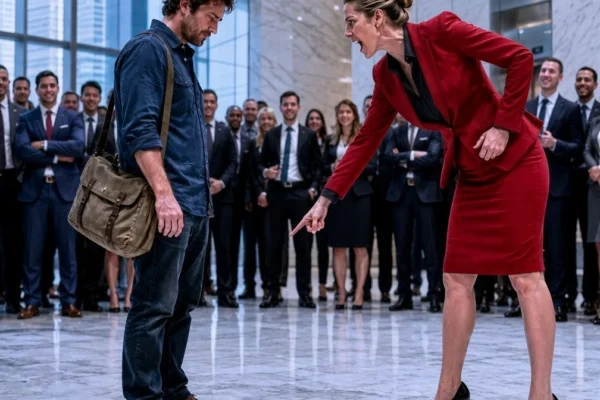
The bustling atrium of the downtown luxury department store echoed with the soft hum of high-end shoppers and classical music, until the piercing, indignant voice of the floor manager sliced through the tranquil atmosphere. Dressed in an impeccably pressed designer suit and sporting a golden name badge that proclaimed her regional authority, she stood with hands planted firmly on her hips, blocking the entrance of the children’s boutique. Standing opposite her was a tired, thirty-two-year-old single father wearing a faded denim work jacket, scuffed leather boots, and a simple grey tee, holding the small hand of his four-year-old daughter who was clutching a slightly frayed plush bunny. He had stopped at the flagship store on his way home from an exhausting double shift in logistics management, carrying an envelope of cash with the simple intention of buying his little girl a warm winter coat and a pair of sturdy school shoes for her upcoming preschool term. Yet, instead of welcoming a paying patron, the manager sneered with visible disgust, taking one look at the father’s dust-dusted boots and tired appearance before loudly declaring that vagrants and destitute street beggars were strictly forbidden from loitering around premier retail clients.
Her voice rose with calculated malice, reverberating off the polished travertine floor and soaring toward the vaulted glass ceiling four stories above. “Did you honestly believe you could drag your filth into an establishment like Delacroix & Crown? Look at you. You reek of diesel and warehouse dust. This boutique caters to legacy families and private clientele, not itinerant vagrants looking for a heated lobby to nurse their squalor. Take your hands off the threshold before I have you thrown into the gutter where you belong.”
David Mercer did not flinch, nor did his expression betray the flash of heat that would have ignited in a lesser man’s veins. He simply tightened his grip around the tiny, trusting hand of his four-year-old daughter, Lily. He adjusted his posture slightly, moving his frame a fraction of an inch to stand between the towering vitrine of imported cashmere and the abrasive woman barring their path.
“Ma’am, please keep your voice at a reasonable level,” David said. His tone was smooth, low, and perfectly modulated, like polished river rock. “My daughter has had a long morning, and there is no cause to raise your voice or cause a public scene. I am here as a patron. I intend to select a coat from the winter rack and a pair of leather shoes for her preschool enrollment. I have legal tender, and I am prepared to settle the transaction immediately upon selection.”
The manager, whose golden plate proclaimed her name as Cynthia Vance, Senior Regional Vice President of Flagship Operations, barked an abrasive laugh that drew the eyes of three dozen wealthy patrons browsing the perfume alcoves. Several women in mink stole collars stopped their murmuring to peer over their diamond spectacles; an elderly gentleman in a bespoke charcoal overcoat paused with his cane hovering above the marble, glancing between David’s worn canvas cuffs and Cynthia’s venomous sneer.
“Legal tender?” Cynthia scoffed, taking a step forward until the scent of her cloying, five-hundred-dollar floral perfume collided violently with the clean, neutral scent of rain and damp wool clinging to David’s jacket. “You think waving a handful of crumpled five-dollar bills grants you clearance to step onto imported Italian tiles? Customers of this house spend more on cuff links in an afternoon than your entire demographic clears in a quarter. Your presence alone degrades the retail ambiance. You are dragging down the prestige of our flagship location, and I will not permit a common vagabond to soil our displays.”
She reached down to the heavy leather belt cinching her tailored trousers, unclipped a high-grade Motorola encrypted two-way radio, and pressed the crimson priority dispatch button on the side.
Her voice amplified across the open frequency, carrying through every ceiling speaker on the mezzanine: “Attention, Central Security. Level One Children’s Atrium. I have an aggressive, unvetted trespasser actively resisting direction and attempting to pocket designer apparel from the secondary vitrines. Dispatch armed units with heavy restraints immediately. Escort this individual and his dependent out through the service alley and into the rain before he disturbs any more of our private account holders.”
Whispers cascaded through the marble corridors like dry leaves. A younger sales associate behind the jewelry counter turned pale, her knuckles whitening against the velvet lining of a display case as she watched Cynthia fabricate a felony out of thin air. Everyone who worked under the roof of Delacroix & Crown knew Cynthia’s reputation: she was the untouchable niece of Julian Vance, a powerful minority board member who had systematically protected her through eleven formal human resources complaints and three wrongful termination lawsuits over the past three years. When Cynthia targeted an employee or a patron who failed her arbitrary aesthetic metrics, she crushed them without mercy.
Lily shrank against David’s leg, burying her face into the rough denim of his jeans, her tiny arms squeezing the threadbare plush bunny against her ribs so tightly that its seams strained. A tiny whimper escaped her lips. “Daddy… did I do something bad? Are the police coming for my bunny?”
David knelt down instantly on the cold marble floor.
He ignored the stares of the socialites, ignored Cynthia’s triumphant, vicious smirk, and focused entirely on the trembling child before him. He reached out with his large, calloused hand—a hand marked by old chemical burns, tiny wrench scars, and years of relentless physical endurance—and gently smoothed the soft curls of dark hair back from her forehead.
“No, sweetheart,” David whispered, his voice an anchor of pure, unshakeable calm in the rising storm. “You did nothing wrong. You are the best thing in this entire room. We are here to get your warm coat with the yellow buttons, just like we promised Mommy. Remember what I told you about people who shout?”
Lily sniffled, her wide, hazel eyes looking into his steady gray gaze. “People who shout are just scared of the quiet.”
“That’s right,” David said, kissing the bridge of her nose. “Stand right here beside me. Don’t look at her, look at me. Daddy has this completely under control.”
He stood back up to his full height of six feet two inches. The slight slouch of physical exhaustion that had rounded his shoulders after thirty hours in the industrial supply terminals vanished completely, replaced by the rigid, terrifying spine of a man who had commanded maritime convoys through freezing squalls and navigated sovereign asset disputes across three continents.
Cynthia crossed her arms, tapping a pointed crimson fingernail against her elbow. “Still posing? The guards are coming up the service escalator, you stubborn fool. If you had half a brain, you’d have bolted for the subway. Now you’re leaving in steel zip-ties, and Child Protective Services will be sorting out your little stowaway by nightfall.”
David didn’t offer a rebuttal. He didn’t plead for understanding, nor did he explain that the dust on his boots was industrial ceramic insulation from the automated port facility across the bay.
Instead, he reached into the internal breast pocket of his weathered denim coat. Bypassing the white paper envelope containing twelve crisp fifty-dollar bills he had drawn from the credit union that morning, his fingers closed around a sleek, rectangular object that had remained untouched in his pocket for nearly four months.
He pulled it out into the bright chandelier light.
It was not a standard commercial smartphone. The chassis was milled from a solid billet of aerospace-grade matte-black titanium, completely devoid of external branding save for a microscopic, laser-etched holographic emblem in the center of the rear casing: a stylized naval anchor wrapped in three unbroken gold rings—the sovereign mark of the Vance-Mercer Maritime and Commercial Syndicate.
David swiped his thumb across the biometric glass sensor. The screen did not display an app matrix or a consumer interface; it booted instantly into a secure Linux command terminal flashing an emerald clearance prompt. He tapped three digits into the encrypted dialer, activated the high-gain external speakerphone, and held the device loosely in his palm.
The line did not ring twice. It was intercepted on the very first oscillation by an automated quantum encryption handshake, followed immediately by the sharp, breathless voice of a man who had clearly dropped whatever he was holding to grab the receiver.
“Executive terminal verified,” the voice said, crisp, European, and quivering with absolute, terrified deference. “Good morning, Mr. Chairman. We did not anticipate a live transmission from your private unit during the third-quarter recess. How may the global executive desk serve you, sir?”
The voice belonged to Alistair Croft, the Chief Operating Officer of the Mercer Sovereign Capital Trust in Geneva, a man who oversaw twenty-two billion dollars in commercial real estate, logistics fleets, and luxury retail conglomerates across thirty-six sovereign jurisdictions.
Cynthia’s sneer faltered for a fraction of a second, her eyebrows twitching at the sheer acoustic fidelity and bizarre gravity of the speakerphone, but her arrogance quickly reasserted itself. She let out a loud, mocking snort. “Oh, brilliant theatricals! A burner phone with an accent on the other end! Did you pay an out-of-work actor twenty bucks to recite lines from an action movie? You are pathetic!”
David ignored her entirely. He kept his eyes locked onto Cynthia’s face, his voice ringing out across the atrium with the chilling, detached authority of a sovereign magistrate reading a death warrant:
“Alistair,” David said, every syllable dropping like a frozen iron ingot onto the marble floor. “Identify the regional retail asset designated as Delacroix & Crown, Flagship Unit 01, metropolitan commercial core.”
“Accessing enterprise portfolio,” Croft’s voice replied instantly, the sound of furious keystrokes audible over the high-speed satellite relay. “Asset identified, sir. Wholly owned subsidiary under the Mercer Consumer Luxuries Division. One hundred percent equity held by your personal trust. Current local management reported to the regional board.”
“Good,” David continued, his voice devoid of heat, which only made it infinitely more terrifying to the dozen floor staff who had begun creeping out from behind the perfume counters to listen. “You will issue an immediate executive decree, effective as of this second. Terminate the on-duty Senior Regional Vice President of Flagship Operations, Cynthia Vance.”
Cynthia’s face turned from a smirk to a scowl of pure, theatrical outrage. “You insolent clown! You can’t fire me! My uncle Julian sits on the—”
“Terminate her for gross operational misconduct,” David spoke over her without raising his volume by a single decibel. “Cite willful defamation of patrons, reckless endangerment of minor dependents on commercial premises, and a catastrophic, non-waivable breach of the Mercer Foundation Human Dignity Charter. Revoke all enterprise security clearances, terminate her administrative credentials across all point-of-sale and vault networks, freeze her deferred equity packages for cause, and have her personal belongings cleared from the fourth-floor executive suite and deposited on the loading dock curb by noon.”
A brief pause hung over the line, followed by Croft’s cold, lethal confirmation: “Directive registered and countersigned under Master Protocol Alpha, Mr. Chairman. The executive termination order has been transmitted directly into the building’s central server matrix. It is done.”
“No, it isn’t done!” Cynthia shrieked, her face turning an ugly shade of magenta as she pointed her radio at David’s chest like an offensive weapon. “You think you can play games with me in my own store? You are an uneducated, penniless piece of trash who probably stole that fancy phone out of an executive’s gym locker! I am going to see you locked in a concrete cell until your hair turns grey, and your brat will be in a state foster home before the sun goes down!”
Suddenly, the store’s ambient classical music—a delicate Vivaldi concerto that had played on an automated loop from the ceiling speakers—cut off with a sharp, electronic chirp.
A low, resonant chime echoed through the four-story atrium: BONG. BONG. BONG.
Every digital cash register across the thirty thousand square feet of the ground floor went dark simultaneously. The glowing LED price displays blinked off, their screens flashing an ominous, enterprise-wide system message in glaring amber text:
SYSTEM INTERLOCK: ADMINISTRATIVE OVERRIDE INITIATED.
SECURITY LEVEL: ZERO (CHAIRMAN AUTHORIZATION).
ALL LOCAL TERMINALS LOCKED PENDING COMPLIANCE AUDIT.
At the exact same instant, the sleek, gold-plated administrative tablet strapped to Cynthia Vance’s left forearm violently vibrated, letting out a series of high-pitched emergency warbles.
Cynthia frowned, her triumphant expression curdling into sudden, uneasy confusion. She lifted her wrist and glanced down at the high-resolution screen.
A full-screen crimson banner was pulsing across the glass:
CREDENTIALS REVOKED: ACCESS DENIED.
EMPLOYEE ID: VANCE-8809.
STATUS: SUMMARY TERMINATION FOR CAUSE.
DIRECTIVE ISSUED BY: OFFICE OF THE PRIMARY BENEFICIARY / SOVEREIGN TRUSTEE.
SECURITY WARNING: VACATE THE PREMISES IMMEDIATELY. CONTINUED PRESENCE CONSTITUTES CLASS-3 CRIMINAL TRESPASS.
The golden name badge on her lapel suddenly felt like an executioner’s brand against her chest. Cynthia stared at the flashing red screen, the blood draining from her cheeks with the speed of an opened sluice gate, leaving her face the color of wet chalk. Her lower lip began to tremble, an involuntary, spastic twitch that she couldn’t master.
“This… this is an error,” she whispered, her voice cracking down the middle, completely stripped of its haughty volume. “The… the IT department has suffered a server partition… Julian… my uncle Julian would never authorize…”
“Julian didn’t authorize it, Cynthia,” David said softly, stepping closer to her until his shadow fell across her trembling hands. “Your uncle owns four percent of the non-voting preferred shares in Delacroix & Crown. I own the remaining ninety-six percent. I own the ground beneath these tiles. I own the steel in these walls. I own the air you breathe while you stand inside this building.”
Before Cynthia could scream, the heavy double fire doors at the eastern end of the atrium were kicked open with a thunderous bang.
Four massive private security contractors in black tactical uniforms, wearing ballistic vests and carrying sidearms and heavy flex-cuffs, came sprinting across the marble at a dead run, their heavy boots drumming against the stone like iron hammers.
In the lead was Captain Robert Miller, a twenty-year veteran of the private security firm that guarded the downtown commercial district, his hand resting firmly on the butt of his holstered taser, his jaw clenched in readiness to neutralize the aggressive felon reported over the dispatch channel.
“Down on the ground! Both of you, hands where I can see them!” Miller roared, his voice cutting through the stunned silence of the boutique corridor.
He lunged forward, his eyes locked on the broad back of the man in the faded denim jacket, preparing to execute a standard takedown—and then Miller skidded to a dead halt so violently that the rubber soles of his tactical boots left black skid marks across the immaculate travertine floor.
The three officers behind him collided into one another, stumbling to a halt, their hands frozen on their weapons.
Captain Miller’s face went completely slack. His pupils dilated until his dark eyes were almost entirely black, his chest heaving inside his Kevlar vest as if he had just run three miles through a sandstorm.
He did not look at Cynthia. He looked at the matte-black titanium phone resting in the laborer’s palm, specifically at the holographic three-ring anchor emblem that was now glowing with a faint, pulsing sapphire verification light.
Miller had seen that emblem only once before in his entire career: four years ago, at the closed-door security briefing following the passing of Elena Mercer, when every private security contractor, intelligence director, and corporate marshal under the Mercer umbrella was shown the biometric profile of the one man whose orders superseded all civil and commercial authority within the syndicate’s private holdings.
Captain Miller instantly snapped his heels together, his spine locking into an iron rod, his right hand rising to his temple in a rigid, trembling military salute.
“Mr. Mercer, sir!” Miller barked, his voice vibrating with absolute, paralyzed terror. “We… we were dispatched under false emergency pretenses! We had no notification that you had crossed the perimeter!”
The three guards behind Miller immediately dropped their hands from their duty belts, snapping into identical, terrified salutes, their eyes wide as saucers as they stared at the man they had been ordered to tackle and zip-tie like a stray dog.
Across the atrium, forty wealthy patrons gasped in unison. The young sales associate behind the jewelry counter let out a choked sob of pure, disbelieving relief, her hands flying to her mouth.
David Mercer did not return the salute. He did not raise his voice. He stood with his left hand still gently holding Lily’s small, warm fingers, his gray eyes looking down upon Captain Miller with the absolute, terrifying weight of a sovereign monarch surveying a garrison that had lost its discipline.
“Captain Miller,” David said, his voice quiet, calm, and carrying to every corner of the frozen hall. “Take this former employee’s badge and radio. Escort her out through the employee basement exit into the service alley. Ensure she takes nothing from her desk except her personal coat and umbrella. If she attempts to re-enter this parcel, detain her for criminal trespassing and hand her over to the county sheriff.”
Miller turned his head toward Cynthia Vance. The deference that the security chief had shown her for three years evaporated into a look of savage, professional revulsion.
“With pleasure, Mr. Chairman,” Miller growled.
He stepped toward Cynthia, his large hand reaching out to rip the golden name badge from her tailored lapel with a sharp, violent tear of fabric, while his second-in-command snatched the Motorola radio from her paralyzed fingers.
“No! Please! Mr. Mercer, listen to me!” Cynthia collapsed, her knees buckling completely as she hit the marble floor, her expensive trousers gathering the dirt that had fallen from David’s boots. She crawled forward on her hands and knees, tears carving black channels through her designer mascara, her hands reaching out toward David’s worn leather boots in frantic, sniveling supplication. “I didn’t know! How could I know the Chairman was wearing… wearing working clothes? I was protecting your brand! I was trying to maintain the standards you set for the flagship! Think of my family! Think of my uncle Julian! If you destroy my career, I have nothing—”
“You should have thought of human dignity, Cynthia,” David interrupted softly, not looking down at her, his voice an epitaph for her vanity. “You didn’t need to know my bank balance to treat my daughter with basic human decency. You didn’t need to see a balance sheet to refrain from calling a child a brat and threatening to throw her into the rain.”
He gestured to Miller. “Remove her.”
Two burly security guards hoisted Cynthia Vance by her armpits, dragging her backward across the polished floor like an empty sack of laundry, her manicured heels squealing against the marble as she shrieked and wept for mercy, her cries echoing through the atrium until the heavy steel doors of the service stairs slammed shut behind her, cutting off her voice forever.
Silence descended upon the grand concourse once more.
The shoppers, the sales associates, and the cashiers stood entirely frozen, looking at the denim-clad father with an awe so profound that no one dared draw a full breath.
David looked down at Lily.
The little girl had finally relaxed her grip on his jeans. She reached up with her free hand, rubbing her small nose against her sleeve, looking at the sparkling glass vitrines with innocent, wide-eyed wonder.
“Daddy?” Lily asked softly, her voice breaking the heavy silence like a small, clear bell. “Is the angry lady gone?”
David knelt down once more, smiling at her with an infinite, tender warmth that completely washed away the terrifying authority of the Chairman. “Yes, baby. The angry lady went home. Now, let’s go find that coat with the yellow buttons.”
He took her hand, stood up, and turned toward the children’s boutique.
Then, the titanium phone in his palm violently pulsed with three short, rapid haptic vibrations.
David paused. He looked down at the screen.
An emergency encrypted transmission had just bypassed the standard firewall, flashing a black-and-crimson alert box directly from the Directorate of Internal Audit and Asset Protection in Zurich:
PRIORITY RED: ACTIVE BREACH IN PROGRESS.
FACILITY: FLAGSHIP 01 (METROPOLITAN).
LOCATION: SUBTERRANEAN VAULT / SECTOR 4 ARCHIVES.
ANOMALY DETECTED: UNAUTHORIZED SYSTEM WIPE OF HISTORIC INVENTORY REGISTERS INITIATED THREE MINUTES AGO UNDER CREDENTIALS: VANCE-JULIAN-001.
INTERNAL SURVEILLANCE FEED: FOUR ARMED OPERATIVES IN TACTICAL GEAR HAVE COMPROMISED THE MAIN POWER RISERS BENEATH THE FLAGSHIP VAULT. PHYSICAL EXTRACTION OF OFF-BOOK HARDWARE IN PROGRESS.
OBJECTIVE: DESTRUCTION OF THE TEN-YEAR DIAMOND FRAUD AUDIT TRAIL BEFORE FEDERAL AUTHORITIES EXECUTE SEIZURE WARRANTS.
WARNING: OPERATIVES ARE ARMED AND OPERATING UNDER TERMINAL ORDERS.
David’s pupils contracted to needle-points.
The pieces of a three-year corporate anomaly fell into place with the terrifying, mathematical precision of an avalanche.
Cynthia Vance’s hysterical arrogance had not merely been the petulance of a spoiled administrator. It was a calculated, daily diversion. For thirty-six months, Julian Vance and his syndicate had been using the flagship location’s sovereign tax-exempt transit vault to launder millions of dollars in unrecorded conflict diamonds from Central Africa, systematically falsifying the store’s import ledgers while Cynthia used her authority to purge, intimidate, and fire any floor worker, stock clerk, or auditor who looked too closely at the cargo crates arriving on the midnight freight lifts.
And now, the moment David had triggered the Master Protocol Alpha override from his phone, the automated security interlock had tripped the audit alarms in Switzerland.
Julian Vance knew the net was closing.
He hadn’t sent Cynthia to protect the store’s prestige; he had sent a cleanup crew of armed mercenaries into the subterranean foundations of Delacroix & Crown to incinerate the physical ledgers, wipe the server drives, and take whatever gold remained in the vault before the corporate marshals arrived.
And they were currently twenty feet directly beneath the floor where his daughter was standing.
David Mercer stood motionless in the center of the glittering children’s boutique, the titanium phone humming quietly against his palm as the subterranean warning indicators shifted from amber to violent crimson.
Around him, the retail floor had begun to normalize in that strange, hollow way high-society spaces do after a public scandal. The classical music had restarted through the ceiling speakers—a delicate Chopin nocturne this time—and the floor associates, terrified of displeasing the newly revealed sovereign owner of the empire, were scurrying about with forced smiles, offering silver trays of sparkling water and imported butter cookies to the few dozen wealthy patrons who still lingered near the glass display cases.
Captain Miller stepped up beside David, his posture still locked in parade-rest, his radio buzzing with low-frequency static.
“Sir,” Miller murmured, his eyes darting toward the titanium screen. “My second-in-command just signaled from the central monitoring station. The sub-basement security feeds just dropped dead across sectors three and four. The cameras didn’t lose power; they were cut with commercial cable shears. Someone is down in the mechanical vaults.”
David did not answer immediately. He slowly turned his head to look at Lily.
The little girl had wandered over to a low velvet ottoman, holding a tiny, double-breasted winter coat made of butter-soft yellow wool with six large, polished amber buttons. Her small fingers were tracing the smooth bone surfaces of the fasteners, her face illuminated by pure, uncorrupted delight.
“Daddy, look!” she called out, her voice floating across the boutique like birdsong. “It has the buttons! Just like the picture Mommy drew in my notebook! Can I try it on? Please?”
The sight of her innocence, so completely detached from the multi-million-dollar criminal syndicate moving through the concrete foundations beneath their feet, struck David with the force of an iron sledgehammer.
For five years, ever since Elena had closed her eyes in that sterile hospice room in Zurich, David had constructed an impenetrable wall around this child. He had walked away from the boardrooms of London and Geneva, surrendered his luxury penthouses, and traded his bespoke Savile Row tailoring for work boots and denim specifically so that Lily would grow up knowing the value of an honest hour’s toil, the texture of unvarnished earth, and the quiet dignity of a life free from the blood-soaked machinations of corporate power.
He had lived in a modest three-room bungalow on the edge of the industrial rail yards. He had packed her lunches in tin boxes, mended her shoes with cobbler’s wax, and taken thirty-dollar double shifts in logistics terminals just to feel the clean, uncomplicated exhaustion of a common working father.
Yet now, the rot of the empire he had built had followed him straight to the threshold of his daughter’s joy.
Julian Vance had not merely stolen from the company; he had turned this building—a house that bore the name of David’s late grandfather—into an abattoir of greed, and now his hired thugs were operating in the dark beneath the feet of an innocent child.
David’s jaw tightened until the bone beneath his skin looked like carved granite.
“Captain Miller,” David whispered, his voice dropping into a register so dark, so cold, that the veteran security officer felt the hair on his arms stand on end.
“Sir?”
“Take four of your men. Secure this boutique. Lock down the internal fire gates of the children’s department, lower the reinforced steel shutters on the eastern corridor, and do not permit a single soul to enter or leave this enclosure. If anyone approaches this threshold without my direct voice clearance, you treat them as an active hostile.”
Miller’s hand drifted toward his holster. “Understood, Mr. Chairman. And what about you, sir?”
David reached down, gently unbuttoned the faded denim work jacket from his shoulders, and laid it across the back of a gilded armchair. Beneath it, he wore only a plain, charcoal-gray tactical thermal shirt that hugged the massive slabs of muscle across his chest and back—the physical receipt of five years spent hauling freight containers and hoisting high-pressure pneumatic tools.
He turned toward his daughter.
Kneeling before the ottoman, David took the small yellow wool coat from Lily’s hands, slipped her small arms through the sleeves, and fastened the amber buttons one by one with steady, gentle fingers. He adjusted the collar, smoothed down her dark curls, and kissed her softly on both cheeks.
“It fits you like a little queen, sweetheart,” David said, his voice entirely warm, devoid of the icy fury that had consumed his mind a second earlier.
Lily beamed, twirling in a small circle, her canvas sneakers squeaking happily against the marble. “Do I look like Mommy?”
“You look even better than Mommy,” David smiled, a brief, genuine warmth softening his eyes. “Listen to me, Lily. Daddy has to go downstairs to the basement for a few minutes to sign some papers with the building engineers. I want you to stay right here with Captain Miller. He has a box of shortbread biscuits behind the counter, and you can draw three pictures in your sketchbook with the bunny. When I come back, we’re going straight to the pastry shop on Third Street for hot chocolate. Deal?”
Lily looked into his eyes, her small brow furrowing slightly, sensing the immense gravity that always accompanied his quiet moments. She reached out, her tiny hand patting his scarred cheek. “Promise you won’t let the loud people shout at you, Daddy?”
“I promise, baby,” David murmured, his voice thick with a father’s unyielding love. “Nobody is shouting ever again.”
He stood up, turned on his heel, and walked through the reinforced glass archway of the boutique.
As he crossed the perimeter, Captain Miller struck the emergency console beside the jamb.
With a heavy, mechanical hum, four-inch-thick steel-mesh security grilles descended from the ceiling, sealing the children’s department into an impenetrable fortress of bullet-resistant glass and hardened titanium.
David Mercer walked toward the service elevator corridor.
With every step he took across the grand atrium, the weary logistics worker died, and the legendary, untouchable Chairman of the Mercer Syndicate woke from his five-year slumber.
He pulled the titanium phone from his pocket, opened the private communications channel to the municipal police commissioner’s office, and tapped the screen once.
“Commissioner Evans,” David said into the mic.
The response from the city’s top law enforcement official was immediate, breathless, and formal: “Mr. Mercer! Sir, our dispatch monitors just lit up with an automated federal alert from the downtown flagship! Is there an active threat?”
“There are four armed operatives operating inside the subterranean vault of Delacroix & Crown,” David stated calmly, stepping into the stainless-steel service lift and inserting his master titanium key into the maintenance slot. “They are attempting to destroy the physical evidence of Julian Vance’s international smuggling pipeline. Surround the exterior perimeter of the block with two tactical containment rings. Seal the subway junctions on Fifth and Main. But do not send your officers down the freight shafts.”
“Sir? If they are heavily armed—”
“This is an internal housecleaning, Commissioner,” David said, his voice as cold as deep sea ice. “I built this house. I will take out the trash myself.”
He hung up, selected the lowest basement level—Sub-Level 4: Secure Vault & Mechanical Archives—and pressed the button.
The heavy steel doors closed with a dull, concussive thud, and the lift plunged into the dark.
Sub-Level 4 was a cavernous labyrinth of reinforced poured concrete, humming high-voltage transformer banks, industrial steam risers, and heavy vault doors built in the early 1920s when the building served as a regional bullion depository. The air was thick with the scent of ozone, damp concrete, and the bitter chemical tang of burning insulation.
The lights were out.
Only the rhythmic, strobing amber glare of the emergency backup beacons illuminated the long, narrow corridor that led to the central archive vault.
At the far end of the corridor, four men dressed in sterile black tactical jumpsuits, wearing Kevlar body armor, ballistic helmets, and suppressed Heckler & Koch MP5 submachine guns, were working around the massive circular door of the primary document vault.
Near their boots sat two heavy commercial demolition charges—military-grade thermite canisters wired to an electronic radio detonator, designed to burn at four thousand degrees Fahrenheit, hot enough to melt through five feet of hardened steel and vaporize every paper ledger, hard drive, and forensic audit trail inside the chamber in less than ninety seconds.
In the center of the squad stood a man who did not wear a helmet.
It was Julian Vance.
At fifty-four, Julian was a patrician figure with silver-streaked hair, wearing a cashmere overcoat over an expensive business suit, but his aristocratic features were now twisted into an ugly, sweat-drenched mask of cornered, desperate panic.
“Move faster, damn you!” Julian hissed, glancing nervously at his gold Patek Philippe wristwatch. “The moment Cynthia’s terminal was severed upstairs, the automated panic switch tripped in Geneva! The federal marshals are probably already rolling out of the field office! Set the thermite charges and initiate the chemical burn!”
The lead mercenary, an Eastern European contractor named Roman whose face was scored by old shrapnel scars, didn’t look up from the electronic lock-picker clamped to the vault handle.
“The mechanical deadbolts are thirty-ton forged iron, Mr. Vance,” Roman rasped, his voice muffled behind a black nomex balaclava. “The thermite needs three minutes to burn through the internal hinge pins. If you want the drives melted clean, you have to wait for the core temperature to peak.”
“We don’t have three minutes!” Julian snarled, his fingers digging into the fabric of his coat. “If those ledgers are recovered intact, the Department of Justice will trace eighty million dollars in blood diamonds straight back to my personal foundation in the Caymans! I will spend the rest of my natural life in a supermax penitentiary! Burn the door now, take the backup drives from the server rack, and we blow the service tunnel out to the sewer line!”
Behind them, sixty yards down the pitch-black corridor, the heavy steel doors of the service elevator slid open with a soft, hydraulic hiss.
The four mercenaries spun around instantly, their suppressed weapons snapping up to their shoulders in synchronized, lethal precision.
The beam of their high-intensity weapon lights sliced through the gloom, converging on the open threshold of the elevator cab.
Standing alone in the center of the beam, illuminated in harsh, surgical white light, was David Mercer.
He had no weapon. He wore no body armor. He stood with his hands resting loosely at his sides, his plain charcoal thermal shirt dark against the stainless steel behind him, his gray eyes unblinking as four laser sights painted three red dots across his chest and one between his eyebrows.
Julian Vance stared through the glare, his eyes widening in sudden, disbelieving astonishment.
“You?” Julian gasped, a high, incredulous laugh tearing from his throat. “David? What… what are you doing here?”
Julian took two steps forward, stepping between the mercenaries, his face a grotesque mixture of relief and venomous condescension.
“You fool,” Julian sneered, shaking his head. “Cynthia radioed that some lunatic in denim was making threats upstairs. I thought the board had dispatched an elite internal security team! And instead, it’s just my pathetic, self-righteous nephew! The boy who gave up his throne to play peasant in the dirt!”
David did not move. He did not look at the laser dot pulsing against his sternum. His voice echoed down the concrete corridor, flat, steady, and terrifyingly calm:
“Hello, Julian.”
“Did you come down here to beg for your inheritance, David?” Julian mocked, his confidence returning with a rush of vicious adrenaline. “Did you spend five years scrubbing grease off diesel engines only to realize that poverty is cold? It’s too late, my boy! The board belongs to me! The holding companies belong to me! And by the time this building opens for business tomorrow morning, the vault will be ashes, your precious audit trail will be smoke, and you will be just another dead trespasser who got caught in an unfortunate basement gas explosion!”
Julian turned to Roman, making a sharp, dismissive slicing motion across his throat with his thumb.
“Kill him,” Julian ordered coldly. “Put two rounds in his chest and throw him into the incinerator chute with the rest of the garbage.”
Roman stepped forward, his finger tightening on the curved trigger of his MP5.
He never squeezed it.
David Mercer did not dive for cover. He moved with a speed that defied the physical laws of human mechanics—a violent, explosive burst of kinetic power honed through years of industrial labor and military-grade close-quarters combat.
In the fraction of a second it took Roman’s brain to transmit the electrical impulse from his eye to his index finger, David had crossed twelve feet of concrete.
His left hand shot out like an iron vise, slapping the barrel of the submachine gun aside just as the weapon discharged with a muted, spitting clack-clack-clack, the 9mm rounds chipping sparks harmlessly off the concrete ceiling.
With his right hand, David drove the open heel of his palm upward beneath the lip of Roman’s ballistic helmet.
The impact sounded like a dry pine log snapping under an axe.
The three-hundred-pound mercenary was lifted clean off his boots, his head violently snapping backward as his cervical vertebrae compressed, his weapon flying from his paralyzed fingers as he crashed into the concrete floor like an empty suit of armor, unconscious before his skull hit the stone.
“Fire! Kill him!” the second mercenary screamed, lunging backward to clear his sightline.
David didn’t give him the distance.
He snatched Roman’s falling MP5 out of mid-air by the receiver, swung the heavy steel buttstock in a brutal, horizontal arc, and smashed it squarely across the second operative’s knee. The joint shattered with a sickening crunch. The man collapsed with a strangled howl of agony, but David’s left elbow caught him on the downward descent, driving his temple into the concrete with concussive finality.
The remaining two mercenaries dropped their submachine guns, drawing their heavy combat sidearms, attempting to fire from behind the cover of the vault door.
David did not raise the rifle.
He lunged forward, caught the five-hundred-pound steel service cart holding the thermite canisters, and shoved it with the full, terrifying power of his legs across the slick concrete floor.
The heavy steel cart hurtled down the corridor like a battering ram, striking the two gunmen at knee height. Both men were thrown backward against the massive circular vault door, their bones groaning under the kinetic impact.
Before they could recover their footing, David was upon them.
His movements were not those of an angry man; they were the cold, surgical strikes of a master technician dismantling a faulty piece of machinery. Two sharp, concussive blows to the solar plexus, followed by an agonizing joint-lock that twisted the weapons from their hands, and both men slumped unconscious against the cold iron of the vault, completely neutralized in less than twenty-eight seconds.
Silence fell over the subterranean corridor once more.
The only sounds remaining were the deep, steady hum of the electrical transformers, the distant hiss of steam in the overhead pipes, and the ragged, terrified wheezing of Julian Vance.
Julian had backed against the concrete wall, his cashmere coat covered in chalk dust, his manicured hands splayed flat against the damp stone behind him. His eyes bulged in pure, unadulterated terror, his throat working in frantic, dry swallows as he stared at the four elite mercenaries lying broken and motionless on the floor.
David Mercer stood five paces away.
His charcoal shirt was untouched. His breathing was slow, even, and calm. His large, scarred hands hung relaxed at his sides, his gray eyes locking onto his uncle with a look of absolute, penetrating judgment that made Julian’s bowels turn to ice water.
“David…” Julian choked out, his voice a pathetic, trembling squeak that bore no resemblance to the swaggering corporate titan of two minutes prior. “David… please… we’re family. Your father was my brother… we shared the same blood…”
“My father built this company on honor, Julian,” David said softly.
He stepped forward. Every step of his worn leather boots sounded like an iron gavel striking an executioner’s block.
“My father built Delacroix & Crown so that working men could buy an honest coat for their children,” David continued, stopping scarcely eighteen inches from Julian’s pale, trembling face. “He didn’t build it to smuggle blood diamonds through diplomatic pouches. He didn’t build it so that your arrogant niece could spit on people who work with their hands. And he certainly didn’t build it so you could burn this house down to save your own miserable skin.”
Julian sank down against the concrete wall, his knees giving out beneath him, his expensive trousers gathering the dirt and motor oil on the floor. He looked up at David, tears of pure, sniveling terror spilling over his wrinkled cheeks.
“I’ll give it all back, David,” Julian wept, clawing at the hem of David’s jeans. “Every dollar! Every share! I have forty million in Zurich! I have private deeds in Monaco! Take it! Take all of it! Just… don’t turn me over to the feds! Don’t put me in a cage!”
David looked down at him.
There was no hatred in his face. There was only a profound, heartbreaking pity—the pity a grown man feels for a creature that has traded its entire soul for shiny pebbles and pieces of paper.
“The money was never yours to give, Julian,” David whispered.
He reached down, caught Julian by the silk lapel of his tailored suit, and hauled the grown man to his feet with one arm, pinning him against the wall with effortless, unyielding strength.
With his other hand, David pulled the titanium phone from his pocket, touched the screen to terminate the local radio jammer, and spoke into the open line:
“Commissioner Evans.”
“Yes, Mr. Mercer!”
“Send your tactical teams down through freight elevator three,” David instructed calmly. “Four hostile operatives are secured on the floor outside Vault Four. Julian Vance is in custody. The physical ledgers and the diamond shipments are intact. Have the federal prosecutors prepare the indictments for international smuggling, racketeering, and corporate fraud.”
“Understood, sir! Units moving in right now!”
David lowered the phone. He looked into Julian’s hollow, defeated eyes for one final second.
“Your niece Cynthia was escorted into the rain twenty minutes ago, Julian,” David said softly. “You will be joining her in the cold. But you will have iron on your wrists.”
He released Julian’s lapel. The disgraced board member slid down the concrete wall into a pathetic, weeping heap on the floor, burying his face in his hands as the distant boots of forty tactical police officers began pounding down the emergency stairwells.
David did not wait for the sirens. He did not wait for the flashbulbs, the handshakes, or the official reports.
He turned his back on the vault, walked past the fallen mercenaries without a glance, stepped into the service elevator, and pressed the button for Level One.
When the stainless-steel doors opened once more onto the ground floor, the grand atrium of Delacroix & Crown was bathed in the warm, golden light of the late afternoon sun breaking through the autumn rain clouds.
The reinforced steel security grilles of the children’s boutique had been retracted.
Standing on the threshold, flanked by two saluting security guards, was Captain Miller. And sitting on the velvet ottoman in the center of the boutique, swinging her little legs happily, was Lily.
She was still wearing the little yellow wool coat with the amber buttons. In her small hands, she held a clean sheet of drawing paper covered in wild, bright crayon strokes depicting a big house with a smoking chimney, a smiling man holding a wrench, and a little girl holding a plush bunny.
When she heard the elevator chime, Lily looked up.
Her hazel eyes lit up with that pure, blinding radiance that exists only in the heart of a child who has never known the darkness of the world.
“Daddy!” she shouted, dropping her crayon and scrambling off the ottoman.
She ran across the polished marble floor, her small canvas sneakers carrying her as fast as her legs could move, her arms outstretched.
David Mercer dropped to both knees.
He didn’t care that his thermal shirt smelled of ozone and concrete dust. He didn’t care that thirty wealthy socialites and five executive directors were watching him from the perfume alcoves with tears in their eyes.
He caught his daughter in his arms, lifting her clean off the floor, pulling her small, warm body tightly against his chest with a ferocity that shook his entire frame. He buried his face in the soft crook of her neck, breathing in the sweet scent of apple shampoo, clean wool, and innocent life.
“Daddy, look!” Lily giggled into his ear, her small fingers patting the six large amber buttons on her chest. “The captain gave me three biscuits with sugar on them! And he said I look like the most important girl in the whole wide world!”
David pulled back slightly, looking down into her bright, laughing face.
A slow, beautiful smile broke across his weathered features—a smile that was entirely free of grief, free of crowns, and free of the burden of the past.
He reached into his back pocket, pulled out the paper envelope containing the twelve fifty-dollar bills he had earned with his own sweat, and handed it to the young sales associate who stood watching them with a trembling smile.
“Six hundred dollars for the coat, miss,” David said gently. “Keep the change for the preschool fund.”
The associate wiped a tear from her cheek and nodded with deep, profound reverence. “Thank you, Mr. Mercer. God bless you and your little girl.”
David stood up, holding Lily securely on his broad hip, her small arms wrapped tightly around his neck, her plush bunny tucked safely beneath her chin.
He did not look back at the grand crystal chandeliers, the high marble pillars, or the empire that was now legally restored to his absolute command.
He walked through the grand revolving brass doors of Delacroix & Crown and stepped out into the crisp, clean afternoon air.
The rain had stopped. The sun was setting over the city skyline, painting the autumn clouds in breathtaking shades of rose, amber, and gold, washing the streets clean and bright.
Lily looked up at the golden sky, her eyes wide with wonder, pointing her small finger toward the bakery at the corner of Third Street.
“Hot chocolate now, Daddy?” she whispered.
David smiled, adjusting her small yellow coat against the cool evening breeze, his worn boots making an honest, peaceful sound against the wet city pavement as he carried his whole world home.
“Hot chocolate now, baby,” David said. “Whatever you want. Forever.”
(𝐷𝑖𝑠𝑐𝑙𝑎𝑖𝑚𝑒𝑟: 𝑇ℎ𝑖𝑠 𝑐𝑜𝑛𝑡𝑒𝑛𝑡 𝑚𝑎𝑦 𝑏𝑒 𝑐𝑟𝑒𝑎𝑡𝑒𝑑 𝑏𝑦 𝐴𝑙 𝑓𝑜𝑟 𝑒𝑛𝑡𝑒𝑟𝑡𝑎𝑖𝑛𝑚𝑒𝑛𝑡 𝑢𝑟𝑝𝑜𝑠𝑒𝑠. 𝐴𝑛𝑦 𝑟𝑒𝑠𝑒𝑚𝑏𝑙𝑎𝑛𝑐𝑒 𝑡𝑜 𝑟𝑒𝑎𝑙 𝑝𝑒𝑟𝑠𝑜𝑛𝑠, 𝑒𝑣𝑒𝑛𝑡𝑠, 𝑜𝑟 𝑝𝑙𝑎𝑐𝑒𝑠 𝑖𝑠 𝑐𝑜𝑖𝑛𝑐𝑖𝑑𝑒𝑛𝑡𝑎𝑙.)
Disclaimer: This story is fictional and created for entertainment purposes only.
Any names, characters, places, or events are fictitious or used fictitiously.
No real person or organization is intended to be portrayed.