The polished Italian marble floors of the elite seventy-story corporate headquarters gleamed beneath towering crystal chandeliers, reflecting the hurried, confident strides of the city’s most formidable female billionaire. Dressed in a bespoke ivory pantsuit, adjusting diamond earrings that cost more than a family home, and checking her gold watch with sharp impatience, she was rushing toward the private executive elevator to finalize a historic three-hundred-million-dollar international merger. She was an untouchable titan of high finance, accustomed to having politicians, foreign investors, and company directors bend completely to her will with a single glance. In her world, time was worth thousands of dollars a second, and anyone who dared step across her path was viewed as little more than an insignificant obstacle to be brushed aside by corporate security. As her high heels clicked precisely two paces away from the open bronze elevator doors, a rough, calloused hand suddenly shot out from the shadowed maintenance alcove, clamping around her tailored sleeve like an iron shackle and violently hauling her backward onto the floor. Before she could scream for armed guards or demand the intruder’s instant arrest, an elderly, gray-haired night janitor dressed in a stained navy jumpsuit threw his entire body weight over her, pinning her flat against the cold marble pillar with terrifying ferocity. His rough hand clamped down hard across her painted mouth, his hollow, haunted eyes boring into her face as he snarled through clenched teeth a furious, desperate command that paralyzed the entire lobby: “Do not move, do not speak!” The heiress’s mind raced with sheer outrage and venomous disbelief, convinced that an unhinged lunatic had breached building security to assault or kidnap her on the most critical morning of her corporate career. She clawed at his scarred wrists, fully intending to have the elderly cleaner thrown into a maximum-security penitentiary for the rest of his miserable life the moment she broke free from his grasp. But before she could bite into his palm, an ear-splitting screech of severed industrial cables ripped through the elevator shaft, followed by the concussive, apocalyptic thunder of a eight-ton reinforced elevator car plunging sixty stories in freefall. The steel compartment smashed into the lobby pit with the force of an artillery shell, blowing out the heavy bronze doors, detonating thick plumes of pressurized dust, and sending deadly jagged shards of shattered safety glass flying across the atrium right through the empty space where she had been standing three seconds earlier. The concussive shockwave left the opulent foyer in stunned, ringing silence, covered in a veil of gray powder and twisted steel. Coughing through the smoke, the paralyzed billionaire stared at the yawning, mangled black void where her body would have been obliterated beyond recognition, her knees turning to water as the realization of her narrow survival sank in. Turning toward her savior with trembling lips, she stammered out a tearful offer of boundless gratitude, promising to write the janitor a blank check for millions and grant him lifelong luxury for saving her life. But the old man did not smile, did not accept her gratitude, and did not brush the plaster dust from his frayed uniform. Instead, he reached into his leather tool belt, pulled out an encrypted tactical frequency scanner and a pair of industrial wire-cutters coated with fresh hydraulic grease, tossing them onto the marble floor at her feet. Looking the weeping heiress dead in the eyes, the janitor revealed the terrifying truth that chilled the marrow of her bones: the catastrophic elevator plunge was not an accidental mechanical failure, but a calculated assassination orchestrated with military-grade precision. The old man was not a simple, uneducated custodian scraping by on minimum wage; he was a decorated former elite military intelligence operative who had secretly taken the janitorial job six months ago under a false identity for one single reason: he was the estranged, dishonored father she had believed died in an overseas prison twenty years ago. He had spent months sweeping floors and emptying trash cans in the dark solely to intercept an active hit contract placed against her by the very private equity board members waiting for her in the penthouse boardroom above. Before she could process the shock of looking into the eyes of the father she mourned for two decades, the building’s emergency alarms were manually cut, and the rhythmic, synchronized footsteps of four heavily armed mercenaries dressed in tactical gear began descending the central fire escape toward the smoke-filled atrium to finish the job. With the building sealed off from the outside world and the corrupt board monitoring the exits, the billionaire and the father who abandoned everything to guard her from the shadows must fight side by side through the darkened towers to expose the conspiracy before they are hunted down. Experience this electrifying thriller of deadly corporate betrayal, hidden identity, and unbreakable parental devotion to uncover what happens when the shadows of the past rise up to save an empire. If you discovered that the lowly stranger who saved your life from a deadly trap was actually the parent you thought was dead for twenty years, would you instantly embrace them with open arms, or demand to know why they stayed hidden in the shadows for so long?
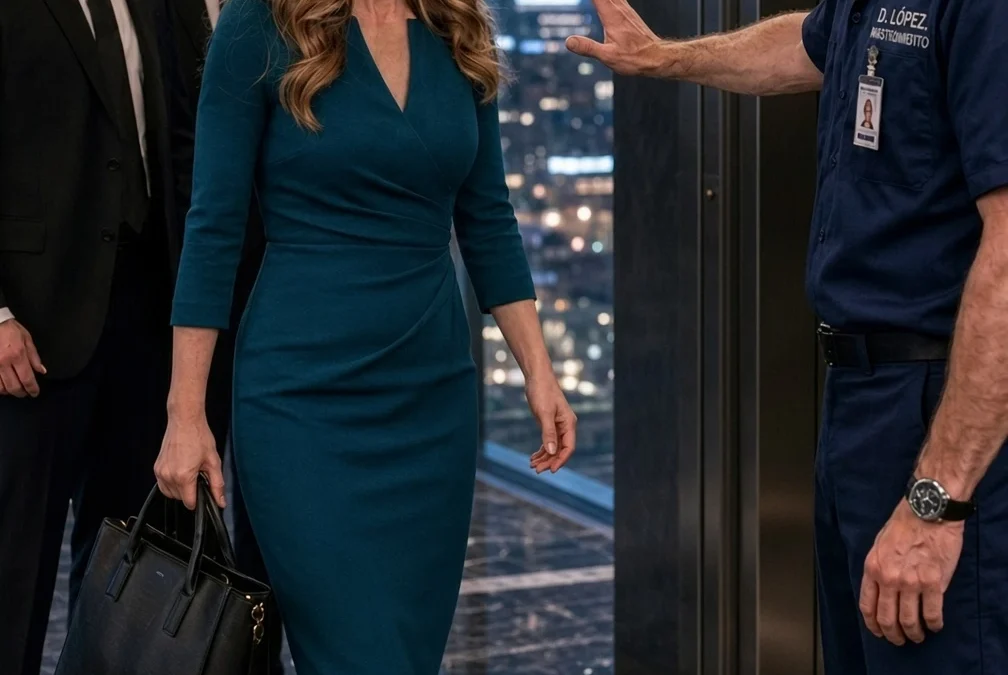
The polished Italian marble floors of the seventy-story Meridian Tower gleamed beneath suspended constellation chandeliers of hand-blown Bohemian crystal, casting cold, mirrored reflections of Elena Vance’s hurried strides. Her ivory silk-wool trousers moved with sharp, geometric precision, her four-inch stilettos striking the stone in a rapid, metronomic cadence that parted administrative aides, vice presidents, and legal retainers like water before an icebreaker.
At thirty-two, Elena was the youngest majority owner of an infrastructure and deep-sea logistics conglomerate in the northern hemisphere. She was a woman carved from pressure and ambition, who had transformed her late mother’s debt-ridden holding company into a three-hundred-billion-dollar sovereign contractor. Her ears were adorned with teardrop diamond solitaires that had once belonged to an Austrian archduchess, her wrist bound by a vintage gold Patek Philippe that counted down the seconds to the single most decisive moment of her life: the ten-o’clock formal signing of the transatlantic harbor integration pact with the Iberian Sovereign Syndicate. In her world, a delayed minute cost forty thousand dollars in clearing fees; an unassertive glance invite predators to the jugular. She did not negotiate on her knees, and she did not brook hesitation from the legions of tailored men who collected their bonuses from her pen.
She approached the private executive elevator bank at the eastern terminus of the atrium. Behind her, a nervous entourage of three junior partners carried heavy leather trial folders embossed with gold foil, checking their tablets while trying to match her relentless pace.
“Tell the European delegation that the maritime indemnity clause remains non-negotiable,” Elena said, her voice like cut glass, not bothering to look back. “If Sterling’s team wants a larger dividend cut on the Rotterdam port concessions, they can find it in their operational margins, not my equity.”
“Yes, Ms. Vance,” her chief counsel stammered, frantically typing. “Mr. Sterling has already taken his seat in the penthouse boardroom. The entire board of directors is assembled. They are merely waiting for your biometric verification to unlock the escrow accounts.”
“They will wait until I step out of the car,” Elena said, reaching the polished brass alcove of Car Alpha, the private express car lined with bird’s-eye maple and reinforced armor plate that ascended directly to the seventy-first floor without intermediate stops.
The bronze doors hissed open with a breath of cool, filtered ozone. The interior was pristine, carpeted in woven slate wool, the brass indicator light pulsing a gentle, welcoming green.
Elena stepped forward, her left foot lifting to cross the brass threshold.
From the recessed utility alcove three feet to her right, where a mop bucket and a gray fiberglass maintenance cart sat parked in the shadows, a sudden blur of navy fabric erupted.
A hand—massive, scarred, with knuckles like gnarled walnut burls and nails blackened by decades of hydraulic grease—shot through the seam of light. The grip closed around the silk lapel of her tailored ivory jacket like an iron jaw.
Before her security detail could draw breath, the figure twisted with terrifying, explosive leverage. Elena felt the air violently ripped from her lungs as her feet left the polished stone. She was dragged backward through the air, her shoulder striking the cold marble floor with a concussive thud that sent her designer purse skidding twenty feet across the lobby.
“Hey! Security!” her lead attorney shrieked, clutching his briefcase to his chest.
Elena scrambled to her elbows, her teeth bared, ready to demand the immediate execution or imprisonment of whoever had dared lay a finger upon her. But before she could scream, a heavy, suffocating mass crashed down atop her.
An elderly man in a faded, oil-spattered navy jumpsuit threw his entire body weight over her ribs, pinning her flat against the base of an octagonal marble support column. Plaster dust and the bitter smell of cheap chicory coffee, machine solvent, and coarse tobacco flooded her nostrils. A calloused, leather-hard palm slammed over her mouth, muffling her furious cry into a wet, strangled vibration.
Above her, hollow, storm-gray eyes sunken beneath thick, silver-shot brows bored into her pupils with a ferocity so ancient and lethal that the venom died instantly on her tongue.
“Do not move,” the janitor snarled through clenched teeth, his voice a jagged, rusted rasp that sounded like iron dragged across gravel. “Do not speak!”
Outrage flared in her veins like kerosene. She was Elena Vance. She commanded boards of governors, directed naval salvage fleets, and dismissed cabinet undersecretaries with a flick of her wrist. She dug her manicured nails into his scarred wrists, fighting to tear his suffocating hand from her lips, preparing to drive her knee into his groin and summon the four armed private security guards stationed at the turnstiles forty paces away.
Then, from the elevator shaft, came the sound.
It was not the hum of an electric motor or the gentle hydraulic sigh of a leveling valve. It was a high, shrieked lamentation of parting steel—an ear-splitting, mechanical scream that vibrated straight through the concrete foundation beneath her spine. High above, sixty floors in the vertical dark, four three-inch woven tungsten-steel hoist cables were severed simultaneously by explosive cutting charges.
A split second of dead, weightless silence followed.
Then, the roar of the sky falling.
The eight-ton reinforced steel elevator car plunged through sixty stories of empty air in pure, uninterrupted freefall, acting as a massive piston that compressed tens of thousands of cubic feet of air before it. The pressure wave hit the lobby first—a concussive blast of displaced wind that blew the velvet stanchions across the floor and shattered the decorative glass display cases along the north wall.
Elena’s eyes widened in sheer, paralyzed horror as the old man drove his weight down harder, tucking her head beneath the thick hollow of his collarbone, wrapping his scarred forearms around her skull like an iron helmet.
BOOM.
The impact was not a crash; it was a localized earthquake. The eight-ton car struck the sub-basement deceleration buffers with the kinetic energy of an artillery bombardment. The heavy bronze doors of Car Alpha blew outward into the atrium like shrapnel, torn from their tracks by the sheer force of the air displacement. Plumes of pressurized gray dust, pulverized asbestos, shredded wiring, and jagged shards of laminated safety glass detonated into the lobby, spraying across the marble in a lethal, horizontal hurricane.
A two-foot spear of tempered glass whistled through the exact coordinates where Elena’s chest had been positioned scarcely three seconds earlier, burying itself four inches deep into the plaster of the column beside her ear with a dull, vibrating thrum.
The concussive shockwave left the grand foyer in stunned, ringing silence.
The ceiling chandeliers swung erratically on their bronze chains, tinkling like broken bells, shedding crystal pendants that shattered on the debris-strewn floor. A dense, suffocating cloud of white pulverized drywall and vaporized grease hung in the air, blotting out the daylight from the street windows. From the yawning, mangled black throat of the elevator shaft rose a column of hot, chemical smoke that smelled of burned rubber and copper.
Elena lay motionless beneath the janitor’s chest, her heart hammering against her ribs with such violent velocity that her vision pulsed in dark, ragged waves. Her ivory pantsuit was blackened with soot, her diamond earrings tangled in her hair, her hands shaking so violently she could barely spread her fingers against the dust.
The old man slowly pushed himself up. He did not groan. He did not brush the white powder from his gray hair or the tears of dust from his eyes. His movements were calculated, economical, and eerily fluid for a man whose spine appeared curved by decades of manual labor.
Elena coughed, the plaster dust burning the back of her throat, her voice trembling as the sheer, staggering reality of her survival punched through her shock. “You… you pushed me… the cables…”
She looked at the mangled heap of twisted bronze and sheared girders that had been the executive lift. Had she taken that single step—had she crossed that threshold—her body would have been compressed into an unrecognizable paste of bone and silk at the bottom of the sump pit.
Tears broke past her aristocratic composure, carving clean lines through the white dust on her cheeks. She looked up at the weathered, lined face of the man kneeling beside her.
“My God,” she stammered, reaching out with a trembling hand, her instincts of wealth and patronage rushing to the surface to shield her from the horror. “You… you saved my life. I don’t… who are you? Tell me your name. The corporate office… I will write you a check right now. Five million dollars. Ten million. Whatever you want. A house… a pension for your family… you will never touch a broom for the rest of your natural life—”
The old man didn’t smile. He didn’t blink. He looked at her with eyes that were entirely dead to the concept of ten million dollars.
Without a word, he reached into the heavy leather pouch slung across his hip—the ordinary pouch where custodians carried spare keys, WD-40, and replacement nylon washers.
He drew out two objects and let them drop onto the marble floor between their knees.
The first was a pair of heavy, forged-steel industrial wire-cutters, their hardened jaws stained with fresh, pressurized blue hydraulic fluid from the elevator’s secondary governor brake.
The second was a small, matte-black military frequency scanner, its digital display scrolling rapidly through military-encrypted radio bands, locked onto an active local repeater frequency: 442.850 MHz — TAC-NET ALPHA.
Elena’s breath hitched in her throat. Her gaze flicked from the tactical radio to the old man’s face. “What… what is this?”
“The counterweight was rigged with thermite cutter tape, set to detonate on a remote radio pulse the instant the car cleared the fourth-floor optical sensor,” the janitor said. His voice was no longer that of a humble cleaner; it was flat, clipped, and possessed an icy, analytical cadence that belonged in a bunker beneath the Pentagon. “The governor cables were pinched three hours ago during the shift change. They didn’t want a drop; they wanted a burial. Nothing left to autopsy.”
Elena’s mind spun, struggling to reconcile the tool belt with the jargon. “An assassination? Who… who would do this? The Iberian investors are upstairs—”
“The Iberians aren’t upstairs, Elena,” the old man said softly.
He spoke her given name with a familiarity so intimate, so profound, that it struck her harder than the concussive blast of the elevator.
The janitor reached up with his rough, scarred thumb and wiped a streak of plaster dust from her cheekbone. The gesture was impossibly gentle, a touch from another lifetime that carried an electric shock of forgotten memory straight to the base of her skull.
“Look at me, Ellie,” he whispered.
The nickname.
Ellie.
No one had called her Ellie since she was twelve years old. Not her mother, who had died of ovarian cancer eight years ago. Not the headmasters at the Swiss boarding schools. Not the corporate sharks she had devoured on her way to the boardroom. Only one person had ever used that name—a man who used to carve small balsa-wood sailboats on the porch of a small lakeside cottage in Maine, a man who smelled of salt, cedar shavings, and gun oil.
Elena stopped breathing. Her vision focused through the white dust, past the deep crow’s-feet, past the crooked line of a nose that had been broken and reset without surgery, past the silver beard stubble and the scar that cut vertically through his left eyebrow.
The photograph. The silver-framed photograph that had sat on her mother’s nightstand until the day she died—the picture of a young, dark-haired captain in the United States Army Special Forces, smiles wide in the Carolina sun, holding a laughing, gap-toothed girl on his shoulders.
“Dad?” The word was scarcely more than a puff of dust in her throat. “No… no. You’re dead. The Department of Defense… they said you were killed in an interrogation facility in Qandahar. The wreckage… they gave us a sealed casket.”
“The Department of Defense buried an empty box of gravel, Ellie,” Marcus Vance said, his hand dropping from her face, his eyes hardening as he scanned the smoke-filled perimeter of the lobby. “Because twenty years ago, when I uncovered who was moving heroin and unregistered defense contracts through the ports in Karachi, the men who signed my deployment orders decided I was an inconvenient witness. They wiped my name, erased my service records, and handed my operational identity to a grave in Arlington.”
He looked at her, his jaw tightening until the muscle ticked.
“I stayed in the dark for two decades to keep the wolves away from you and your mother. As long as Marcus Vance was a dead traitor, nobody looked at his widow or his daughter. But six months ago, my old intercept relays flagged a high-dollar escrow deposit in an offshore bank in the Caymans. Two million dollars, split three ways, tied to an operational contract for an executive liquidation.”
Elena felt the marble beneath her turn into thin ice. “The merger… the board…”
“Julian Sterling didn’t invite the Iberians to buy your shipping routes, Ellie,” Marcus said, his eyes narrowing as he unzipped his navy jumpsuit, reaching into the lining to pull out a compact, suppressed Sig Sauer P229 and three spare magazines. “He invited them to divide the carcass. Under Section 14 of your company’s corporate governance charter, if the primary shareholder suffers catastrophic accidental death prior to the finalization of the fiscal year, all voting rights revert to the executive oversight committee. Sterling doesn’t need your signature. He just needed your death certificate.”
Before Elena could speak, before the twenty years of grief, fury, and betrayal could pour from her lips, the high-pitched hum of the lobby’s central fire alarms abruptly died.
The strobing white emergency lights went black.
High above, on the ceiling of the grand atrium, the heavy iron louvers of the smoke vents slammed shut with an echoing, pneumatic crash. The exterior revolving glass doors clicked, their electromagnetic locking pins sliding into place with the dull, definitive sound of a vault sealing shut.
From the central emergency fire stairwell thirty yards away, the heavy fire-rated steel door swung open.
Through the drifting haze of white plaster dust stepped four figures.
They wore sterile black combat fatigues without national insignia or agency patches, lightweight Kevlar helmets fitted with panoramic night-vision tubes, and load-bearing vests carrying high-capacity magazines. In their gloved hands, they held suppressed submachine guns with laser-aiming modules already casting thin, emerald lines through the smoke.
They moved with the silent, rhythmic economy of professional hunters who had walked through hundred-room clearing operations in foreign capitals.
The radio scanner on the floor let out a tiny, static-laced burst:
Car is down. Target confirmed in the concourse. Clean the lobby. No witnesses among the staff.
Elena’s heart seized. She looked at the four armed silhouettes advancing through the white fog, then at her attorneys and the two lobby security guards who lay groaning amidst the rubble fifty feet away, completely unarmed and defenseless.
“They’re going to kill everyone,” she breathed.
Marcus didn’t hesitate. The posture of the broken night janitor vanished completely, replaced in a microsecond by the terrifying, lethal machinery of a former special operations team leader.
He grabbed Elena by the collar of her ruined ivory coat, his legs driving with explosive, hydraulic power, hauling her behind the thick, three-foot granite barrier of the central decorative fountain just as the first suppressed burst tore through the smoke.
PHT-PHT-PHT-PHT.
Subsonic rounds chewed through the marble pillar where they had been sitting a second earlier, throwing plumes of powdered stone and sparking off the reinforced steel rebar.
The two corporate attorneys who had been crawling toward the street doors shrieked as a second burst raked across the floor, stitching a neat line of holes through the leather briefcases and dropping them motionless into the dust.
“Keep your head below the granite coping,” Marcus whispered into her ear, his breath cool, steady, and entirely free of panic. “Breathe through your nose. Don’t look at the flashes.”
He reached into his pocket, pulled out a small, glass ampoule of industrial ammonia from his cleaning kit, snapped the neck between his fingers, and rubbed the sharp, pungent chemical beneath his nostrils to clear the dust from his sinuses. He offered it to her, his gray eyes unyielding.
Elena took a sharp sniff; the burning gas hit her brain like an electric shock, incinerating the paralyzing fog of terror, replaced by an icy, desperate clarity.
“They have the exits,” she whispered, her hands balling into fists against the wet granite of the fountain. “The building has a Level-Four architectural security lockdown. The windows are three-inch laminated ballistic poly-carbonate. You can’t break them with a sledgehammer. The elevators are all grounded, and the master override is in the penthouse.”
Marcus dropped the empty magazine from his pistol, checked the top round of the fresh magazine, and slammed it home with the heel of his scarred palm.
“Then we aren’t going out, Ellie,” Marcus said softly, a dark, terrifying smile touching the corner of his weathered mouth. “We’re going up.”
The tactical reality inside the Meridian Tower was an absolute meat-grinder.
The lobby was an eighty-foot-wide kill-zone with zero organic cover between the fountain and the street facade. The four mercenaries—operators from the Kestrel Private Risk Consortium, a deniable wetwork outfit recruited from former eastern bloc special units—had established a textbook bounding-overwatch formation. Two shooters knelt behind the reception counter, laying down suppressive fire with subsonic 9mm armor-piercing rounds, while the other two advanced along the eastern and western flanks to encircle the fountain.
Marcus leaned his back against the granite, his breathing rhythmic and deep. He pulled an old brass Zippo lighter from his jumpsuit pocket, flicked the wheel, and tossed the burning lighter into the pool of lubricating oil that had spilled from the elevator’s crushed hydraulic reservoir five feet to their left.
WHOOSH.
A four-foot wall of thick, oily black smoke erupted along the base of the fountain, billowing upward to merge with the white plaster dust, creating a thermal blindness that rendered the mercenaries’ infrared optics useless.
“Move,” Marcus commanded.
He didn’t run for the fire doors; he dragged Elena toward the narrow service hatch set flush into the floor behind the maintenance alcove—the access conduit for the building’s central vertical pneumatic trash chute and hydraulic bypass risers.
He kicked the iron latch free, hauled the circular hatch open, and shoved her through the opening feet-first into the darkness of the service tunnel below, dropping in behind her just as a hail of submachine-gun fire pulverized the rim of the hatchway, showering their hair with sparks and molten lead.
They hit the metal catwalk of the intermediate mechanical level six feet below with a heavy clang.
The subterranean air was hot, smelling of recirculated air-conditioning coolant, grease, and ozone. Above them, the heavy steel hatch slammed shut, and Marcus jammed an iron maintenance spanner through the locking lugs, buying them precious minutes.
Elena leaned against the galvanized ductwork, her chest heaving, her ivory trousers torn at the knees, her hands black with soot. She looked at the man who had abandoned her childhood to the cold halls of boarding schools and corporate courts—a father who had returned from the dead not with open arms and an apology, but with a smoking pistol and the cold efficiency of an executioner.
“Why?” The word ripped from her throat, sharp, bitter, and drenched in twenty years of unhealed agony. “Why now? If you were alive… if you could survive whatever hell they put you in… why did you leave me alone? Do you know what they did to Mom? Do you know how many nights she sat by the telephone waiting for an agency that never called?”
Marcus stopped in the narrow beam of his small pocket torch. The white LED illuminated the deep, terrible scars that ran along the side of his neck and disappeared beneath the collar of his navy uniform—burn scars from electrical cattle prods, the thick keloids of untreated shrapnel wounds, and the notched tissue where a rifle bullet had taken the tip of his left collarbone.
“Because the men who ordered the hit on me twenty years ago weren’t strangers, Ellie,” Marcus said, his voice dropping into a register so dark it made the metal walls feel like a tomb. “They were your mother’s brothers. The Sterling family. Julian’s father.”
Elena froze, the blood draining from her face until she looked like an ivory statue in the beam of the flashlight. “Uncle Thomas? Julian’s father was my mother’s brother… he gave the eulogy at your memorial service.”
“He gave the eulogy, and he collected three million dollars from the naval logistics syndicate that bought our family’s original transport patents,” Marcus said, his eyes locking onto hers with unblinking certainty. “Your mother knew. That’s why she took you and moved away from the estate. She spent eight years fighting their legal injunctions to keep the Vance assets in your name. She made me swear on her life that I would never show my face until you had the majority shares in your hands, because as long as I was dead, their legal claims were tied up in probate.”
He stepped closer, his rough, calloused fingers gently catching her wrist, lifting her hand so she could see the trembling diamond bracelet that still clung to her sleeve.
“Your mother died holding my hand in that clinic, Ellie,” Marcus whispered, his voice cracking slightly, the only crack in his armor she had seen all morning. “I was in the room. Disguised as an orderly. She looked at me, and she told me: ‘Keep her alive, Marcus. She is better than all of them. Don’t let them take her light.’“
He released her hand, turning his gaze toward the vertical maintenance ladder that disappeared into the sixty-story utility shaft beside them.
“I took this job with the night cleaning crew six months ago because Julian Sterling finalized the Iberian merger contract,” Marcus said, racking the slide of his Sig Sauer. “I knew the moment the papers were drawn, they would clear the board. You aren’t walking into a business meeting upstairs, Ellie. You’re walking into a slaughterhouse. And the only way out of this tower is through the men who ordered it.”
Elena closed her eyes.
The boardroom meetings, the sudden shifts in proxy votes, the late-night calls from Julian urging her to finalize the asset transfers before the annual audit—all the pieces of the puzzle that had felt slightly misaligned over the past six months snapped together with the terrifying, deafening finality of a closing trap.
Julian hadn’t invited the Iberian syndicate to expand their company. Julian had sold the company’s maritime infrastructure to a foreign cartel, and Elena’s signature was the final obstacle. With her dead, the board would declare an emergency receivership, sign the transfer protocols, and divide fifty billion dollars in sovereign payoffs before the stock market opened at two o’clock.
She opened her eyes. The tears were gone.
The fear, the grief, and the twenty years of orphanhood hardened into an unyielding, predatory resolve that matched the steel in her father’s spine. She was Elena Vance. She was the daughter of a master operative and an indomitable mother, and she had not built an empire to die like an animal in a utility pipe.
She reached down, took off her four-inch designer heels, and snapped the slender wooden spikes off against the iron catwalk, turning the expensive shoes into flat leather slippers. She tore the silk sleeves from her ruined ivory jacket, freeing her arms for climbing, and looked up at the vertical iron rungs disappearing into the dark.
“There’s an optical server hub on thirty-four,” Elena said, her voice dropping into the cold, authoritative tone that had broken corporate strikes in three ports. “The building’s secondary security sub-station is located behind the fire dampers. If I can reach the central multiplexer, I can bypass the local telecom blackout and patch a live satellite feed straight to the federal securities commission and the metropolitan police commissioner’s personal desk.”
Marcus looked at her, a faint, proud gleam cutting through the hard lines of his face.
“Thirty-four floors is a long climb, Ellie,” he said.
“Then you better keep up, old man,” she replied, planting her hands on the iron rungs and hauling herself into the vertical dark.
The climb through the central service core of the Meridian Tower was an endurance trial through a mechanical inferno.
Every five stories, the massive vertical air-conditioning ducts roared with pressurized drafts that threatened to tear their fingers from the frost-covered iron rungs. Above them, the elevator cables hummed with tension as the secondary service cars were mobilized by the strike team.
On floor twenty-two, the metal ladder shuddered.
Marcus looked down through the iron grating between his boots.
Two hundred feet below, through the gloom of the shaft, two pencil-thin red laser lines were scanning upward along the structural beams. The Kestrel team had breached the mechanical basement; they were ascending via the counterweight service ladders using motorized ascenders, moving at four times their climbing speed.
“They’re on the wire,” Marcus said calmly, reaching into his tool belt.
He withdrew a four-inch brass pipe fitting, a roll of high-voltage electrical friction tape, and a small, gray block of C-4 demolition putty he had kept concealed inside the false base of his custodial floor waxer on the twenty-sixth floor. He inserted an electronic blasting cap wired to a mechanical tripwire, wrapped the assembly around the rung beneath his feet, and hooked the monofilament line across the gap to the main chilled-water line.
“Don’t look down,” Marcus told her. “Keep your rhythm. Four rungs at a time.”
They reached the thirty-fourth-floor maintenance portal fifteen seconds before the ascenders cleared the twentieth floor.
Marcus hauled the heavy steel access hatch open, pulled Elena through onto the carpeted floor of the server sub-station, and let the heavy fire door drop shut.
KABOOM.
A muffled, concussive subterranean thump reverberated through the steel deck beneath their feet. The utility shaft acted as an acoustic horn, carrying the screech of twisted iron, the violent hiss of ruptured three-hundred-pound steam lines, and the brief, agonized scream of an operative whose ascender had been shredded by the fragmentation wave.
The secondary air dampers throughout the building snapped shut with pneumatic thuds, trapping the super-heated vapor inside the vertical shaft.
“One down,” Marcus muttered, his face impassive as he latched the server room door with an iron crowbar.
The room was vast, an eerie labyrinth of seventy black server racks glowing with pulsing blue and green fiber-optic arrays, cooled by high-capacity ceiling units that hummed at sixty decibels.
Elena did not hesitate. She dropped to her knees before the primary terminal console, ripped her diamond earring from her ear, and used the sharp platinum post to pop the security seal on the local maintenance port.
She plugged her encrypted corporate smartphone directly into the mother-bus, her fingers flying across the virtual terminal with the blinding speed of an architect who had personally approved the security architecture of the entire tower.
“Bypassing local domain servers,” Elena muttered, her eyes reflecting the blue glow of cascading code. “Sterling’s team rerouted the exterior satellite uplinks through a commercial proxy in Panama. They’ve placed the building under a virtual quarantine… wait.”
Her hands froze over the glass.
On the high-resolution monitor above the console, three live video feeds popped onto the screen.
The first was the penthouse boardroom on the seventy-first floor.
Gathered around the oval mahogany table were twelve men in bespoke dark suits—the executive board of Vance Global Logistics. At the head of the table sat Julian Sterling, her forty-year-old first cousin, holding a crystal glass of scotch, laughing with the lead representative of the Iberian Sovereign Fund. On the wall-mounted presentation display, a live digital document was open: VANCE INFRASTRUCTURE ASSET LIQUIDATION & RECEIVERSHIP DIRECTIVE.
The second feed was the lobby concourse.
Elena’s two corporate attorneys lay motionless on the bloody marble floor. Standing over them were three city police officers wearing high-visibility vests—officers who were not drawing their weapons, but were calmly rolling out yellow crime-scene tape and waving off civilian traffic from the street outside, reporting over their vehicle radios that a catastrophic cable failure had compromised the building’s lower lobby.
The local authorities were in Sterling’s pocket. The perimeter was sealed under the guise of an industrial accident.
The third feed was the interior of the private penthouse express staircase.
Ascending the carpeted stairs from the sixty-eighth floor was a team of four more Kestrel operators, their suppressed rifles slung low, clearing the executive suites room by room.
“They aren’t just covering their tracks, Dad,” Elena said, her voice shaking with an unvarnished fury that made the glass screen vibrate. “They’ve already filed the emergency succession paperwork with the state probate registrar. The notification of my accidental death was pre-dated to nine-forty-five this morning. If this merger document is digitally signed by Julian before noon, the foreign holding companies take legal possession of the Atlantic deep-water terminals. It’s an irreversible transfer under international maritime maritime treaties.”
Marcus leaned over her shoulder, his eyes tracking the network topology displayed on the lower monitor.
“Can you kill their connection from here?”
“No,” Elena said, her teeth grinding together. “The master cryptographic key isn’t stored in this subnet. It’s locked inside the biometric executive terminal in the penthouse desk. To abort the transfer, my physical right thumb has to touch the optical scanner in the center of that boardroom table.”
She looked at her father.
“We have to go to the seventy-first floor.”
Marcus looked down at his Sig Sauer. He pulled the magazine, counted the remaining nine-millimeter rounds, and clicked it back into the well. Eleven rounds in the magazine, one in the chamber.
“The utility risers are flooded with super-heated steam from the charge I blew,” Marcus said, his voice flat. “The express elevators are destroyed. The fire stairs are guarded by at least six heavy shooters with night-vision and body armor.”
Elena stood up. She pulled her hair back, twisting it into a tight, severe knot at the nape of her neck, tying it off with a strip of black friction tape from his tool belt. Her ivory pantsuit was ruined, her skin smudged with soot and blood, but in the blue glow of the server racks, she looked like an avenging fury carved from diamond.
“Then we don’t take the stairs,” Elena said, her gaze locking onto the high-pressure window overlooking the exterior western facade. “We take the window-washing gantry.”
The gale outside the thirty-fourth floor was screaming at forty-five knots off the Atlantic, carrying needle-sharp pellets of freezing rain that blurred the city below into a gray abyss of cloud and steel.
Marcus kicked the exterior emergency maintenance portal open, and the sub-zero wind roared into the server room like an unleashed animal.
Mounted to the exterior structural tracks along the building’s glass skin was the primary high-altitude maintenance gantry—an eighty-foot aluminum platform suspended from two motorized high-tensile steel cables, used by the exterior glass-cleaning crews to service the floor-to-ceiling curtain walls.
Elena stepped out onto the swaying aluminum mesh platform, the wind instantly tearing at her silk blouse, the dizzying drop of four hundred feet yawning beneath her bare leather soles. She did not look down. Her fingers clamped around the galvanized safety rail with an iron grip that turned her knuckles chalk-white.
Marcus stepped out behind her, secured the platform’s secondary safety brake with an iron pin, and reached for the manual control box.
“This rig is geared for five feet per second,” Marcus shouted over the shrieking wind, his hair whipped wild by the gale. “At this rate, it will take us six minutes to reach the penthouse terrace. Once we clear the fiftieth floor, we will be in plain sight of the boardroom windows.”
“Then we make sure they’re looking the other way,” Elena yelled back, pointing toward the heavy commercial solvent tanks mounted to the gantry’s cleaning manifold.
Inside the tanks were two hundred gallons of industrial-grade, alcohol-based glass-cleaning compound—highly volatile, pressurized, and flammable.
Marcus looked at the tanks, then at his Zippo lighter, and a slow, terrifying smile broke across his scarred face.
He engaged the heavy electric winch.
With a deep, mechanical groan of steel gears against high-tensile wire, the gantry lifted off its safety brackets and began its vertical crawl up the sheer glass face of the seventy-story monolith.
The city fell away beneath them.
The gray clouds wrapped around the platform like wet cotton, blinding them in a swirling vortex of mist and freezing rain. Thirty-eight. Forty-two. Fifty floors.
At the sixty-second floor, the gantry broke through the ceiling of the low storm clouds into the bright, blinding glare of the high-altitude morning sun.
Above them, rising like a jagged obsidian spear into the azure sky, was the three-story glass crown of the penthouse boardroom.
Through the floor-to-ceiling windows of the seventy-first floor, Elena could see them: Julian Sterling standing with a crystal champagne flute, surrounded by the eleven board members, raising a toast as an administrative assistant placed a leather-bound document folio onto the center of the mahogany table.
A sudden, sharp crack echoed above the wind.
CRACK.
A high-velocity sniper round punched through the aluminum floorplate of the gantry three inches from Elena’s foot, sending jagged metal shards whistling through the air.
On the western observation terrace of the sixty-ninth floor, two Kestrel mercenaries in cold-weather tactical gear had spotted the ascending platform. One was kneeling behind a suppressed bolt-action rifle; the other was leveling a short-barreled automatic carbine.
“Down!” Marcus roared.
He threw his massive body over Elena once more, slamming her against the floor of the gantry, his left hand reaching up to haul the manual solvent purge valve wide open.
Two hundred gallons of high-pressure, eighty-percent isopropyl alcohol mist erupted from the gantry’s spray nozzles, blown backward by the forty-knot wind directly toward the sixty-ninth-floor terrace in a massive, aerosolized cloud of vapor.
Marcus leaned out over the safety rail, brought his Sig Sauer to bear with one hand, and fired three rounds into the terrace’s decorative gas-fired heating pylons.
BOOM.
The spark met the alcohol cloud in a blinding, concussive fireball that rolled across the exterior glass of the upper ten floors. The intense heat shattered the secondary laminated panes of the sixty-ninth-floor terrace, throwing the two mercenaries backward into the interior office in a whirlwind of flame and melting synthetic fabric.
The shockwave snapped the gantry’s left hoist cable.
With an ear-splitting screech of sheared steel, the eighty-foot platform tilted violently onto a forty-five-degree angle, dangling over the thousand-foot drop by a single three-inch steel wire.
Elena shrieked as her feet slipped off the wet aluminum deck, her body sliding toward the open sky.
Marcus lunged.
His scarred left hand caught the galvanized safety stanchion, his boots locking into the gear-teeth of the winch housing, while his right arm shot out over the abyss, his fingers clamping around Elena’s wrist with a grip that bruised bone.
She dangled between heaven and earth, her hair whipped by the hurricane-force draft, looking down into seven hundred feet of empty air and the tiny, toy-like cars crawling along the avenues below.
“Ellie!” Marcus roared, his neck veins bulging like thick cables against his skin, his left shoulder screaming in agony as the old shrapnel wounds tore beneath his flesh. “Look at me! Look at my eyes!”
Elena forced her gaze upward, past the sheer glass drop, past the black smoke of the burning terrace, straight into the gray, storm-hardened eyes of her father.
“I’ve got you,” Marcus grunted, his teeth bared in a savage snarl of absolute, unbreakable will. “I’m not letting go! I will never let you drop again! Swing your left leg! Catch the terrace parapet!”
Elena looked up at the stone balustrade of the seventy-first-floor penthouse terrace, dangling scarcely two feet to her left.
She did not hesitate. She gathered every ounce of strength, every drop of Vance blood that ran in her veins, and swung her body with the rhythm of the wind. Her scuffed leather shoe caught the lip of the concrete molding; she hauled herself upward, her fingers digging into the limestone joints, and pulled herself over the rail onto the wet flagstones of the executive terrace.
Marcus followed.
Using the single remaining cable like a climbing line, the sixty-year-old operative scaled the tilted frame of the ruined gantry, leaped across the void, and landed heavily upon the terrace stones, rolling into a defensive crouch with his weapon drawn.
They stood outside the towering double glass doors of the boardroom.
Inside, the crystal champagne flutes had been dropped.
The twelve members of the board of directors and Julian Sterling were staring through the glass with eyes wide in paralyzed, disbelieving horror, looking at the two specters who had climbed out of the smoke and the grave to stand upon their balcony.
Elena did not knock.
Marcus raised his heavy steel work boot and kicked the center mullion of the reinforced glass doors with the kinetic force of a battering ram.
CRASH.
The tempered glass shattered into ten thousand glittering diamonds, showering the Persian rugs of the boardroom with sharp, crystalline shrapnel.
Elena Vance stepped through the broken frame.
She wore no diamonds. Her ivory suit was shredded, stained with black oil, soot, and her own blood. Her hair was wild, her bare feet bleeding from the glass, her face a terrifying mask of righteous, sovereign fury.
Behind her, filling the doorway like an iron colossus of the past, stood Marcus Vance, the suppressed Sig Sauer leveled at the center of Julian Sterling’s forehead.
The room went dead silent.
Julian Sterling took three staggering steps backward, knocking his leather armchair against the mahogany credenza, his face turning an alarming shade of curdled milk, his hands trembling so violently that the gold pen in his hand clattered across the table.
“Elena…” Julian stammered, his voice rising into a shrill, hysterical squeak. “You… you were in the car… the news reported… the cable broke…”
“The cable didn’t break, Julian,” Elena said, her voice quiet, clear, and carrying the absolute, unyielding density of an executioner’s gavel. “You cut it.”
She walked toward the center of the table. The twelve directors—men who had managed billions of dollars and commanded armies of lobbyists—cowered backward against the wood-paneled walls, raising their hands in pathetic, trembling gestures of surrender.
Julian looked past her, his eyes locking onto the scarred, gray-haired man standing in the doorway holding the smoking pistol.
A sudden, chilling realization detonated in Julian’s brain. His jaw dropped, his knees wobbling beneath his bespoke trousers.
“Uncle… Uncle Marcus?” Julian whimpered, his voice cracking into pure, unadulterated madness. “No… no, you died in Pakistan… we had the certificate… my father verified the burial…”
“Your father was a thief, Julian,” Marcus said, his voice flat, steady, and devoid of the slightest flicker of mercy. “And he raised a coward.”
Elena reached the head of the mahogany table.
She looked down at the document lying open before the executive chair: the three-hundred-million-dollar receivership transfer, assigning all naval logistics assets to the Iberian shell syndicate.
Beside the document sat the high-resolution biometric scanner—the glowing blue glass plate that controlled the sovereign cryptographic keys to Vance Global’s global infrastructure empire.
Elena brought her right thumb down onto the scanner.
BEEP.
A pleasant, automated synthetic voice chimed from the overhead audio monitors:
BIOMETRIC AUTHENTICATION CONFIRMED: ELENA VANCE, PRIMARY TRUSTEE.EMERGENCY EXECUTIVE OVERRIDE ENGAGED.LOCAL TELECOM QUARANTINE: TERMINATED.SATELLITE DOWNLINK TO FEDERAL TRADE COMMISSION AND DEPARTMENT OF JUSTICE: LIVE.
On the panoramic wall displays around the boardroom, the blacked-out screens suddenly flickered to life.
Appearing across twelve high-definition monitors simultaneously were the faces of the Regional Director of the Federal Bureau of Investigation, the United States Attorney for the Southern District, and the commanding admiral of the Coast Guard Maritime Logistics Directorate—all patch-routed through Elena’s emergency fail-safe channel.
“Gentlemen,” Elena said, her eyes never leaving Julian’s disintegrating face. “I am transmitting a real-time digital forensic log of three offshore wire transfers executed by Julian Sterling and the eleven individuals in this room, totaling six hundred million dollars in unlawful bribes, along with the mechanical telemetry confirming the intentional detonation of the Car Alpha elevator cables.”
She looked at her cousin, her lips parting in a cold, merciless smile.
“Arrest every single person in this room for high treason, attempted capital murder, and corporate espionage. And ensure they are held without bail.”
Julian let out a strangled, breathless shriek, lunging toward the open drawer of the credenza where an ivory-handled snub-nosed revolver sat nestled in velvet.
CRACK.
A single nine-millimeter round tore through Julian’s right shoulder, spinning him halfway around and slamming him hard against the plate-glass window, his weapon skittering uselessly across the Persian rug.
Julian slumped to the floor, clutching his bleeding arm, weeping and groveling in the dust like a broken child.
“Don’t shoot!” Julian wailed, his tears washing clean channels through the soot on his cheeks. “Elena… please… we’re family! Your mother was my aunt! We shared the same blood!”
Elena walked over to him.
She stood towering above him, her cold gray eyes looking down upon the architect of her destruction with the total, unshakeable contempt of an empress surveying a worm.
“My family,” Elena said softly, every word falling like an iron spike through his chest, “died twenty years ago to protect this empire from men like you. And he just walked back from the grave to collect the debt.”
Behind them, the fire stairwell doors were kicked open.
Dozens of federal tactical agents in green body armor, accompanied by uniformed state police officers, poured into the penthouse boardroom with rifles raised, their tactical boots crunching over the shattered glass.
“Drop your weapons! Federal agents! On the ground! All of you, down!”
Marcus did not wait to be shouted at.
He smoothly dropped the magazine from his Sig Sauer, ejected the chambered live round into his palm, and laid the disassembled pistol onto the mahogany table. He raised his hands slowly, stepping back against the terrace doors, his face impassive, ready to submit to the bureaucratic machinery he had eluded for two decades.
Elena turned instantly.
She stepped between her father and the wall of federal rifles, her chin held high, her voice ringing across the seventy-first floor with an authority that stopped forty federal agents dead in their tracks.
“Lower your weapons,” Elena commanded.
The lead FBI special agent paused, blinking in confusion at the soot-blackened billionaire heiress standing barefoot in shredded silk. “Ma’am… step aside. That man is an armed combatant—”
“That man is Captain Marcus Vance, United States Army Special Forces, retired,” Elena said, her voice trembling with an emotion so fierce, so majestic, that it brought absolute silence to the shattered room. “He is my father. He is the master security consultant who just neutralized an illegal corporate terrorist cell and saved my life. You will not touch him. You will not handcuff him. And if you have any questions regarding his status, you will direct them to my personal legal counsel, who will present his full military reinstatement orders signed by the Secretary of Defense before sunset.”
The agent looked at the iron-spined woman, then at the scarred veteran standing in the navy janitor’s uniform behind her, and slowly lowered his carbine.
“Yes, Ms. Vance,” the agent murmured, nodding to his men to secure the cowering board members.
As the agents moved in with flex-cuffs, dragging Julian Sterling and the weeping directors toward the service lifts, the storm clouds outside the high terrace broke completely apart.
A blinding, golden shaft of midday autumn sunlight poured through the shattered glass doors, bathing the ruined boardroom in warmth and light.
Elena stood motionless for a long, quiet second, listening to the sirens wailing sixty stories below on the city streets—the sound of an empire being purified by fire.
She turned to face the man in the stained navy jumpsuit.
Marcus stood with his arms hanging at his sides, his shoulders slightly rounded once more, his weathered face catching the golden sunlight. The terrifying predator was gone; in his place stood an old soldier who had spent twenty years in the cold, looking at his daughter as if he had no right to stand in her presence.
“Ellie,” Marcus said softly, his voice cracked with a lifetime of buried sorrow. “I… I can go now. The evidence is secured. The syndicate is broken. You don’t need a ghost hanging around your glass house.”
Elena looked at his scarred hands.
She looked at the calloused knuckles that had held her as an infant, that had wiped the dust from her cheeks in the lobby, that had held her weight over seven hundred feet of empty air without ever slipping.
A single, clean sob tore from her throat.
She didn’t care about the sixty federal agents watching. She didn’t care about the blood on her feet, the soot on her clothes, or the cameras that would be waiting at the bottom of the tower.
Elena lunged forward, throwing her arms around the old man’s neck, burying her face into the rough, oil-stained cotton of his jumpsuit, weeping with all the fierce, desperate, unhealed agony of the twelve-year-old girl who had waited twenty years for her father to come home.
Marcus froze for a fraction of a second, his body trembling beneath the weight of her touch.
Then, his massive, scarred arms came up, wrapping around her shoulders like an impenetrable shield of iron and leather, pulling her small, shaking frame tightly against his chest, burying his face in her dark hair as great, silent tears finally broke past his guard and soaked into her collar.
“I’ve got you, Ellie,” the old soldier wept softly against her cheek, his voice steady, warm, and home at last. “Daddy’s got you. And I’m never leaving again.”
Outside the high glass walls of the Meridian Tower, the city stretched toward the horizon, vast, vibrant, and reborn beneath the clear blue sky, while inside the ruins of her empire, the daughter of Marcus Vance held the only treasure that had ever truly mattered.
(𝐷𝑖𝑠𝑐𝑙𝑎𝑖𝑚𝑒𝑟: 𝑇ℎ𝑖𝑠 𝑐𝑜𝑛𝑡𝑒𝑛𝑡 𝑚𝑎𝑦 𝑏𝑒 𝑐𝑟𝑒𝑎𝑡𝑒𝑑 𝑏𝑦 𝐴𝑙 𝑓𝑜𝑟 𝑒𝑛𝑡𝑒𝑟𝑡𝑎𝑖𝑛𝑚𝑒𝑛𝑡 𝑢𝑟𝑝𝑜𝑠𝑒𝑠. 𝐴𝑛𝑦 𝑟𝑒𝑠𝑒𝑚𝑏𝑙𝑎𝑛𝑐𝑒 𝑡𝑜 𝑟𝑒𝑎𝑙 𝑝𝑒𝑟𝑠𝑜𝑛𝑠, 𝑒𝑣𝑒𝑛𝑡𝑠, 𝑜𝑟 𝑝𝑙𝑎𝑐𝑒𝑠 𝑖𝑠 𝑐𝑜𝑖𝑛𝑐𝑖𝑑𝑒𝑛𝑡𝑎𝑙.)