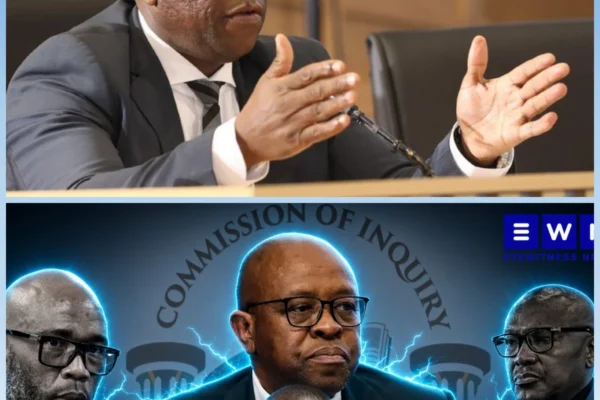
BREAKING: POLICE ASSET DISCLOSURES UNDER SPOTLIGHT | PSC NAMES GENERAL KHAN AT MADLANGA COMMISSION

Explosive State Inquiry Exposes Systematic Integrity Failures And Shocking Departmental Inefficiencies Crashing South Africa Administration

A high-stakes national inquiry has laid bare a staggering web of institutional decay, unmasking severe administrative vulnerabilities that compromise the structural foundation of the nation’s public sector.
Formal proceedings commenced with the official swearing-in of critical evidence, confirming that every statement and opinion submitted represents verified operational reality.
Commissioners immediately established that the central proposition of the Public Service Commission centers on examining the criminal justice system as an interconnected public administration network.
Official testimony established that a primary failure at the initial recruitment stage inevitably transforms into a command accountability collapse further down the operational line.

Investigative findings confirm that a single poor appointment escalates into a severe integrity risk, while weak performance management allows sheer operational incapacity to persist unchecked across state entities.
Subversive political intrusion into public administration actively weakens professional judgment, while fragmented information systems intentionally conceal emerging institutional risks.
Failure to enforce consequence management normalizes widespread misconduct, creating a systemic loop where inadequate parliamentary follow-up allows administrative collapses to recur endlessly.
The Public Service Commission presented its core evidence through three distinct structural themes designed to unmask the systemic rot.
Theme one addresses a comprehensive assessment of the criminal justice system, spanning personnel practices, professionalization, performance metrics, ethics, financial disclosures, and rule-based compliance cultures.
Theme two focuses intensely on the political-administrative interface, emphasizing the urgent need to preserve democratic executive authority alongside a continuous, professional administration.
Theme three targets parliamentary oversight, demanding an unbroken accountability chain that does not terminate simply because an oversight body issues a report or formal recommendation.

Evidence submitted under Section 195 of Chapter 10 of the Constitution proves that promoting professional ethics must remain at the absolute center of public administration across national, provincial, and local government tiers.
Investigators exposed a widespread culture of superficial conformance, where public officials simply master the art of completing reporting templates rather than fulfilling their constitutional mandate.
Public Service Commission officials revealed that current financial disclosure protocols operate as a fundamental misnomer, advocating for a shift toward comprehensive asset disclosures used in international jurisdictions.
Verification teams confirmed that official financial disclosures have devolved into performative box-ticking exercises where formal red flags submitted to cabinet ministers trigger zero administrative action.
A explosive case study exposed severe asset discrepancies during the verification of top law enforcement leadership, specifically regarding police commissioner General Khan.
Official data from Hinatis verified that while physical tracking showed a single vehicle, formal asset declarations submitted by General Khan listed multiple vehicles, exposing massive reporting variances.
Auditors unmasked a complete failure inside departmental ethics offices, where ethics personnel passively accept conflicting disclosures without coordinating with risk management officers.

The inquiry exposed shocking conflicts of interest within high-level law enforcement, highlighting cases where active personnel operating in organized crime units simultaneously own private vehicle body shops where stolen cars are processed.
Public Service Commission leadership confirmed that cabinet ministers routinely respond to serious conflict-of-interest warnings with generic promises to look into the matter, after which all official action permanently ceases.
Testimony formally identified this phenomenon as a “political economy of inefficiency,” proving that public sector inefficiency is actively designed by intent rather than occurring by default.
State departments deliberately manipulate public metrics by lowering internal performance targets to artificially overachieve on paper while the lived experience of citizens continues to collapse.
Addressing systemic legislative paralysis, officials revealed that the newly signed Public Service Commission Act required a staggering 19 years to pass after being initialed in the 2007 Kada Small report.
Despite explicit cabinet endorsements in 2011 and formal inclusion in Chapter 13 of the 2012 National Development Plan, political figures deliberately “hurried slowly” to delay institutional independence.
Under the previous framework, the Director General heading the Public Service Commission secretariat was appointed by the Minister of Public Service and Administration—the very minister the commission was tasked to oversee.
This structural conflict forced the Public Service Commission Chairperson into a perpetual voting minority on panel appointments, granting the executive absolute authority over the constitutional watchdog.
The newly enacted legislation finally separates the commission from government departments, expanding its oversight powers to include local government structures, state entities, and state-owned enterprises.
Section 13 of the new Act establishes a legal framework making Public Service Commission rulings legally binding, effectively stripping corrupt officials of the ability to ignore oversight directives.
Copyright: