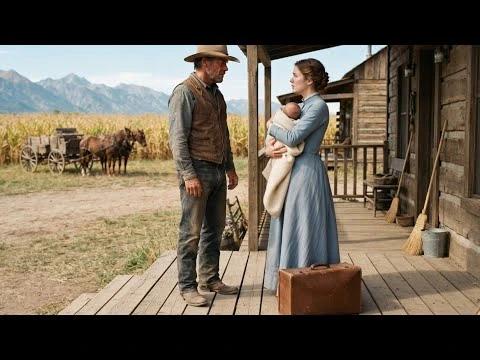
Everyone Called Him Poor.
.
.
They Had No Idea He Owned 40,000 Acres
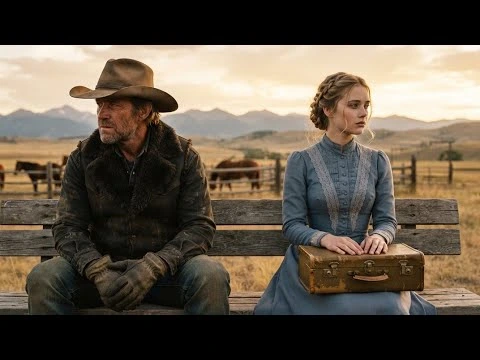
Eleanor Hayes had learned in her 24 years that the world rarely gave a woman a second chance to choose her own path.
And so when her father’s debts finally swallowed the last of their family’s Boston townhouse, she had packed a single trunk and boarded a westbound train with nothing but her pride and a fierce determination never again to depend on any man’s fortune.
She arrived in the small territorial town of Larksburg Creek, expecting hard labor and harder winters, and she found both.
taking a position as a school teacher in a one- room schoolhouse that smelled of chalk dust and pine smoke.
It was there, on her very first week in town, that she met the man everyone called Jesse Coloulton, a lean, sunbr cowboy with quiet gray eyes and calloused hands who worked cattle on land nobody could quite say he owned, and who never once, in all the months that followed, gave her any reason to believe he was anything more than what he appeared to be.
Jesse rode into her life the way a stray dog wanders into a yard.
Unassuming and patient, never pushing for more than she was willing to give.
He fixed the schoolhouse fence without being asked after a storm knocked it flat.
Appearing one morning with fresh cut lumber and a hammer, working through the day without a word of complaint or expectation of thanks.
He brought her family firewood when the autumn chills set in early, always leaving it stacked neatly by her rented room above the merkantile before she woke, so that she rarely caught him in the act of kindness itself, only its quiet aftermath.
When she finally did catch him, red-handed with an armful of split logs on a frosty October morning, he had simply tipped his worn hat and given her a crooked, unbothered smile, as though there were nothing at all remarkable about a man doing such things for a woman who owed him nothing and could offer him even less.
Eleanor, who had spent her whole life surrounded by men who gave nothing without expecting something greater in return, found herself utterly unprepared for a man who seemed to want nothing at all.
Their courtship, if it could even be called that, in those early months, unfolded slowly across the changing seasons of Larks Creek.
Jesse would appear at the schoolhouse some evenings after her students had gone home, leaning against the fence post with his hat pushed back, waiting to walk her the short distance to her boarding house, filling the quiet with easy stories about the land, the cattle, the mountains that ring the valley in blue shadow at dusk.
He never spoke much of his own past, deflecting her gentle questions with a shrug or a change of subject, and Eleanor, respecting the same privacy she guarded so fiercely herself, never pressed.
She assumed, as anyone would, that a man who dressed in patch trousers and rode a serviceable but unremarkable geling, who took odd ranch work wherever he could find it and lived, as far as she could tell, in a modest line shack somewhere out past the eastern ridge, was exactly what he appeared to be, a poor cowboy scraping together a living on land that belonged to someone else, same as half the working men in the territory.
It did not trouble her in the slightest.
If anything, it made her trust him more completely.
Because a man with nothing to offer had nothing to gain by deceiving her, and after the ruin her father’s empty promises had wrought on their family, honesty mattered to Elellanor more than any fortune ever could.
By the time the first snow dusted the peaks above Larks Creek, Elellanor had fallen in love with Jesse Coloulton in the unhurried, deeprooted way that only grows from genuine friendship first.
And when he finally asked to court her properly one crisp evening beneath the schoolhouse eaves, she said yes without a single flicker of hesitation, though she made him promise half inest and half in dead earnest, that he would never expect her to be anything other than a woman who worked for her own bread.
Jesse had laughed at that, a warm low sound that she had come to treasure, and told her that was precisely the thing he admired most about her, that she wanted nothing from him but his honest company.
She did not know then how heavy those words would come to weigh on him in the months that followed, nor how carefully he had chosen them to avoid an outright lie.
The truth was that Jesse Coloulton was not in fact a poor cowboy at all, but the aranged son of Bartholomew Coloulton, one of the wealthiest cattle barons in the entire Western Territory, a man whose sprawling ranch called Cottonwood estate spanned nearly 40,000 acres and whose name carried weight in banks and boardrooms as far east as Chicago.
Jesse had walked away from that inheritance 5 years earlier after a bitter falling out with his father over the ruthless, often cruel way the old man conducted his business, evicting struggling homesteaders, undercutting smaller ranchers into bankruptcy, and treating the men who worked his land as little more than replaceable tools.
Jesse had wanted no part of a fortune built on such foundations.
And so he had ridden away with only his horse and his saddle, determined to build an honest life with his own two hands, far from his father’s shadow and the estate that bore his family’s name.
He had never intended to hide his identity as some kind of test or game.
He had simply wanted, for the first time in his life, to be judged for who he was rather than what he owned.
And Larks Creek, far enough from Cottonwood Estate to escape recognition, had offered him exactly that freedom.
He told himself again and again that he would explain everything to Eleanor eventually once he was certain her feelings for him were built on solid ground.
He simply kept underestimating how much courage that particular confession would require.
Fate, as it so often does in matters of the heart, forced Jesse’s hand before he was ready.
In the depths of that first winter together, word reached Larks Creek that old Bartholomew Coloulton had suffered a severe apoplelexi and lay gravely ill at Cottonwood estate, and that his aranged son was being urgently sought by riders sent out across three counties.
Jesse received the news himself, delivered by a weathered ranch hand, who rode into town asking after him by his full name.
Jesse Bartholomew Coloulton in front of half the Morcantile, including Eleanor, who stood frozen with a basket of flower in her arms, staring at the man she loved as though seeing him for the very first time.
The color drained from Jesse’s face as every eye in the room turned toward him, and he understood with sick clarity that the moment he had been avoiding for months had arrived in the worst possible way, stripped of any chance to explain himself gently or choose his own words.
Eleanor said nothing to him that day, not one word, simply setting down her basket with careful, controlled precision, and walking out of the merkantile with her spine rigid and her chin lifted, the very picture of the proud, wounded dignity she had carried since Boston.
Jesse followed her, of course, calling after her down the frozen street, but she did not slow her pace until she reached her boarding house.
And even then, she turned on him with eyes bright, with a fury he had never seen in her before, demanding to know how long he had planned to let her believe a lie, whether their entire courtship had been some cruel amusement for a rich man’s son playing at poverty, whether anything he had ever told her was true at all.
Jesse, his own voice raw with desperation, tried to explain, tried to tell her that none of it had been a game, that his feelings for her were the only honest thing he had left after walking away from everything his name once meant.
But Eleanor was not ready to hear it.
Not with a wound of her father’s deception still so fresh in her memory.
Not with a humiliation of having been once again the last to know the truth about a man she had trusted completely.
She told him in a voice that shook with barely contained grief that she needed time.
And then she closed her door and Jesse stood alone on the frozen step for a long while before finally riding away into the night.
Torn between his dying father’s urgent need and the woman whose trust he had just watched shatter in front of him.
Jesse rode through that bitter winter night to Cottonwood estate, arriving just before dawn to find his father clinging weakly to life.
Aged far beyond his years by illness and the particular loneliness of a man who had spent his fortune building an empire and lost his family in the process.
The reunion was not an easy one, old Bartholomew, even in his frailty, could not entirely shed the sharp edges of his pride.
And there were hard words exchanged in those first difficult days.
Old wounds reopened before they could begin to heal.
But illness has a way of stripping a man down to what truly matters.
And as the days passed, father and son found their way slowly and imperfectly toward something like reconciliation.
Bartholomew confessed in a rare, unguarded moment, that he had spent years regretting the ruthlessness that had driven his only son away, that watching Jesse build an honest life from nothing had in the end made him prouder than any acre of land ever had.
He asked Jesse to stay, not merely to nurse him back to health, but to help him remake Cottonwood estate into something worthy of the family name, something built on fairness rather than fear.
Jesse agreed on the condition that changes would be made immediately, fair wages for the ranch hands, fair prices for the smaller ranchers his father had once crushed, and an end to the practices that had driven Jesse away in the first place.
Bartholomew, weakened and humbled, agreed to every term.
Word of Jesse’s true identity spread through the territory like wildfire in the weeks that followed.
And inevitably, it reached Larks Creek, growing more elaborate with each retelling until the school teacher’s cowboy suitor had become, in the town’s collective imagination, something halfway between a fairy tale prince and a scandalous fraud.
Eleanor endured the whispers and the sideways glances with the same iron composure that had carried her through every hardship since Boston, teaching her lessons each day with a steady hand, even as her heart remained in tatters.
She told herself she was better off without a man who had built their entire relationship on a foundation of omission.
No matter how gently he tried to frame it, and yet in the quiet hours of the night, alone in her small rented room, she found herself missing the particular warmth of his laugh, the steadiness of his presence.
The thousand small, unremarkable kindnesses he had shown her before she ever knew his name carried any weight at all.
She could not decide which hurt worse, the fear that she had been played for a fool, or the deeper, more frightening possibility that everything between them had been real, and that she had let her pride push away the one honest thing in her life because it had arrived wrapped in a complicated truth.
6 weeks after that terrible night in the Merkantile with his father’s stable and Cottonwood estate already showing the first signs of the fairer future they had promised each other, Jesse rode back into Larksburg Creek, though not on the plain geling Eleanor remembered.
This time he came openly in a fine but unpretentious coat, his identity no longer a secret, he carried like a stone in his pocket, and the whole town watched with undisguised curiosity as he walked, not to the merkantile or the saloon, but straight to the schoolhouse, arriving just as Eleanor was dismissing her final class of the day.
She stood frozen in the doorway when she saw him.
her students filing past her into the cold afternoon.
And for a long moment, neither of them spoke, the weight of six weeks of silence stretching taught between them like a rope pulled to its breaking point.
Jesse spoke first, his voice low and unguarded in a way she had never quite heard from him before, stripped of the easy charm he’d once used to deflect her questions about his past.
He told her the whole truth then, standing in the fading light outside the schoolhouse, holding nothing back.
About his father’s cruelty and his own flight from Cottonwood estate, about the freedom he had found in being simply Jesse Coloulton the cowboy rather than Jesse Colt in the air.
About how terrified he had been that revealing his fortune would change the way she looked at him.
Would make her doubt whether her feelings were her own or simply a reaction to what he could provide.
The very things she had fled Boston to escape.
He told her he had returned not to sweep her off to a life of empty luxury, but because Cottonwood estate, for all its grandeur, had felt like nothing but cold stone and colder silence without her in it, and that he would gladly trade every acre of it for the chance to earn back her trust, one honest day at a time, exactly as he had before she knew his name meant anything at all.
He did not ask her to forgive him on the spot, only asked if she might be willing to see the estate for herself, to judge with her own eyes whether the man standing before her was truly any different from the one who had mended her fence and brought her firewood in the dead of night.
Eleanor moved despite every guarded instinct, urging her toward caution, agreed to visit, though she made the journey to Cottonwood estate with her heart carefully armored against disappointment.
What she found there surprised her more than she had expected.
The estate itself was indeed grand, sprawling white buildings and neat fences stretching toward mountains that caught the last gold light of afternoon, but it was not the cold, imperious place she had half imagined.
The ranch hands greeted Jesse with genuine warmth rather than fearful deference.
And old Bartholomew, propped in a chair on the wide porch, watched his son with an expression of such humbled pride that Eleanor found her resolve softening despite herself.
Jesse showed her everything with the same unassuming honesty he had always carried.
the new fair wage ledgers, the smaller ranchers who had begun returning to do business now that Cottonwood no longer sought to ruin them.
The modest cabin he still preferred to sleep in over the main house because, as he told her with a rofal smile, old habits and honest living suited him better than silk sheets ever had.
It was that small telling detail more than any grand estate or fortune that finally convinced Eleanor that the man she had fallen in love with in Larks Creek had never truly been a lie at all.
only a man who had needed the freedom of anonymity to become the person he was always meant to be.
standing together at the edge of the ranch as the sun sank low behind the mountains, painting the whole valley in the same warm gold light that had first drawn Eleanor west.
Jesse took her hands in his and asked with none of the polish a wealthy man might have employed and all of the plain unguarded honesty of the cowboy she had first fallen for whether she might find it in her heart to forgive him and whether she would consider building a life with him not as the heir to Cottonwood estate but simply as Jesse the man who had once fixed her fence for no reason but that it needed fixing.
Elellanor, feeling the last of her carefully constructed armor finally give way, told him through tears that she had never loved him for his poverty any more than she could ever love him for his fortune.
That what she had loved from that very first frosty morning she caught him stacking firewood, was simply his heart, steady and unassuming, and entirely his own, regardless of what name he carried or what land he owned.
She said yes to him, then beneath that same wide western sky, and Jesse, laughing with a relief so profound it nearly broke him, pulled her into his arms and held her as though he intended never to let her go again.
They were married that spring at Cottonwood estate, though at Eleanor’s gentle insistence, the ceremony was a modest one, held not in some grand ballroom, but in the open pasture where Jesse had first learned to ride as a boy, surrounded by ranch hands and neighboring families rather than distant society acquaintances drawn only by the Colton name.
Bartholomew growing stronger each week under his son’s care, gave a short, uncharacteristically humble toast at the small gathering afterward, admitting before the whole assembled crowd that his son had taught him, in the twilight of his own life, what it truly meant to build something worth having.
Eleanor continued teaching at the Larksburg Creek Schoolhouse for two more years after their marriage, refusing every suggestion that she abandoned the work simply because she no longer needed the wage, insisting that the honest labor she had found in that small town remained as precious to her as anything Cottonwood estate could offer.
Jesse, for his part, split his time faithfully between the ranch and the town, determined that the fair, decent way of living he and Eleanor had built together in Larks Creek would never be lost beneath the weight of his family’s fortune again.
In the years that followed, Cottonwood Estate became known throughout the territory not for its wealth, though that remained considerable, but for its fairness, its open gates, its willingness to lend a hand to struggling homesteaders rather than crush them underfoot.
A legacy that visitors often remarked seemed to flow directly from the quiet, steady character of the woman who had once believed herself in love with nothing more than a poor cowboy, and who had, in the end, discovered that the truest fortune Jesse Coloulton ever possessed had never been his father’s land or money at all, but the simple, unwavering honesty of his own heart, the very thing that had drawn her to him in the first place, and the very thing that once fully revealed made her love him more completely than any fairy tale fortune ever could.
Copyright: Golden Heart Stories!