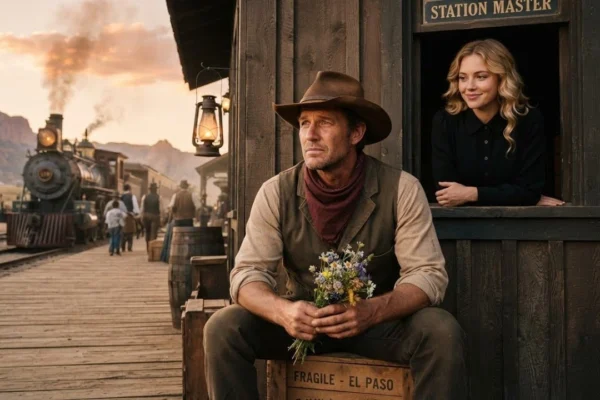
He Sent for a Cook.
.
.
What She Brought Changed His Life Forever
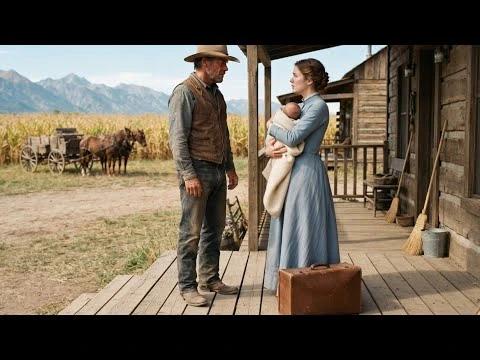
Clara Doyle had answered the advertisement three times before she worked up the courage to send her letter.
And even then, she had rewritten it a dozen times, crossing out every line that might reveal too much.
Wanted a cook for a cattle ranch outside Boseman, Montana territory.
The notice had read, Experienced in feeding hired hands.
Must be capable and reliable.
Room and board provided.
Wages fair.
There had been no mention of a family in the advertisement.
No mention of children.
No mention of anything beyond flour and beef and the steady work of keeping 12 hungry ranch hands fed through a Montana winter.
Clara had a son, 5 years old, with her late husband’s dark eyes and her own stubborn chin, and she had debated for three sleepless nights whether to mention him at all.
In the end, she had written only that she would need to bring her boy Samuel with her, and that he was quiet and no trouble, and that she hoped this would not disqualify her from the position, because she needed the work more than she had ever needed anything in her life.
The reply had come back turse and business-like, signed by a man named Wade Callaway, foreman and owner of the Callaway spread, stating simply that the position was hers if she still wanted it, that the wage was as advertised, and that arrangements would be made for the boy, though the bunk house was no place for a child, and she’d need to see to him herself during working hours.
There had been nothing warm in the letter, nothing that suggested welcome, only the flat practicality of a man hiring help for a specific and limited purpose.
And Clara had told herself that was fine.
That was more than fine because warmth did not pay for bread and warmth would not have kept her and Samuel from starving through another Ohio winter after Thomas died of the fever that took half their county 2 years back.
She needed a cook’s wage and a roof.
And Wade Callaway was offering both, and she had learned by then not to ask for more than the world was willing to give.
The journey west had been long and hard.
three connections by rail and then two days by stage coach into country so vast and empty it made Clara’s chest ache with something between wonder and fear and Samuel had pressed his face to the coach window for the better part of a day watching mountains rise blue and jagged against a sky bigger than any he’d known asking his mother in his solemn 5-year-old way whether they were going to the edge of the world maybe close to it Clara had told him and pulled him against her side and did not tell him how frightened she was herself riding toward a stranger’s ranch with nothing but a single trunk punk and a boy who was all she had left of the life she used to know.
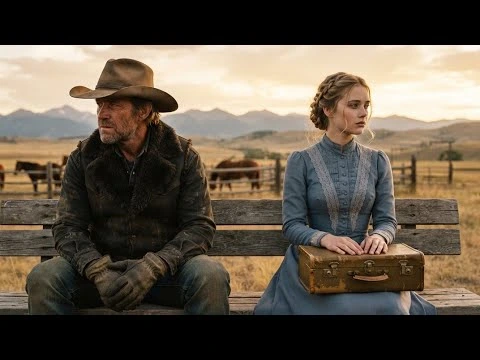
Wade Callaway met the stage coach himself and Clara’s first impression of him was of size and stillness.
A big man in his late 30s with sundarkened skin and hands scarred from rope burn and branding iron, dressed plainly in a gray work shirt and worn leather vest.
His hat brim low enough that she couldn’t read his eyes until he tipped it back and looked at her directly.
And what she saw there was not unkindness exactly, but a kind of guardedness, a wall built brick by careful brick.
the look of a man who had shut a door somewhere inside himself and had no intention of opening it again for a stranger and her child.
He greeted her with a nod and a handshake more suited to a business arrangement than a homecoming.
And when his gaze dropped to Samuel standing half hidden behind his mother’s skirts, something flickered across his face.
Quick and gone, an expression Clara couldn’t name, but that made her hold her son’s hand a little tighter.
The ranch house was larger than Clara had expected, a sprawling timber structure with a wide kitchen that would become her domain, and a bunk house set some distance off where the hired men slept, and beyond that the endless rolling grazing land that Wade Callaway had built, she would learn entirely with his own hands and his fathers before him.
He showed her to a small room off the kitchen, meant originally for storage, but cleared out and fitted with two narrow beds, and said this would do for her and the boy, that meals for the men started before dawn, and ran until after dark, and that he expected the kitchen kept clean, and the accounts kept honest, and that was the whole of his welcome.
He did not ask about her husband or her journey, or how a widow with a young son had come to answer an advertisement for ranch cook three states from anywhere she’d ever known.
He simply showed her the flower stores and the root seller and the schedule the previous cook had kept before he’d taken ill and gone to live with his daughter and Helena.
And then he left her to it.
And Clara stood alone in the strange kitchen with Samuels hand in hers and felt for the first time since Thomas died entirely and completely on her own.
The work was brutal in its constancy bread and beans and beef from before sunrise until the last hand had eaten his supper.
And Clara threw herself into it with the same fierce discipline that had carried her through two years of widowhood.
Because the alternative to working was thinking, and thinking led always to Thomas’s face, and the fever that had taken him so fast, there hadn’t even been time to say the things a wife means to say to her husband before the end.
Samuel, meanwhile, learned to make himself small and useful around the ranch.
Fetching kindling, gathering eggs from the small flock of hens Wade kept, sitting quiet as a church mouse in the corner of the kitchen with a whittling knife too large for his hands, working at a piece of soft pine that never seemed to become anything in particular.
The hired men were kind enough to the boy in their rough way, tossing him scraps of conversation and once memorably a puppy that had been born in the barn and needed a home, which Samuel named Biscuit, and which followed him everywhere thereafter like a small brown shadow.
Wade Callaway, though, kept his distance from both of them with a consistency that Clara at first took for simple reserve, and later came to understand was something closer to deliberate avoidance.
He ate his meals at the head of the long table with the hired hands and spoke to Clara only of practical matters, supplies needed, meals planned, wages due, and he seemed to arrange his days so that he was rarely in the kitchen when Samuel was.
And if the boy wandered into his path in the yard, Wade would nod at him with the same careful, guarded courtesy he might extend to any stranger’s child, and move on.
It puzzled Clara this deliberate distance because the hired hands spoke of their employer with rough affection, telling her over supper of small kindnesses he’d shown them over the years, a loan extended when a man’s family fell sick.
Work found for a hand too old and stiff to break horses anymore, and none of that generosity seemed to reach towards Samuel, and Clara wondered, with a kind of quiet hurt she was careful not to show, whether her employer simply did not care for children, or did not care for hers in particular.
The truth, when Clara finally learned it, came from the ranch’s oldest hand, a weathered man named Silas, who had worked the Callaway spread since before Wade was born, and who told her the story one evening while she scrubbed pots, and he mended harness by the kitchen fire in the low, unhurried voice of a man who had decided she deserved to know.
Wade had married young, Silas told her, a sweetheart from town named Ellen, and they’d had a daughter, a little girl with her mother’s fair, and for 3 years, the ranch house had rung with a kind of happiness Silas said he’d never forget.
Wade laughing in a way he hadn’t laughed since.
Then the dtheria came through the territory the winter the girl was four and it took her in the space of 5 days.
And Ellen, unable to bear the empty house afterward, had left for her sisters in Denver within the year and never come back.
And Wade had shut up whatever part of himself had been capable of that kind of joy and had not in the six years since allowed himself to look too closely at any child.
Because looking too closely, Silas said meant remembering and remembering was a country.
Wade Callaway had no intention of visiting again.
Clara absorbed this story in silence, her hands going still in the dishwater and felt something in her chest crack open with sympathy for a man she had until that moment thought merely cold.
She understood grief, understood exactly the particular shape of a hole a person leaves behind.
And she understood too with sudden clarity why Wade Callaway had hired a cook and gone out of his way to make clear that a cook was all he wanted.
Why he had written that the bunk house was no place for a child rather than asking after the boy at all.
Why he kept himself so carefully apart from Samuel’s small orbit.
He was not cold.
He was a man standing very carefully away from a fire he had once been badly burned by.
And Clara found she could not fault him for that.
Even as some part of her, the part that watched her son’s quiet loneliness on this vast ranch with something like an ache, wished he might find his way back toward warmth eventually, for Samuel’s sake, if not his own.
It was Samuel himself, of course, who eventually broke through what 6 years of grief had built, because children rarely respect the walls adults construct with such care.
It happened on an ordinary afternoon in early autumn when a storm blew in fast and hard off the mountains and weighed out mending fence on the ranch’s northern boundary was thrown from his horse when lightning spooked the animal and came home an hour later soaked to the bone and limping badly on an ankle swollen tight against his boot.
Clara had fussed over him with a brisk efficiency of a woman who had nursed a dying husband and knew exactly what needed doing, boiling water and finding clean cloth and instructing him, in a tone that brooked no argument, to sit and let her look at the injury properly, and Wade, too tired and in too much pain to resist, had allowed it, sitting stiff and uncomfortable at the kitchen table while she worked.
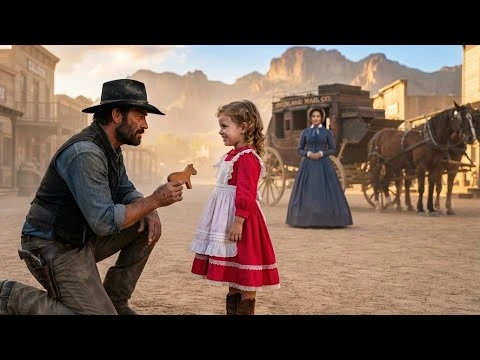
It was in the middle of this that Samuel appeared, drawn by the commotion, and instead of retreating to his usual quiet corner, the boy climbed unbidden onto the bench beside Wade, and with a solemn seriousness of a 5-year-old conducting important business, presented him with a piece of pine he’d been whittling for weeks, now revealed to be a small, lopsided, but unmistakable horse, and announced that he’d made it because Mr.
Callaway’s horse had run off scared, and he thought he ought to have a new one that wouldn’t run away.
this one being made of wood and therefore obligated to stay put.
The kitchen went very quiet.
Clara, kneeling with a cloth in her hands, held her breath, watching WDE’s face, waiting for the polite, distant nod she’d seen him give the boy a hundred times before.
The courtesy that was really just another brick in the wall.
Instead, Wade Callaway sat very still for a long moment, looking at the small, crooked wooden horse in his large scarred hand.
And something moved across his face that Clara had not seen there before.
something that looked almost like pain and almost like relief arriving together.
The way a wound aches worse in the moment just before it finally begins to heal.
He turned the little horse over once, examining the careful, imperfect whittling, the places where the boy’s knife had slipped and been patiently corrected.
And when he looked up at Samuel, his eyes were bright and unsteady in a way that had nothing to do with the storm outside.
and he said in a voice rougher than his usual flat calm that it was the finest horse he’d ever owned and that he intended to keep it on the mantle where he could see it every day.
Samuel, delighted and entirely unaware of the weight of what had just passed between the grown man and himself, grinned and asked if the horse needed a name, and Wade, after a moment said he thought Biscuit’s friend would suit just fine, and Samuel laughed, a bright, unguarded sound that seemed to Clara to loosen something in the room itself.
That evening marked a change in Wade Callaway that grew slowly but unmistakably in the weeks that followed.
He began appearing in the kitchen at odd hours, ostensibly to discuss ranch business, but staying longer than business required, and Clara noticed him watching Samuel with an expression of careful, hungry attention, as though he were relearning a language he’d forgotten he knew.
He taught the boy to whistle for biscuit properly, showed him how to sit a pony without gripping the mane in terror, sat with him some evenings by the fire, while Clara finished the last of the kitchen work, answering Samuel’s endless stream of questions about cattle and mountains, and whether wolves really howled at the moon or just happened to howl at night regardless.
Clara watched all of this with a tenderness she tried hard to keep private, because she understood better than most the particular vulnerability of a heart daring itself to feel something again after loss.
and she did not want to rush a process that seemed in its slow unfolding almost sacred.
But grief, even healing grief, does not vanish without a fight.
And there came an evening in early winter when Wade watching Samuel and Biscuit chase each other across the yard in the blue dusk light, went suddenly and strangely silent.
And Clara, following his gaze, saw the shadow cross his face, and understood at once that he was seeing another child, another dusk, a daughter with fair hair, who would now be nearly 11, had the fever spared her.
He excused himself abruptly, and did not come to supper that night.
And Clara, after Samuel was asleep, found him instead on the porch in the cold, staring out at nothing.
and she came to stand beside him without speaking at first because she had learned through her own grief that sometimes the kindest thing was simply presence rather than words.
It was Wade who finally broke the silence, telling her in halting sentences that seemed to cost him considerable effort about Ellen and about his daughter Grace, whose name he had not spoken aloud, Clara realized in years, and about the particular guilt he carried for having in some sense been relieved when Ellen finally left for Denver.
because her grief had been a mirror to his own and he had not been able to bear looking into it any longer.
He told her he had hired a cook and specifically not a family because he believed with a flat certainty of a man protecting a wound that he could not survive loving and losing again that it was safer cleaner to keep the ranch running on labor and wages and nothing more complicated than that.
And then Samuel had come along with his lopsided wooden horse and his fearless questions and his utter unconcern for the careful distance Wade had built.
And every day since Wade admitted he had felt something in himself thawing that he wasn’t certain he wanted thaw because Thaw things could be heard again and he did not know if he had the courage for that a second time.
Clara listening to this confession in the cold dark found herself speaking with a directness she hadn’t quite planned.
Telling him that she understood the fear better than he might guess that she too had built walls after Thomas died.
had told herself that surviving meant never again wanting more than bread on the table and a roof overhead, and that she had come to this ranch expecting nothing more than a wage, and had not anticipated, had not even permitted herself to hope for the particular ache of watching her son come alive again under the attention of a man who was not his father, but who was in every way that seemed to matter now, becoming something like one anyway.
She told him that grief was not a debt that had to be paid by refusing all future joy.
That Grace’s memory did not require his loneliness as tribute, and that a wooden horse whittleled by a boy who had lost his own father did not diminish what he’d loved and lost, but rather honored the shape of a heart still capable of loving at all.
Wade turned to look at her then in the cold porch light, and something passed between them that was not quite a decision yet, but was the seed of one.
The recognition two wounded people sometimes reach when they realize the walls they’ve built to protect themselves have also quietly become prisons and that the door out might be standing closer than either had dared to believe.
He did not kiss her that night, though Clara would later admit she had wondered if he might.
And instead, he simply thanked her plainly and with more warmth in his voice than she had heard from him since her arrival, and told her that he was glad, whatever else came of it, that she and Samuel had answered that advertisement, mismatched as the situation might have been from the start.
The winter that followed was hard, as Montana winters always are.
But it was, Clara would later think, the first winter since Thomas’s death that had not felt like mere survival.
Wade began taking his meals at the small family table rather than the long-hired hands table, a shift the ranch hands noted with knowing looks and tactful silence, and he took to walking Samuel to the barn each morning to feed the horses together.
A small ritual that grew over the cold months into something neither of them discussed, but both clearly treasured.
Clara watched her son’s face change.
Watch the particular loneliness he’d carried since his father’s death soften and fill in the way a scar softens with time.
Not vanishing, but becoming simply part of the whole healed shape of him.
And she understood that whatever else happened between herself and Wade Callaway.
This alone, the sight of her son laughing freely in the company of a man who had chosen against every instinct grief had taught him to let himself care again would have been enough.
But there was more, as there so often is when two careful hearts finally stopped guarding the same door.
By the time the first thought came in March, Wade had taken to seeking Clara out in the evenings, not for ranch business, but simply for her company, sitting with her by the kitchen fire after Samuel was asleep, talking of small things, the shape of the clouds that day, a fullborn early to one of the Mars, and slowly carefully of larger things too, of Ellen and Grace, of Thomas, of the particular grief of building a life and having it taken, and the terror of building another one.
Anyway, it was on an evening in April, with the first green coming up along the fence lines and biscuit grown into a gangly half-formed dog sleeping by the hearth, that Wade finally told her plainly what both of them had known for some weeks, but had been too careful, too well practiced in caution, to say aloud, that he had sent for a cook the autumn before, and had received instead, without ever asking for it, or believing he deserved it, a family, and that he did not intend to let either her or Samuel walk out of his life the way everything else he’d loved once had.
Clara married Wade Callaway that summer in a small ceremony on the ranch with Silas standing as witness and the hired hands crowding the yard in their best clothes.
And Samuel, 5 years old and utterly without ceremony about the whole matter, spent the reception showing anyone who would look the wooden horse still sitting on the mantle, informing them all with great authority that he had made it himself, and that it had never once run away.
Wade adopted the boy formally the following spring.
A piece of paperwork that changed little in practice but meant everything in the ways that mattered.
And Clara watched her son grow up in the shadow of the mountains with a father’s hand steady on
Copyright: Golden Heart Stories!