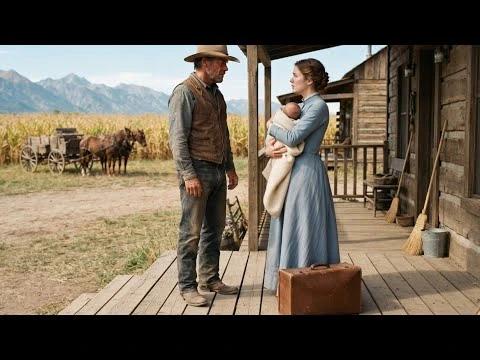
She Hadn’t Spoken in 3 Years — Then This Single Father Changed Everything

The town of Cedar Hollow had never known a woman like Adeline Marsh.
And in the two years since she arrived on the back of a supply wagon with nothing but a single trunk and a face carved from grief, not one soul had heard her speak a word.
She lived alone in the small house at the edge of town, the one with a crooked porch and the garden that no one ever saw her tend, though somehow it bloomed every spring.
She walked to the general store on Tuesdays and Fridays, always at the same hour, always with her eyes fixed on some point in the distance that no one else could see.
She paid an exact coin, nodded when nodding was required, and vanished back down the dusty road before anyone could gather the courage to ask her name twice.
The children called her the quiet woman.
The old men at the saloon called her worse, though never to her face, because there was something about the stillness in her that made even the crulest tongues fall silent when she passed.
Nobody in Cedar Hollow knew where she had come from, or what had stolen her voice, or why her hands trembled faintly whenever a rider passed too fast down Main Street.
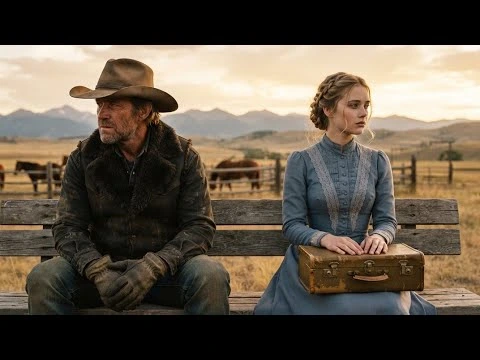
They only knew that grief had built a wall around her taller than any fence in the territory, and no one had ever tried to climb it until Caleb Whitfield rode into town with his six-year-old daughter asleep against his chest and a silence of his own that he carried like a second skin.
Caleb had buried his wife 18 months earlier, out past the Kansas line, in a plot of land he could no longer bear to look at.
Sarah had died bringing their daughter Josephine into the world.
And though the girl had grown into a bright, curious child with her mother’s same copper hair, Caleb had never quite forgiven himself for the trade the universe seemed to have made.
He had sold what little they owned, packed what remained into a wagon, and set out west with no destination in mind beyond the vague hope that somewhere in some town he hadn’t yet seen, the weight on his chest might loosen its grip.
Cedar Hollow was not a place he had chosen so much as a place he had stopped.
The way a man stops walking when his legs simply refused to carry him another mile.
He rented a small parcel of land on the outskirts, took work at the livery to make ends meet, and told himself that this quiet, unremarkable town would be enough.
He did not expect to notice the woman who never spoke.
He did not expect her to be the first thing that made him feel anything at all in over a year.
It happened on a Friday, the kind of gold lit afternoon that made even a broken town look like something worth painting.
Josephine had wandered off from the livery while Caleb was occupied with a lame mayor, and by the time he noticed her absence, his heart had already climbed into his throat.
He found her two streets over, crouched in the dirt beside the quiet woman’s garden.
Her small hands cupped around a bird with an injured wing.
Adeline was kneeling across from her, close enough to touch, guiding the girl’s fingers with a gentleness that made Caleb stop dead in the street.
He had heard the stories, of course, the whispers about the woman who never uttered a sound.
The woman, folks said, had lost something so terrible that words themselves had abandoned her.
But what he saw in that moment was not a broken, frightening creature.
It was a woman with kind eyes and careful hands, teaching his daughter how to hold something fragile without crushing it.
When Josephine looked up and grinned, missing her front tooth, and said, Papa, she’s helping me save him.
Caleb felt something in his chest crack open for the first time since Sarah’s funeral.
He should have simply thanked her and taken his daughter home.
That would have been the sensible thing, the thing that avoided the stairs and whispers that were sure to follow any man seen lingering near the quiet woman’s fence.
But Caleb found himself crouching down instead, introducing himself in a low, easy voice, careful not to startle her the way one might approach a spooked horse.
Adeline did not answer, of course, but she did not look away either.
Her eyes, a deep and startling shade of gray, held his for a long moment, and in them Caleb saw something he recognized immediately because he carried the very same thing behind his own ribs.
It was not madness, and it was not coldness.
It was the particular exhaustion of a person who has been surviving day after day on nothing but sheer stubborn will.
He nodded to her the way one soldier might nod to another across a battlefield and said only, Thank you for looking after my girl.
Then he scooped Josephine up bird and all, and walked home, though his mind stayed behind in that small, dusty garden for the rest of the evening.
It became a habit after that, though neither of them ever called it one.
Josephine, with a fearless devotion only a six-year-old can offer, took to visiting Adeline’s garden nearly every afternoon once her chores were done.
And Caleb, unable to bear the thought of his daughter wandering alone, took to walking her there and lingering a while longer than necessary.
He talked because Adeline could not, and he found that he did not mind the one-sidedness of it the way he thought he might.
He told her about Sarah.
At first, only small things.
The way she used to hum while she needed bread.
The way she’d laughed at his terrible jokes, even when they weren’t funny.
And Adeline listened with such quiet, complete attention that he found himself telling her more than he had told anyone in 18 months.
She never flinched from his grief, never tried to hurry him past it the way well-meaning neighbors often did.
She simply sat beside her rows of beans and squash, hands busy with the soil, and let him speak until the words ran dry.
In turn, though she offered nothing in words, Adeline began leaving small things for him to find.
A jar of preserves on his porch, a mended shirt he hadn’t realized was torn, a carved wooden horse for Josephine that must have taken her hours to whittle.
It was a language all its own, built entirely of gestures and silences.
and Caleb found he understood it better than he un It was on a stormy evening in early autumn that Caleb finally learned the shape of what had silenced Adeline, though not from her own mouth.
A traveling preacher passing through Cedar Hollow recognized her instantly, and after a few careful questions at the saloon, the story came tumbling out in pieces, the way such stories always do in small towns.
Adeline Marsh had once lived 200 m east, married to a man named Thomas Reyes, a rancher with a temper as vast as his land holdings.
She had borne him a son, a boy named Eli, golden-haired and full of laughter.
And for a few years, it seemed she had built something like happiness despite her husband’s darker moods.
But 3 years before she came to Cedar Hollow, a fire had swept through their ranch house in the dead of night.
An accident born of an overturned lamp and dry summer wood.
Adeline had woken to smoke and flame, had fought her way through a collapsing hallway to reach her son’s room, only to find the door blocked by a fallen beam she could not move alone.
She had screamed for her husband, screamed until her throat tore raw.
But Thomas, drunk and slow to wake, had not reached the house in time to help her clear the door.
By the time the neighbors arrived to pull her from the wreckage, Eli was gone, and something in Adeline had gone with him.
She had not spoken since the night of the fire.
Not one word.
Not to her husband, not to the doctors who examined her throat and found nothing physically wrong.
Not to the grief counselors the church sent, not to anyone.
Thomas, unable to bear the silent accusation of her presence, had eventually put her out, and she had wandered west with what little money remained until Cedar Hollow, for reasons she could never explain even to herself, felt like a place she could stop.
Caleb sat with this knowledge for 3 days before he worked up the courage to go to her.
And when he did, he did not go with pity because he understood well enough that pity was the last thing a person carrying that kind of weight needed.
He went instead with the truth, plain and unadorned, the way he might have delivered it to a friend on equal footing.
He told her he knew now that a stranger’s loose tongue had given him a story that was hers alone to share, and he was sorry for that.
sorry that it had reached him sideways instead of from her own hand.
He told her that he did not see a broken woman when he looked at her, and he never had, not from that first afternoon in the garden.
He told her that grief did not make a person less whole, only differently shaped the way a tree struck by lightning still grows, still gives shade, still stands.
And then because he did not know what else to offer a woman who could not answer him in words, he simply sat down beside her on the porch step and stayed until the sun went down, saying nothing more, asking nothing of her, simply present in the way he hoped might mean something.
What happened over the following weeks was not a sudden transformation because real healing rarely arrives that way.
It was smaller than that and slower and far more precious for its slowness.
Adeline began in tiny increments to let herself be seen more fully.
She started joining Caleb and Josephine for supper twice a week.
First cooking for them and eating alone in her own kitchen after they left.
Then gradually sitting at the table while they ate, and finally one evening in late October, ladelling stew into her own bowl and sitting across from them as though she had always belonged there.
She taught Josephine to write her letters in the dirt with a stick, patient beyond measure, and taught her two the alphabet of hands that Adeline had built for herself over three years of silence, simple signs for yes and no, for hungry and tired, for love.
Josephine picked up the signs faster than she picked up her letters, delighted by the secret language that belonged only to the three of them.
And Caleb found himself learning it too, clumsily at first, his large, calloused hands fumbling through gestures that Adelines had made look like poetry.
It was Josephine in the end who forced the question that Caleb had been too afraid to ask aloud.
One evening in November, as the three of them sat by the fire in Caleb’s small house, the girl looked between the two adults with a frank assessment only children possess and asked quite simply whether Adeline might like to be her new mama.
The silence that followed was not the comfortable kind they had grown accustomed to sharing.
Caleb felt his face go hot, stammered some half-formed apology for his daughter’s boldness.
But Adeline set down the mending in her lap, and reached for Josephine’s hand, and then slowly, deliberately, for Caleb’s as well.
She held both their hands in her lap for a long moment, her gray eyes bright with unshed tears, and then she nodded.
It was such a small gesture, a single tilt of the head, but it landed in that small room like the toll of a great bell.
Caleb, who had not cried since the day he buried Sarah, found his own eyes stinging.
And he understood in that moment that he had fallen in love with this silent, steadfast woman somewhere between the garden and the supper table, without ever quite marking the day it happened.
Their courtship, if it could be called that, unfolded without a single spoken word of romance passing between them.
And yet, it was somehow the most honest courtship either of them had ever known.
Caleb took to leaving small carved trinkets on her porch the way she had once left preserves on his wittleled birds and horses that grew steadily more confident in their craftsmanship as the weeks passed.
He learned that she loved the particular gold of the cottonwoods in late autumn that she still hummed sometimes without noticing a low wordless melody that might have been a lullaby once meant for a boy who never got the chance to grow up.
He never asked her to speak, never made her silence feel like a debt owed to him.
And it was precisely that patience, that refusal to treat her wound as something to be fixed rather than simply carried alongside, that finally began to loosen something in her chest that three years of silence had held locked tight.
The town, for its part, slowly came around, the way small towns often do once the initial scandal wears thin and ordinary human decency reasserts itself.
Mrs.
Callaway herself, in a gesture that surprised everyone, including herself, brought a basket of preserves to Adeline’s door one afternoon, and stayed for tea, communicating through Josephine’s careful hand signs, and coming away by her own later admission, thoroughly ashamed of every unkind word she had ever spoken.
By the time winter set its teeth into Cedar Hollow, the quiet woman had become simply adeline to most of the town.
a woman who tended the finest garden in the county and had somehow against all odds found her way into the affections of the whole Witfield family.
It was on Christmas Eve with Snow falling soft and silent outside the little house at the edge of town that Caleb finally asked her the question he had been carrying for weeks.
He did not kneel with a ring in a grand gesture because he understood by then that grand gestures were not the language Adeline needed.
Instead, he simply took her hands in his by the fire, Josephine asleep in the next room, and told her plainly that he loved her, that he wanted to build a life with her, that he did not need her voice to know her heart, because she had been speaking to him in every language that mattered since the first afternoon he found her kneeling in the dirt with his daughter.
He asked if she would marry him, and if she would let him spend the rest of his days making sure she never again felt as alone as she must have felt in that burning house 3 years before.
For a long moment, Adeline said nothing, as she had said nothing for three years, and Caleb felt his heart drop, certain he had moved too fast, asked too much of a woman who had already lost everything once.
But then, in a voice rusted from diseuse, cracked and trembling, and barely above a whisper, Adeline spoke the first word she had uttered since the night of the fire.
She said simply, Yes.
The sound of her own voice seemed to startle her as much as it startled him.
And for a moment, they simply stared at each other, stunned by the fragile miracle hanging in the air between them.
Then the tears came for both of them.
And Caleb pulled her into his arms and held her while she wept.
Not from grief this time, but from something that felt at last like relief.
Josephine, woken by the commotion, padded into the room, rubbing her eyes.
And when Adeline turned to her and said her name aloud for the first time, the girl’s face broke into the widest, most delighted grin Caleb had ever seen, and she threw herself into both their arms, declaring that this was the best Christmas there had ever been in the history of Christmases.
They were married in the spring, in the very garden where it had all begun, beneath cottonwoods, just beginning to leaf out in tender green.
Adeline’s voice, though it never fully regained its old strength, grew steadier with each passing month.
Coaxed back into the world one word at a time by a patient husband and a chattering, delighted step-daughter who seemed determined to fill every silence in the house with joy enough for all three of them.
Adeline never forgot her son Eli, and she spoke of him sometimes now in the quiet hours after Josephine had gone to bed, telling Caleb small stories of the boy’s laughter, his stubbornness, the particular way he used to chase fireflies in the yard back home.
Caleb listened the way she had once listened to him without flinching, without hurrying her past the pain.
Understanding that love did not ask a person to set down their grief, but only offered to help carry it a while.
Cedar Hollow in time, forgot that Adeline had ever been called the quiet woman at all.
She became instead simply Mrs.
Whitfield, known throughout the county for her garden and her gentle hands, and the soft, careful way she spoke, as though each word were a gift she had once thought she’d never be able to give again.
Caleb often thought in the years that followed, watching her chase Josephine through the very garden where they’d first found each other, that grief had a strange way of leading people toward the very things they needed most.
if only they were brave enough to sit still long enough to notice.
He had ridden into Cedar Hollow, expecting nothing but a place to stop running, and instead he had found a woman who had taught him that healing was never a solitary road, and that sometimes the quietest people carry the loudest hearts, waiting only for someone patient enough to listen.
And in that small house at the edge of town, through every golden autumn and every soft spring that followed, the silence that had once defined Adeline’s life became instead a language of its own, one built from patience and presence, and the simple, unshakable truth that some kinds of love need no words at all to be understood.
Copyright: Golden Heart Stories!