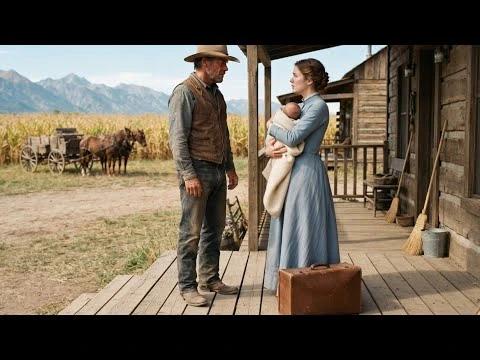
He Waited at the Station Every Night… Until a Single Mom Clerk Asked, Who Are You Waiting For?
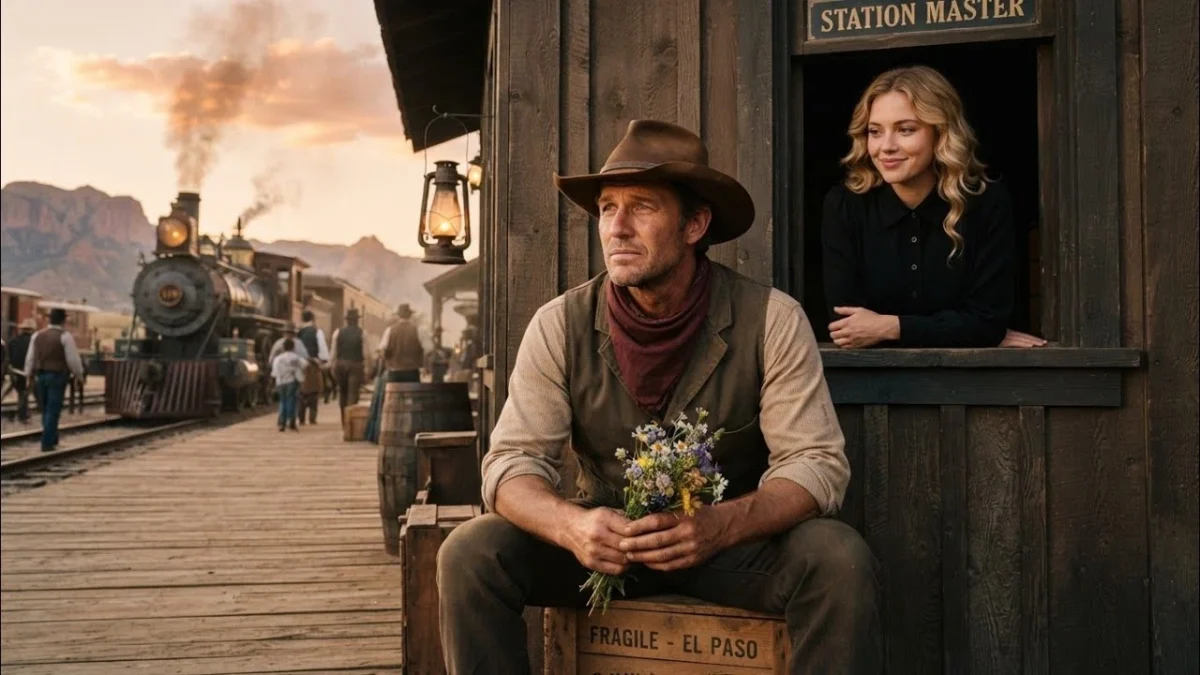
The train station at Redemption Hollow had a way of turning gold at dusk.
The kind of gold that made a man forget for a few minutes that his life had fallen apart somewhere between one sunrise and the next.
Caleb Witmore had learned every inch of that light.
He had watched it change through the seasons, the harsh white gold of summer, the thin amber gold of autumn, the pale, almost apologetic gold of winter evenings when the cold came early and stayed late.
He had watched it for 312 nights.
Though he had stopped counting out loud somewhere around night 200 because counting made it sound like madness and he told himself he was not a madman.
He was a man waiting for someone who might one day step off that 7:00 train.
He always sat on the same crate worn smooth by his own weight positioned just so beneath the overhang where the lantern light didn’t quite reach his face.
He liked it that way.
He didn’t want anyone to look too closely at his eyes because eyes were the one thing a man couldn’t fully arrange into calm when his heart was busy breaking over and over on schedule every single evening at 7:00.
The town’s folk had long since stopped asking.
In the beginning, there had been questions, kind ones mostly, from neighbors who remembered the fire that took the Whitmore Ranch House and the woman who had been in it.
But grief that refuses to end makes people uneasy.
And after a while, the questions stopped, and Kayla became something like a fixture of the station, no different than the water tower or the old iron bell that no longer rang.
Eleanor Hayes had been the ticket clerk at Redemption Hollow Station for 8 months, ever since her husband’s name had been read off a list of men lost to a mine collapsed two counties over.
A man she had married too young and lost too soon, leaving her with a four-year-old daughter named Josephine, and a grief of her own that she had learned to fold up small enough to carry through a workday.
She noticed Caleb the very first week.
It was hard not to.
A grown man sitting alone on a crate every evening, watching a train arrive and depart without ever once trying to board it, without ever once greeting a passenger, was the kind of sight that stayed with a person.
At first, she thought he might be simple-minded, or perhaps some kind of drifter waiting on a delivery.
But drifters didn’t wear boots that fine, and simple-minded men didn’t carry themselves with a quiet, controlled dignity that clung to Caleb Whitmore, even in his worst hours.
She watched him for weeks before she ever said a word, partly out of respect, and partly because she recognized something in him that she saw in her own mirror each morning.
The particular stillness of a person who has stopped expecting good news, but hasn’t yet given up hoping for it.
Anyway, it was a Tuesday in late September when she finally spoke to him.
The sky bruised purple and orange, the wind carrying the first real bite of autumn.
Josephine had fallen asleep in the back room of the station house, tucked into a nest of old male sacks that Eleanor had turned into a makeshift bed.
And Eleanor found herself with a rare quiet moment before the 7:00 arrived.
She walked out onto the platform with two tin cups of coffee, more out of impulse than plan, and set one down on the crate beside Caleb without a word.
He looked up at her, startled, as though he had forgotten that other human beings existed outside of the borders of his grief.
Figured a man who sits out here every night deserves something warm in his hands, she said, settling herself on the edge of a nearby barrel, careful to keep a respectful distance.
He looked at the cup for a long moment before he picked it up, turning it slowly, the steam curling against the cool evening air.
That’s kind of you, ma’am.
Didn’t expect it.
Nobody ever does, she said.
That’s usually when it’s needed most.
They sat in silence after that.
The kind of silence that doesn’t ask to be filled.
And when the train finally groaned into the station, hissing steam and screeching iron against iron, Caleb straightened on his crate the way he always did, eyes fixed on the doors as passengers began to step down.
Eleanor watched him watch them.
An older couple, a peddler with a case of tin goods.
a young mother wrangling two boys who tore off down the platform the moment their boots hit the boards.
Caleb’s face went through each of them like a man reading a list, searching for one name that never seemed to appear.
And when the last passenger had gone and the conductor’s whistle sounded for departure, something in his shoulder sank, just slightly, just enough that a person who was watching for it could see.
She didn’t ask him that night.
It felt too soon, too much like prying open a door that wasn’t hers to open.
But she came back the next evening with coffee again.
And the evening after that, until it became a quiet ritual between two people who understood without needing to say it, that some kinds of loneliness were easier to sit beside than to sit alone with.
It was nearly 2 weeks before she finally worked up the courage.
The coffee gone cold between her palms, the platform empty, and the last light draining out of the sky.
Can I ask you something, Mr.
Witmore? She said, Caleb, he corrected gently.
And you can ask me most anything, Mrs.
Hayes.
Elellanor, she said back, and something like the ghost of a smile passed between them before it faded.
Who are you waiting for? Every night, same crate, same hour.
I’ve watched you search every face that comes off that train, and I’ve never once seen you find who you’re looking for.
For a long moment, Caleb said nothing at all.
The wind picked up, rattling the tin sign above the station door.
And somewhere in the distance, a dog barked twice and went quiet.
When he finally spoke, his voice had a rasp to it that hadn’t been there before, as though the words had to claw their way up from somewhere deep and unused.
My wife, he said.
Her name was Mary Anne.
We had a ranch out past Miller’s Creek.
Good land, good water, two years married, and we were fixing to have our first child come spring.
He paused and Eleanor saw his jaw tighten, the muscles working beneath a beard that had gone unshaved for longer than was proper.
There was a fire.
Middle of the night, lamp oil spilled.
Nobody rightly knows how it started.
I was out in the north pasture chasing down a couple of steers that had wandered off through a broken fence.
By the time I saw the smoke and got back, the house was gone, and so was she.
Eleanor’s hand rose to her mouth, though she said nothing, letting him continue in his own time, in his own way.
They found what they found, he said quietly.
Buried what could be buried.
And I should have accepted it same as any sensible man would.
But there was a fella, a d who used to pass through, said he saw a woman matching her description three towns over, maybe two months after.
said she looked frightened, wouldn’t give her name, got on a train heading east before he could ask more.
I know it sounds like a mad man’s hope.
I know grief plays tricks, but I keep thinking, what if she got out? What if she was hurt or scared or lost her memory of who she was and she’s out there somewhere trying to find her way back to me? And what if the only way she’d know how to come home is through this station? Because this is the station she always said she loved, the one with the gold light in the evenings.
So, I wait every night because if there’s even the smallest chance she’s coming back to me, I intend to be here when she does.
Eleanor sat with that confession for a long moment, feeling the particular ache of a grief that refused the comfort of certainty, a grief far cruer than her own in some ways, because her husband’s death had at least come with a name on a list, a fact she could hold on to even as it broke her.
Caleb had nothing but a rumor and a hope and hope she knew from hard experience could be its own kind of prison.
I’m sorry, she said finally.
That’s an awful thing to carry.
Everybody carries something, he said, and there was no self-pity in it.
Only a plain weathered truth.
You lost your husband.
I see it in you, too.
The way you go quiet when a certain kind of song plays from the saloon down the road.
The way you hold that little girl of yours like you’re afraid the wind might take her.
Eleanor felt her throat tighten.
Surprised that a man so wrapped in his own sorrow had still found room to notice hers.
His name was Thomas, she said.
Worked the Baxter mine.
Cave took 11 men.
I was left with Josephine and a house I couldn’t keep up the payments on.
So I took this job because it came with a room in the back and enough wages to keep her fed.
Some days that’s enough.
Some days it isn’t.
From that night on, something shifted between them.
Quiet and unhurried, the way Frost creeps over a window pane without anyone quite noticing the moment it started.
Eleanor kept bringing coffee.
Caleb kept his crate warm, but more and more he found himself glancing toward the station house even before the 7:00 train arrived, hoping to catch a glimpse of Eleanor moving behind the ticket counter or hear the particular sound of Josephine’s small boots thumping across the wooden floor.
The little girl, for her part, took an immediate and uncomplicated liking to him, the way children do to adults who ask nothing of them and simply are present.
She began bringing him things, a smooth stone she’d found by the creek, a drawing of a horse that looked more like a dog, a wild flower pulled crooked from its stem.
Caleb kept every single one of them in his coat pocket.
And Eleanor noticed, though she never said so.
Winter came hard that year.
The gold light thinned to something pale and gray, and the platform grew slick with frost most mornings.
But Caleb never missed a night, and more often than not, Eleanor found reasons to stay late after her shift ended, telling herself it was for the extra coin from selling coffee to travelers, though both of them knew that wasn’t the whole truth.
Josephine started calling him Mr.
Caleb, and then just Caleb.
And then on a particularly cold evening in December, she climbed up onto his crate uninvited, tucked herself against his side, and fell asleep there while the two adults talked in low voices about nothing in particular and everything that mattered.
Caleb sat very still that night, afraid to disturb the small weight against his ribs, and Eleanor watched him hold himself so carefully, so tenderly around a child that wasn’t his, and felt something crack open in her chest that she hadn’t expected and wasn’t sure she was ready for.
You’re good with her, Eleanor said quietly.
Once Josephine’s breathing had gone deep and even.
She’s easy to be good to, Caleb said.
Reminds me some of what I always pictured before.
He didn’t finish the sentence, but he didn’t need to.
There were nights, as the months wore on, when Eleanor found herself wanting to ask him to stop.
Not out of jealousy for a dead woman or a woman who might not be dead at all, but out of a growing fear that watched him fold deeper into himself with every train that came and went without bringing him what he was waiting for.
She began to understand that his vigil wasn’t hope anymore.
Not really.
It had calcified into something closer to penance, a punishment he was inflicting on himself for the sin of having been in the north pasture instead of the house on the night everything burned.
She saw a man drowning in the fear that if he ever let go of the waiting, he would be letting go of Mary and all over again, admitting a second time that she was truly gone.
It was Josephine, in her small and uncomplicated wisdom, who finally cracked the door that neither adult had been brave enough to open.
On a spring evening nearly seven months after Eleanor first brought him that cup of coffee, the little girl looked up at Caleb with a particular directness only children possess and asked, Caleb, if your first wife comes back on the train, will you stop sitting with us? The question landed like a stone dropped into still water, rippling out into a silence that neither Caleb nor Eleanor seemed to know how to fill.
Caleb looked down at the little girl and then slowly at Eleanor, whose eyes had gone bright and careful in the lantern light and something in his chest.
Something that had been clenched tight for over a year, loosened just slightly for the first time since the fire.
I don’t rightly know how to answer that, sweet pee, he said finally, his voice rough.
I’ve been asking myself something like it for a long while now, and I haven’t found the courage to answer it honest, not even to myself.
Eleanor stood then, gathering Josephine gently into her arms, murmuring that it was past her bedtime, though the truth was she needed a moment to breathe, to step away from a conversation that had suddenly become far too large for a train platform at dusk.
She carried her daughter inside, tucked her into the mail sack bed, and stood for a long while at the window, watching Caleb’s silhouette against the darkening sky, unmoving on his crate, waiting the way he always waited.
Though something about the set of his shoulders looked different now, heavier and yet somehow more honest.
She went back out to him after Josephine was asleep.
The station was empty.
The platform lit only by two lanterns and the thin silver edge of a rising moon.
Caleb heard her boots on the boards and turned.
And for a long moment, neither of them said anything at all.
I think, Elellanor said carefully, that I need to ask you something, and I need you to answer it true, even if the truth is hard to hear.
All right, he said.
If Marian walked off that train tomorrow, Eleanor said, would you still want her? Not out of guilt, not out of what you think you owe a memory, but truly want her the way a man wants the woman he means to build a whole life with.
Caleb was quiet for a long time.
He looked down the empty tracks toward the horizon where the rails disappeared into darkness, the place from which for over a year he had expected salvation to arrive.
I loved her, he said finally.
I won’t ever say I didn’t.
And I won’t ever be a man who forgets what she meant to me.
But I’ve been sitting on this crate every night for so long, Eleanor, that I stopped noticing somewhere along the way that I wasn’t waiting for her anymore.
Not really.
Somewhere in these last months, without my even choosing it, I started waiting for the sound of your footsteps instead.
I started listening for that little girl’s boots on the boards more than I ever listened for a train whistle.
I think, he said, his voice breaking slightly on the words.
I think I’ve been using Maryanne’s memory as a wall to hide behind because loving somebody again, actually letting myself want a future instead of just guarding a past scared me a good deal more than any fire ever did.
Eleanor felt tears rise hot and sudden, and she didn’t try to stop them.
I’ve been scared of the same thing, she admitted.
Thomas was a good man and I loved him.
And some days I still feel guilty for the fact that lately it’s not his face I think of first when I wake up.
It’s yours.
And I didn’t know what to do with that.
So I kept telling myself it was just kindness, just coffee between two lonely people.
Was it ever just that? Caleb asked, rising from his crate, closing the small distance between them.
No, she whispered.
I don’t think it ever was.
The 7:00 train came and went that night as it always did.
And for the first time in over a year, Caleb Whitmore did not turn to watch the passengers step down.
He kept his eyes on Eleanor Hayes instead, and when the whistle blew for departure, and the platform emptied back into silence, he reached for her hand slowly, giving her every chance to pull away, and she didn’t.
It would be dishonest to say that letting go was simple after that, because grief rarely surrenders all at once.
And there were nights in the weeks that followed when Caleb still found himself glancing toward the tracks out of old habit, a reflex worn deep into his bones.
But he no longer sat on the crate to wait.
He sat on it because Eleanor liked to bring her mending out to the platform in the last of the evening light, and because Josephine had taken to using his shoulder as a pillow while she listened to the trains, and because for the first time since the fire, the station had stopped feeling like a place of vigil and started feeling like something closer to home.
He told Eleanor everything in pieces over the months that followed.
How he had rebuilt a small cabin near where the ranch house once stood, unable to bring himself to leave the land entirely, but unwilling to raise a family in the same footprint as the fire.
How the d story about a woman on a train had eventually been traced through careful and painful inquiry to a case of mistaken identity.
A stranger who resembled Mary and only in the vague, unreliable way that grief makes.
Strangers look like the people we’ve lost.
how the county records office had finally formally closed the matter, giving Caleb something he hadn’t realized he needed until he had it, an ending, plain and final, instead of an open wound dressed up as hope.
He asked Eleanor to marry him on a September evening, exactly one year after she’d first set that tin cup of coffee down beside him.
The gold light falling across the platform in the same way it always had, though it felt different now, warmer, less like a countdown to disappointment and more like a promise kept.
He didn’t do it with flowers or speeches because that wasn’t his way and Eleanor wouldn’t have wanted it any other way even if it had been.
He simply sat down beside her on the crate that had become in its strange and quiet fashion the sight of everything that mattered most in his second life and said, I spent 312 nights on this crate waiting for someone who was never coming back.
Eleanor, I don’t intend to spend one more night waiting for something I already have.
Marry me.
Let me build a life with you and Josephine that doesn’t have a single empty seat in it.
She said yes before he’d even finished the sentence.
And Josephine, who had been listening from just inside the station door, the way children always seem to know exactly when the important things are being said, came running out onto the platform and threw her arms around both of them at once, nearly knocking Caleb clean off the crate.
They were married the following spring in the small chapel at the edge of town with half of Redemption Hollow in attendance.
Because a story like theirs, the man who waited every night at the station, and the widow who finally asked him why, had become, without either of them intending it, something the whole town had quietly witnessed and quietly hoped for.
Caleb rebuilt the cabin into a proper house that year, with a room for Josephine painted the pale yellow she’d chosen herself, and a porch facing west so that Eleanor could watch the very same gold light she’d grown to love on that station platform.
Except now she watched it from her own front steps, with her husband’s arm around her shoulders and her daughter’s laughter drifting up from the yard below.
He still went down to the station sometimes in the years that followed, though not to wait anymore.
He went because Eleanor kept her job there a while longer until their first son was born.
And Caleb liked to walk down at dusk to meet her.
The same crate still sitting under the same overhang, though now it served no purpose but as a place for a family to sit together and watch the evening trains
Copyright: Golden Heart Stories!