He Rode Two Extra Miles Just for Her Pie.
.
.
What She Whispered Left Him Speechless
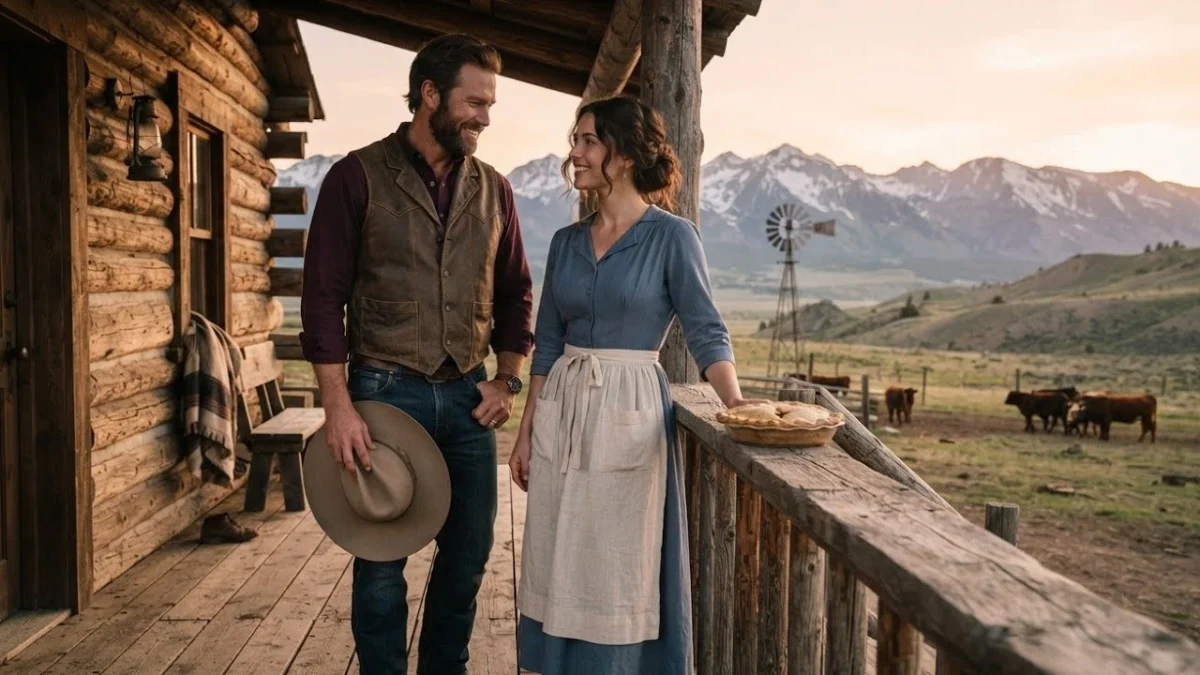
The Wyoming sky had turned the color of a ripe peach by the time Jonas Calder rode his chestnut mare through the last stretch of open range that led to the Whitmore homestead.
He hadn’t planned on stopping there that evening.
He had told himself, as he told himself most evenings, that he was simply riding the fence line to check for breaks, that the Whitmore land happened to sit along his usual route, that there was nothing more to it than a man doing his job before supper.
But the truth, the one he kept folded away somewhere behind his ribs, was that he had been finding reasons to ride past that particular stretch of fence for almost 3 months now, ever since the day he first saw Clara Whitmore standing on her porch with flower on her hands and sunlight caught in her dark hair.
He slowed the mayor to a walk as the cabin came into view, its weathered boards silvered by years of wind and snow, smoke curling lazily from the stone chimney.
The windmill behind the barn creaked in the evening breeze, turning slow circles against the darkening mountains.
And there, on the porch railing, sat up high.
Even from this distance, Jonas could see the golden lattice crust, the faint wisp of steam still rising from it, cooling in the evening air.
His stomach, which had been growling since noon, gave an embarrassing rumble.
He rained the mayor to a stop at the edge of the yard, close enough to be polite, far enough not to presume.
Clara stepped out onto the porch just then, wiping her hands on her apron.
And when she saw him, something crossed her face that he chose to believe was pleasure and not merely surprise.
She was wearing a blue dress the color of a autumn sky, her dark hair pinned up loosely, a few strands escaping to frame her face the way they always seem to by this hour of the day, as if her hair knew better than she did how becoming that looked.
Mr.
Calder, she said, her voice carrying easily across the yard.
You’re a long way from your own fence line.
Mom.
He touched the brim of his hat.
Was just riding through, checking for breaks on my side of the property.
He felt the tips of his ears go warm.
Grateful the hatch shaded most of his face.
Fences don’t always respect boundary lines, ma’am.
Sometimes a man’s got to check further than he planned.
Clara’s mouth twitched, fighting a smile she didn’t quite want him to see.
She crossed her arms and leaned against the porch post, studying him with a particular patience of a woman who has caught a man in a small lie, and decided for now to let him keep it.
That’s so.
That’s so.
He dismounted, more out of habit than invitation, and looped the mayor’s res loosely over the hitching post near the water trough.
The horse dipped her head gratefully toward the water, and Jonas found himself standing in the yard with his hat in his hands, unsure quite what to do with himself now that he was here.
It was one thing to ride past a woman’s homestead and tip his hat through the fence rails.
It was another thing entirely to stand in her yard at supper time with nothing but good intentions and an empty stomach.
I said, this pie smells wonderful, he said, nodding toward the porch railing.
because it was true and because it gave him something to say that wasn’t the thing he actually wanted to say.
Clara looked at the pie as though she had forgotten it was there.
Though Jonas doubted very much that a woman who had spent the better part of her afternoon rolling dough and cing apples could forget such a thing.
Dutch apple, she said.
My mother’s recipe.
Cinnamon and a little bit of nutmeg.
Though most folks around here don’t bother with the nutmeg.
Your mother teach you to bake it? She did.
Back in Ohio, before we came west, a shadow passed over her face, brief as a cloud crossing the sun.
And Jonas understood without being told that there was grief tucked somewhere inside that memory.
The kind of grief a person learns to carry so quietly that most people never notice the weight of it.
He didn’t ask.
He had learned in the months since his own family had settled the stretch of Wyoming territory that a person’s sorrows were theirs to share when they were ready and not a moment before.
Well, he said, It smells like something a man could ride an extra 2 mi for.
Is that an invitation you’re fishing for, Mr.
Calder, or merely an observation? He laughed, surprised into it, and the sound seemed to loosen something in the evening air between them.
Little of both, I suppose, if you’re offering.
Clara considered him a long moment, her dark eyes moving over his face with an attention that made him feel not uncomfortable exactly, but seen in a way he wasn’t entirely used to.
Then she straightened, pushed off from the porch post, and reached for the pie.
It’s not quite cool enough to cut, but I imagine a hungry man riding fence lines all afternoon isn’t overly particular about that.
No, ma’am, not overly particular at all.
She carried the pie inside, and Jonas followed her up the porch steps, ducking slightly under the low door frame, the way he always had to in a cabin built for a family shorter than he’d grown to be.
The inside of the Whitmore home was small but well-kept, a black iron stove in the corner still radiating heat from the day’s baking, a table set with two mismatched chairs, a rifle propped near the door the way any sensible homesteader kept one.
Clara set the pie on the table and reached for two plates from the shelf, and it did not escape Jonas’s notice that she reached for two without having to think about it, as though some part of her had already decided he would be staying before he had decided it himself.
They ate at the little table as the last light drained out of the sky beyond the window, the pie every bit as good as it had smelled, maybe better, the crust flaking apart under his fork in a way that spoke of a steady hand and years of practice.
Jonas found himself talking more than he usually did, telling her about the herd his father had left him when he passed the previous winter, about the new Fullborn just that spring with a white patch on its face shaped like a crescent moon.
About how he’d been thinking of expanding the herd come autumn if the grazing held.
Clara listened the way few people listened, not simply waiting for her turn to speak, but actually taking in what he said, asking questions that showed she’d been paying attention.
And somewhere between the second slice of pie and the coffee she poured after, Jonas realized he had told her more about himself in one evening than he told most people in a year.
You’re easy to talk to, he said, somewhat surprised to hear himself say it aloud.
Or you’re just hungry for conversation the way you were hungry for pie, Clara said, though there was no sting in it.
Only a gentle teasing that made him smile into his coffee cup.
Might be both, he admitted.
Night had fully settled by the time he rose to leave, and Clara walked him out onto the porch.
The cool evening air carrying the scent of sage and distant rain.
The stars had come out thick and bright the way they only did out here, far from any town, far from any light but the moon and the windows of a few scattered homesteads.
Jonas stood at the top of the porch steps, his hat back on his head, the mayor waiting patient and dark against the paler dark of the yard, and he found himself reluctant to climb back into the saddle and ride the long way home.
Thank you for the pie, he said.
And the company.
You’re welcome for both.
Clara wrapped her arms around herself against the chill, though Jonah suspected the gesture was as much about nerves as it was about cold.
You’re welcome to ride past my fence line again sometime, Mr.
called her.
Should you happen to find yourself in the area, I have a feeling I’ll be finding myself in the area quite often.
I have a feeling you might.
He should have left it there.
He knew he should have left it there, tipped his hat, mounted his horse, and ridden home with a memory of pie and coffee and easy conversation to keep him warm on the ride.
But there was something about the way the moonlight fell across her face.
something about the quiet way she was looking up at him, waiting.
That made the words rise up in his chest before he could think better of them.
I said, This pie smells wonderful, he repeated softer this time, the words no longer about the pie at all.
Clara went very still.
For a moment, he thought he had said too much, misread the evening entirely, and he began to feel the familiar heat of embarrassment climbing up his neck.
But then she stepped closer.
Close enough that he could see the small private smile forming at the corner of her mouth.
Close enough that her voice when it came was barely more than a whisper carried on the night air.
Not as wonderful as you, she said.
The words settled over him like the first warm morning after a long winter.
He didn’t trust himself to speak, afraid that anything he said would break whatever fragile, precious thing had just opened up between them.
Instead, he reached out slowly, giving her every chance to step back if she wanted to.
And when she didn’t, he brushed a loose strand of hair from her face, his fingers lingering against her cheek.
Clara leaned into his palm, her eyes closing briefly.
And when she opened them again, there was something fierce and certain there that hadn’t been present a moment before.
Clara, he said, and it was the first time he had used her given name aloud.
and the sound of it in his own voice felt like a door swinging open onto a room he hadn’t known existed.
Jonas, she answered, and that was all either of them needed to say.
He kissed her there on the porch beneath the wide Wyoming sky, with a windmill turning slow behind them, and the mayor stamping impatiently at the hitching post, and it was every bit as good as the pie had promised.
And better still, because a pie could only fill a man’s stomach, while this filled something that had been empty far longer, something he hadn’t fully understood was empty until this moment.
When they finally parted, Clara laughed softly, pressing her fingers to her own lips as though checking that the kiss had truly happened.
Well, she said, I suppose you’ll be needing directions back to your own fence line, Mr.
Calder, seeing as you’ve clearly lost your way.
I don’t think I have, ma’am.
I think I finally found it.
He rode home that night with a taste of cinnamon and apples still on his tongue and the memory of her whispered words wrapped around his heart like a blanket against the cold.
He did not sleep much, though it wasn’t restlessness that kept him awake, but a kind of quiet, disbelieving joy, the sort that made a man lie in the dark and grin at nothing in particular.
In the weeks that followed, Jonas found more reasons than ever to ride the fence line that skirted the Whitmore property, and Clara found more reasons than ever to be baking something when he arrived, until the whole arrangement became something of an open secret between them.
An excuse neither one bothered pretending they needed anymore.
He mended a loose board on her porch without being asked.
She began setting three plates at supper on the evenings she knew he’d come, though it was still only ever the two of them who sat down to eat.
Word traveled the way it always did in a territory as thinly settled as theirs.
And soon enough, the folks at the little church, some 6 mi distant, were exchanging knowing looks whenever Jonas Calder and Clara Whitmore happened to arrive within minutes of one another on a Sunday morning.
By the time the first frost silvered the grass that autumn, Jonas had ridden into town and spoken with the reverend, and had spent three sleepless nights working up the courage to ask Clara’s aunt, the only family she had left in the territory, for her blessing, which the older woman gave readily enough, remarking dryly that she’d been wondering when the fool would get around to it.
And on a crisp October evening, with the mountains dusted in their first snow and the windmill turning steady, behind them, Jonas rode up to the Whitmore homestead one more time, dismounted in the yard, and instead of waiting for an invitation, walked straight up the porch steps to where Clara stood waiting for him, having somehow known, the way she always seemed to know things about him before he said them aloud, that this evening would be different from all the others.
He didn’t have a ring, not yet.
Not one that would do her justice.
But he had brought instead a small carved wooden box that had belonged to his mother.
And inside it he had placed a single pressed wild flower from the field where he’d first seen her all those months ago, standing on the same porch with flour on her hands.
He got down on one knee right there among the porch boards he himself had mended and asked her the only question that had mattered to him since the night of that first pie.
And Clara, laughing and crying all at once, said yes before he had even finished asking.
They were married that December in the little church with a whole scattered community crowded into pews built for half as many people.
And afterward there was a celebration back at what would become their shared home.
Tables groaning under the weight of dishes brought by neighbors.
Fiddle music drifting out into the cold, clear night.
And of course, at the center of the dessert table, taking pride of place above the cakes and cobblers brought by other hopeful cooks, sat Clara’s Dutch apple pie, made from her mother’s recipe, with just a little more nutmeg than most folks around these parts were used to.
Years later, when their own children were old enough to ask how their parents had fallen in love, Jonas would tell the story the same way every time, describing the golden light of that first evening, the smell of cinnamon carried on the porch air, the courage it had taken to ride two extra miles just for the chance of seeing her.
And Clara would smile the same private smile she’d worn that very first night, and finish the story the way she always did, reminding her children that their father had said the pies smelled wonderful, and that she, foolish and brave and certain all at once, had told him the truth.
That nothing, not even her mother’s finest recipe, could ever smell half so wonderful as he did, standing there beneath a Wyoming sky full of stars, waiting for her to say yes.
And every autumn afterward, without fail, on the anniversary of that first ride past the fence line, Jonas would find some excuse to wander toward the kitchen window right around supper time, breathing in deep, and Clara would look up from her rolling pin, flower dusting her hands, just as it had that very first day, and ask him with the same teasing lift in her voice she’d never quite lost, whether he was simply checking fences again.
And he would tell her every single time that he had never once in all those years stopped finding his way home to
Copyright: Golden Heart Stories!