She Begged for Just One Bed.
.
.
What Happened Next Changed Everything
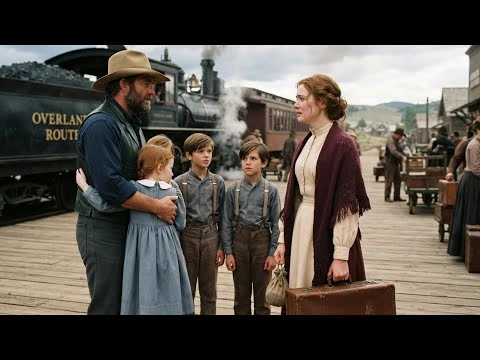
Amelia Grant stepped off the stage coach into a cloud of dust and squinted at the man waiting by the hitching post.
He was taller than she’d imagined from his one brief letter with sunweathered hands and eyes the color of a Montana sky before a storm.
Jonas Whitfield didn’t smile.
He simply nodded, took her single worn trunk, and said the words that would change everything.
There’s been a mixup at the boarding house, he told her.
Fire took half of it last night.
I’ve only got the one room at my place and one bed.
You can have it.
I’ll sleep in the barn.
Amelia’s cheeks burned, but she was too tired and too far from anywhere else to argue.
She had crossed three states on the promise of a fresh start.
Running from a father who’d sold her hand in marriage to a man twice her age back in Ohio, a man she had fled the night before her wedding with nothing but her mother’s sewing basket and the clothes on her back.
She had answered Jonas Whitfield’s advertisement for a wife with a lie in every line, claiming she was a simple farm girl, good with a needle, eager for quiet country life.
The truth was Messier.
The truth was that Amelia Grant had a gift nobody back home had ever valued, and a past she wasn’t ready to explain to a stranger with kind, tired eyes and a jaw set like carved stone.
The ride to his homestead took nearly an hour.
the wagon jostling over ruts in the road while the prairie stretched gold and endless on either side.
Jonas spoke little.
He told her his name again, though she already knew it.
He told her the land had been his father’s and his father’s before that, and that the house was small but sound.
He did not ask about her past, and she did not offer it, and the silence between them was not unkind, only careful, the way two strangers might tiptoe around a shared secret neither had spoken aloud yet.
When they reached the house, Amelia saw at once that he had not exaggerated.
It was one room, honest and plain, with a stone hearth, a table built by hand, and a bed in the corner covered with a quilt gone soft from years of washing.
Jonas set her trunk down by the wall, and would not meet her eyes.
I know this isn’t what you were promised, he said.
The preacher can marry us proper next week when he rides through.
Until then, folks in town don’t need to know the particulars of where you’re sleeping.
Amelia nodded, throat tight, and said she understood, though she understood nothing about this life yet.
Not really, not the loneliness of it, or the labor, or the way the wind talked to itself at night across empty land.
That first evening, he made a supper of beans and cornbread, apologizing for the plainness of it, and Amelia, unable to sit idle, found herself mending a tear in his workshirt while it hung drying by the fire.
She did it without thinking, the needle moving fast and sure between her fingers.
And when Jonas glanced over and saw the stitches, small and even as printed type, he went quiet in a different way than before.
That’s fine work, he said.
Where’d you learn to sew like that? Amelia’s hands stilled.
My mother taught me, she said, which was true, though it was not the whole truth.
Her mother had taught her the needle, yes, but it was Amelia herself who had turned it into something more, something her father had called a waste of a woman’s time, and her intended husband had called unbecoming.
In Ohio, she had spent her nights after the chores and the churning and the silence of a house ruled by a man’s temper, drawing patterns no one had taught her, piecing together garments from scraps that other women threw away, turning flower sacks into dresses so fine that the minister’s wife had once asked in a hushed and almost embarrassed voice whether Amelia might make her something for Easter.
Her father had forbidden it.
A wife’s hands are for her husband’s house, he’d said, not for chasing vanity.
So Amelia had buried the gift the way she buried everything else that made her herself and had come west believing she would have to bury it forever.
That first night, true to his word, Jonas took a blanket to the barn.
And Amelia lay alone in the strange bed, listening to the house settle and the coyotes call somewhere far off, and she cried quietly, not from sorrow exactly, but from the strange, disorienting relief of having escaped one cage, only to wonder if she had stepped into another gentler one.
She did not yet know that Jonas Whitfield was nothing like the man she had run from.
She would learn it slowly, the way you learn the shape of a room in the dark, by bumping gently against its edges until you understand where the walls are and where they are not.
The days that followed took on a rhythm.
Jonas worked the land from before dawn until the light failed.
And Amelia kept the house, learning the particular geography of a stranger’s life, which drawer held the good spoons, which floorboard creaked, how he liked his coffee strong enough to stand a fork in.
In the evenings, after supper, she sewed.
At first, it was practical, patching his shirts and her own worn dresses, but before long her hands wanted more than patching.
She unpicked an old curtain no one used, and over three nights by fire light, turned it into a blouse with a collar shaped like nothing anyone in that county had seen, soft and gathered in a way that flattered without announcing itself.
She wore it to town on market day, not thinking much of it, and it was the blacksmith’s wife of all people who stopped her outside the merkantile and asked with open envy who had made such a fine garment.
Amelia, startled, admitted it was her own work.
And within the week, three women had come to the Whitfield homestead, asking shily whether Mrs.
Whitfield might make something for them, too, for a price they were willing to pay in coin or in trade.
Jonas said nothing discouraging.
That surprised her most of all.
Her father would have forbidden it outright.
Her intended husband back in Ohio would have laughed at the idea of his wife earning money with a needle, as though it were a child’s game.
But Jonas, when she nervously told him what the women had asked, only considered it for a long moment and said, If it makes you happy and it don’t take you from what needs doing here, I don’t see the harm.
There was no permission being granted.
Not really.
Only a kind of respect she hadn’t known to expect, and it undid her more than any tenderness could have.
They were married the following week when the circuit preacher came through, a small plain ceremony in the yard with a blacksmith’s wife and two neighboring families as witness.
And that night, for the first time, Amelia slept in the bed, and Jonah slept beside her, though he kept careful distance, and neither of them spoke of what that distance meant or how long it might last.
They were husband and wife in name and law, but they were still, in the ways that mattered most, two careful strangers, learning each other’s edges.
It was in the second month that the trouble came.
Riding in the shape of a man named Elias Combmes, who owned the largest spread in the county, and who had Amelia gathered from the way conversation died whenever his name arose, wanted Jonas’s land for years, ever since the surveyors had found that the creek running through Whitfield property watered half the valley below it.
Combmes came calling under the guise of neighborliness, complimenting the house, complimenting Amelia’s sewing when he saw the dress she wore, and then almost as an afterthought, mentioning that he’d heard the Whitfield mortgage with a bank in Cheyenne was coming due sooner than most folks realized, and that a man in Jonas’s position might do well to consider a generous offer before hard times forced a poor one.
Jonas’s jaw had gone tight as wire, and he told Combmes, evenly, but without warmth, that the land wasn’t for sale and never would be, and Combmes had smiled the way men like that always smile, as though the conversation were merely paused rather than finished and ridden off.
That night, Jonas didn’t touch his supper.
Amelia, watching him from across the table, asked gently what troubled him, and for the first time since she’d arrived, he told her the truth of things.
The mortgage was real.
His father had borrowed against the land two winters back when the cattle took sick and the note was coming due in the fall and between the bank and combs circling like a buzzard waiting for the numbers to fail him.
Jonas didn’t know how he’d hold on to what four generations of his family had built.
Amelia sat with that knowledge overnight, turning it the way she turned fabric in her hands, looking for the seam that would let it open into something workable.
By morning, she had an idea, small and strange and entirely her own.
She had heard from the blacksmith’s wife, that the railroad was extending its line through the territory, and that with it would come surveyors, engineers, and their wives, women from cities like Denver and Chicago, who would arrive in this rough country hungry for anything that reminded them of civilization.
Women who would pay real money for fine dresses rather than wait for mail order cataloges to deliver something 6 months out of fashion.
Amelia proposed, haltingly at first, and then with growing conviction, that she use what little fabric and coin they had to make not one dress, but a dozen, ready-made in a range of sizes, and sell them the moment the railroad camp women arrived, before any merchant thought to undercut her.
Jonas listened without interrupting, which she was coming to understand was simply his way.
And when she finished, he asked only one question.
What do you need? She told him fabric from Cheyenne, thread, the good needles, and time enough by the fire each night to work.
He sold two of his horses that he could ill afford to lose, and did not tell her until much later that he had done it, and brought back bolts of gingham and lawn, and even a small length of blue silk he’d found at a discount, saying only that he guessed she would know what to do with it better than he did.
Amelia worked through that summer like a woman possessed.
Her fingers blistered and then calloused, her eyes strained by candle light.
But for the first time in her life, the labor was entirely hers, chosen rather than commanded, and there was a fierce, quiet joy in it that she had never been permitted to feel before.
Jonas took over chores she would ordinarily have shared, milking and hauling water without being asked.
And in the evenings, instead of retreating to silence, he took to sitting near her by the fire, mending harness leather while she sewed.
And somewhere in those long quiet evenings, filled with nothing but the sound of thread pulling through cloth and his knife working leather, something between them shifted from careful distance into something that neither of them named, but both of them felt, a warmth that had nothing to do with the hearth.
When the railroad camp finally reached the valley in late August, Amelia rode in with Jonas and a wagon bed full of finished dresses.
12 of them, each one different, each one built with an eye toward flattering the particular figures common among working women who’d spent years in corsets and city fashions and were now sunburnt and homesick in a canvas tent town.
She sold out within 2 days.
The camp foreman’s wife bought three dresses alone and asked, with the same hushed envy the blacksmith’s wife had shown months before, whether Amelia might take custom orders, whether she might consider supplying dresses regularly as the rail line pushed further west.
Camp after camp, town after town, each one needing exactly what Amelia could provide, and no one else in 300 m could match.
By the time the first frost came, Amelia Grant Whitfield had more orders than she could fill alone.
And Jonas, watching his wife’s small enterprise grow into something that brought in more coins some months than the cattle did, began driving her into Cheyenne himself to buy fabric wholesale, standing patiently outside dress shops, while she negotiated with merchants who had at first looked down their noses at a farm wife until they saw the ledger of her orders and reconsidered entirely.
The mortgage that had loomed over the fall was paid not through the sale of land or livestock, but through bolts of gingham and careful stitches paid off two full months before it was due.
And when Jonas rode home from the bank with a note marked settled, he did not go to the barn or the fields first.
He came to find Amelia at her sewing table, and without a word, without the careful distance he had kept for so long, he knelt beside her chair and told her that she had saved everything his family had built, and that he loved her plainly and simply.
The way a man says a true thing he has been carrying a long while.
Elias Combmes came by one final time that autumn, his offer for the land now laughably beneath its worth.
And Jonas, standing on his own porch with his wife beside him and the mortgage paid clean, told him there was nothing left to discuss.
And Combmes, seeing at last that the game was truly over, rode off and never returned.
The valley kept its water, the Witfield land kept its name, and Amelia’s dresses in time became known clear across three counties.
so well regarded that women rode half a day just to be measured for one.
And eventually she took on two girls from town to help with the sewing, teaching them the stitches her mother had taught her, passing the gift forward the way it had once briefly nearly been taken from her entirely.
She never did tell Jonas the whole truth of why she’d fled Ohio.
Not in detail, not the man’s name or the cruelty she’d escaped.
But she told him enough.
One night by the fire with the children, they would eventually have asleep in the next room.
that a girl had once been told her hands were good for nothing but a husband’s house, and that she had believed it until a man with tired, kind eyes had given her one room, one bed, and the quiet, unasked for gift of being allowed to become entirely herself.
Jonas had taken her hand, then, the same hand that had stitched together a life for both of them out of scraps other people would have thrown away, and said that he thought her hands were good for a great many things, and that he intended to spend the rest of his life grateful for every one of them.
Outside, the Wyoming wind moved over the grass the way it always had, indifferent to the small, hard one happiness contained inside that little house.
But Amelia no longer feared what the wind might carry off, because for the first time in her life, she had built something that was entirely unshakably her own.
And no one, not her father, not the man she’d fled, not Elias Combmes, with all his land and his greed, could ever take it from her again.
Copyright: Golden Heart Stories!