You May Stay Until Winter Ends, the Widow Said… He Asked, What If I Want to Stay Forever?
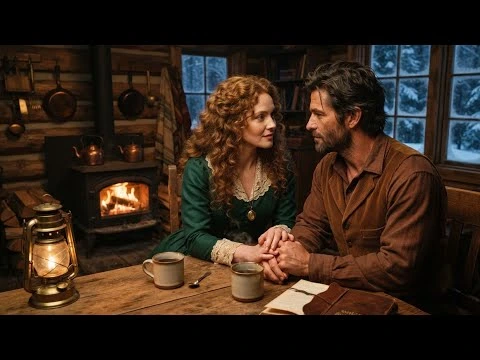
The snow had not stopped falling for three days when Thomas Averly first knocked on widow Margarite Kovville’s door, and it did not stop for three more after she let him in.
He had come from the east, half frozen, his horse lame from a fall on the icy pass, carrying nothing but a canvas pack, a rifle wrapped in oil, and a letter he would not explain.
Margarite had opened the door with a lantern in one hand and a shotgun leaning within reach of the other.
and she had looked at him the way a woman looks at a stranger who might be trouble or might simply be cold, which in the Montana territory in the dead of January were not always different things.
She was 28 years widowed for one winter.
Her husband Elias, having gone through the river ice the previous November while hauling timber, and the ranch that remained, was too much for her hands alone, and too little for anyone else’s ambition.
She had two hired men who came by day and left by dusk.
A barn with six horses and 11 head of cattle, and a house that had grown too quiet for her liking, though she would not have admitted that to a living soul.
When Thomas Averly stood shivering on her porch, snowcrusted white in his dark hair, she thought first of turning him away, and second of the fact that a man frozen on her property come morning would bring more trouble than one warmed by her fire tonight.
You may stay until the storm breaks, she told him.
though even as she said it, she suspected the storm outside was not the one she meant.
There’s a cot in the barn loft, and I’ll not have you in my house past supper.
He had thanked her plainly, without the practiced courtesy of a man used to charming widows, which she noted and approved of.
He ate what she gave him without complaint, spoke little of where he had come from or where he intended to go, and when she asked after the letter tucked inside his coat.
He only said it was for a man in Boseman, business unfinished, nothing that concerned her.
She did not press him.
She had learned in her 30 years that men who volunteered too much were often lying, and men who volunteered too little were often only tired.
And Thomas Averly had the look of a man bone tired in a way that went past his body and into whatever a man carries instead of a soul.
When the soul has been worn thin, the storm did not break in a day, nor in three.
It settled over the valley like a judgment, burying the road to town under drifts taller than a man, and Margarite found herself waking each morning to the sound of Thomas already at work in the barn, mending the fence the wind had torn loose, or breaking ice from the trough so the cattle could drink, or splitting wood enough to keep both the house and barn stove fed through the brutal nights.
She had not asked him to do any of it.
She had only meant to give him shelter, not a stake in her land.
But he worked as though the work itself were payment enough, as though a man who ate another’s bread owed something more than thanks, and she found she could not fault him for that, only for the way it made her look at him a moment longer than she intended each time he passed the kitchen window.
By the second week, she had stopped pretending the arrangement was temporary in her own mind, though she had not said as much aloud.
He took his meals at her table now, not from any invitation she remembered giving, but from the plain fact that it was foolish to carry a plate to the barn when the house was warm and the company, she admitted only to herself, was not unwelcome.
They spoke more as the days wore on.
He asked about Elias once carefully.
The way a man asks about a grave he has not been given leave to stand near.
And she told him plainly that Elias had been a good husband and a hard worker, and that the river had taken him quick, which was the only mercy in it.
Thomas had said nothing to that, but had looked at her with an expression she could not name.
Something between grief for a man he had never known and something else she did not let herself examine too closely.
He told her in pieces of his own life, that he had fought in a war he did not care to speak of in detail.
that he had buried a wife of his own for years passed to a fever that took her in 11 days from first cough to last breath and that he had spent the years since moving from one place to another because staying still in anyone house made the silence unbearable.
He did not say this for pity.
He said it the way a man states a fact of weather, something that had simply happened and could not be undone, and Margarite found that she respected him more for the plainness of it than she would have for any amount of sorrowful performance.
There came an evening in the third week, the wind howling low against the eaves, when the two of them sat by the stove after supper, she mending a torn shirt of her late husbands that she had never quite brought herself to give away, and he oiling the leather of his boots by the fire light.
The quiet between them had become a comfortable thing rather than an awkward one.
And it was into that quiet that he said without any preamble she could point to afterward, that the storm looked near broken, that the drifts on the south ridge had begun to settle, and that within the week the road to town would likely clear enough for a man to pass.
She had felt something drop in her chest at that, some feeling she did not examine, and she had said only that it would be good for him to be on his way then, to finish whatever business waited for him in Bosezeman.
He had looked at her a long moment, the fire light catching the gray at his temple she had not noticed before, and he had said that the business in Bosezeman was nothing more than a letter from a lawyer regarding land he had no wish to claim, land that had belonged to his late wife’s family, and that he had been putting off dealing with for over a year, because dealing with it meant admitting there was nowhere in particular he needed to be.
Then why go at all? she had asked, and immediately regretted the boldness of it, though she did not take it back.
He had set down the boot he was oiling and looked at her with a plain honesty that had become.
She realized the thing she trusted most about him.
Because you told me I could stay until winter ends, he said, and I am a man who keeps to the terms he is given, even when he does not care to.
She had not known what to say to that, and so she had said nothing, and the silence had stretched long enough that he had gone on, quieter now, as though the words cost him something to speak.
I have not felt a house feel like a house in four years, Mrs.
Kovville.
Not since Anna died.
I have slept in barns and boarding rooms and other men’s spare beds from the Dakotas to here, and none of it felt like anything but waiting.
This past month is the first time I have woken in the morning without dreading the day ahead of me.
I do not say that to burden you.
I say it because you asked me why I would go, and that is the truest answer I have.
Margarite had sat very still, the mending forgotten in her lap, and had felt the peculiar vertigo of a woman who has spent a year building walls around a particular kind of grief, only to find a stranger had walked through them without seeming to notice they were there at all.
She thought of Elias, of the year of mourning she still wore like a second skin, of the ranch that was hers to keep or lose by her own hand.
And she thought that a woman in her position had no business feeling what she was feeling for a man she had known scarcely a month.
A man passing through, a man with a dead wife of his own, and a life that had clearly taught him not to stay anywhere long enough to be heard again.
The storm will break, she said finally carefully.
And you have a letter waiting.
I do, he agreed.
and a lawyer and land and business that wants finishing.
There is all of that, he said, and none of it is a reason I could not finish it and come back if there were a reason to come back to.
She had looked up at him then, and he had held her gaze without flinching, without the careful courtesies that lesser men use to soften a hard question, and she understood that he was not asking her permission to leave.
He was asking her something else entirely.
And he was doing it the same plain way he did everything without artifice, without a performance of romance that a woman of her age and her losses would have seen through in an instant and resented him for.
I told you, she said, and her voice was not as steady as she wished it.
That you may stay until winter ends.
You did, he said.
And I am asking you, Mrs.
Kovville, what if I want to stay forever? The words sat in the warm air between them, plain as the fire and twice as dangerous.
And Margarite found that she could not answer him at once, because to answer him at once would be to admit how long she had been turning the question over in her own mind without daring to give it words.
She rose instead and went to the window where the snow outside had begun at last to thin the wind dying down to something almost gentle, and she stood there long enough that he did not press her, only waited, the way he seemed to wait for everything, with a patience that had been carved into him by loss rather than given to him by nature.
Elias has been gone a year, she said at last, to the window, to the snow, to the dark shapes of the barn and the fence line beyond it that Thomas’s hands had mended.
I built this place up thinking I’d built it for the two of us.
And when the river took him, I thought I’d spend the rest of my days keeping it up out of stubbornness, because letting it fall to ruin would feel like letting him go twice over.
I did not think there’d be room in that plan for anything else.
I did not want there to be.
I am not asking you to make room, he said quietly.
I am asking if there already is some.
She turned to face him then and found him standing, though she had not heard him rise, close enough that she could see the honest uncertainty in his face.
A man who had asked a true question and was prepared.
She understood to accept a true answer, even if it was not the one he hoped for.
It occurred to her that this was the whole of what she had come to trust in him.
not charm, not persistence, but the plain willingness to hear a hard truth and not flinch from it.
The same willingness with which he had told her of his wife, of his war, of his years of restless wandering.
I do not know how to want something again, she admitted, and the words came harder than she expected, scraped up from somewhere she had kept locked since the November the ice gave way beneath Elias’s boots.
I have spent a year learning how to want nothing, because wanting nothing cannot be taken from you.
I know that lesson, Thomas said.
I taught it to myself for four years.
I am not certain it is a lesson worth keeping.
No, she agreed quietly, surprising herself.
Perhaps it is not.
He did not move to close the distance between them.
Did not reach for her hand or press his advantage the way a lesser man might have sensed an opening and rushed it.
He simply stood there waiting, giving her the same room he had given her all month.
And it was that restraint more than any word he might have spoken that decided her.
She crossed the small space between them herself.
And when she took his hand, it was with the same plainness he had shown her from the first night on her porch.
No performance in it.
Only the honest fact of two people who had each spent long enough alone to know the value of not being so any longer.
Finish your business in Boseman, she told him, her hand steady now in his.
Settle the land, close the letter, be done with whatever ties you to a life you no longer want.
And when it’s finished, if you still mean what you’ve said tonight, you may come back and we will speak a forever properly in the daylight with clear heads and no storm to blame it on.
And if I come back before the roads are fully clear, he asked, and there was the ghost of a smile in it now, the first real lightness she had seen in him, then I expect you’ll have ridden through worse than snow to get here, she said.
and I will not turn away a man who’s done that twice.
He left three days later when the sun broke fully through for the first time in nearly a month, and the road south showed black mud beneath the melting drifts.
She stood on the porch and watched him go.
His lame horse traded for a sounder one from her own stock, which she had insisted on, though he had argued it was too much a gift for a man who had not yet proven himself.
She told him it was not a gift, but a loan, and that loans were meant to be returned, along with the borrower, and he had laughed at that, an unguarded sound she had not heard from him before, and it had settled something in her chest to hear it.
The weeks that followed were quieter than any she could remember, but it was not the same quiet as before.
It was a quiet with an edge of waiting in it, the particular waiting of a woman who has allowed herself, against her own careful rules, to hope for something.
She kept the ranch as she always had, minded her hired men, mended fences of her own alongside the ones Thomas had already fixed, and found that the work did not feel like penance anymore, the way it had through the long, gray months of her morning.
It felt, instead, like keeping a place ready.
He returned on the first true day of spring.
The mud finally dried enough for easy riding.
The letter from Boseman folded and settled, and the land there sold to a cousin of his late wife, who had wanted it more than he ever had.
He came up the road at a pace that told her he had not doawled, and she was on the porch before he had fully rained in.
And neither of them pretended this time that there was any storm to hide behind.
I told the lawyer I had unfinished business of my own to return to, he said, swinging down from the horse.
And he asked what business that was, and I found I did not have a tidy answer for him beyond the truth.
And what was the truth? she asked, though she thought she already knew it.
that there was a widow in the Montana territory who had once told me I could stay until winter’s end, and that winter had ended, and I had come to see whether the offer still stood.
Margarite looked at him a long moment at the man who had walked into her life half frozen and left it whole, who had asked his question honestly, and given her the room to answer it in her own time.
And she thought that Elias, wherever the river had carried what remained of him, would not have begrudged her this, would perhaps have been glad of it, because he had been a plain and honest man himself, and would have known one when he saw one standing before his widow with his hat in his hands and hope carefully guarded in his eyes.
The offer stands, she said, though I believe the terms have changed.
How so? He asked, and there was that same ghost of a smile.
Winter’s ended, she said.
And I find I’m no longer offering a room in the barn loft until the snow clears.
I’m offering a place at my table and in my house and in whatever’s left of my life, for as long as you care to have it.
Forever.
Then, he said, if you’ll have me.
Forever.
She agreed, and found that the word, which had frightened her a month before, did not frighten her now at all, but settled over her instead the way the first warm sun of spring settles over ground too long buried under snow, patient, certain, and entirely welcome.
They were married before the summer grass had fully greened the valley.
in a small ceremony at the ranch house with her two hired men as witnesses and a circuit preacher who happened through at the right time to make it proper.
Thomas never did go back to wandering, and the letter from Boseman was the last piece of unfinished business either of them carried into the life they built together, season after season, on the land Margarite had once thought she would keep alone forever, and which she now understood had simply been waiting all along for someone willing to Hey.
Copyright: Golden Heart Stories!